supplementnoun 1 the handout is a supplement to the officialmanual. addition, supplementation, additive, extra, companion, add-on, accessory, adjunct, appendage, appurtenance. 2 the single room supplement is$30. surcharge, addition, increase. 3 a supplement to theessays. appendix, addendum, endmatter, tailpiece, codicil, rider, postscript, addition, extension, coda, sequel. 4 our specialsupplement is packed with ideas for healthy hair. magazinesection, pullout, insert, special-feature section. verb most of the families in the villagesupplemented their incomes by working in the wool-spinningmills. augment, increase, add to, boost, swell, amplify, enlarge, makelarger/bigger/greater; complement, roundoff, complete; widen, broaden, expand; British English top up.
Welcome to the fourth edition of ‘The Supplement’.
Once more, and as explained in the introductions to the first three editions, “the selection of included writing [in the magazine]…won’t be systematic or structured, or even the ‘best’ of the students’ writing. It’s simply designed to give a sense of the things that have been done…”
Sometimes, this means presenting quite concise pieces as the development of some students is focused on ‘writing short’, i.e., getting them into the habit of tackling manageable tasks that they accomplish with confidence and assurance rather than being engulfed by the demands of more long form responses.
The more considerable work, of course, tends to come from older students, who not only have the belief to write at greater length but also have the means to do so, by which I mean the resources and the academic context to support their endeavours.
Although ‘writing long’ has its merits and is often assumed to be the sign of a mature and selfassured writer, the shorter pieces also have qualities and characteristics worth applauding. At some point, for example, we might showcase some creative ‘short-short stories’ – some of the greatest writers have tried their hands at this sub-genre, the six-word story being a specific example.
That, however, is in the future. For the moment, please enjoy a snapshot of what the students have been working on in the last month or so. And, remember, if parents want to contribute some of their own writing, they should feel free to do so.
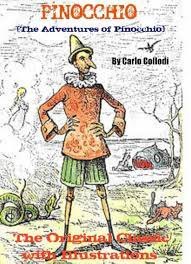
Some thoughts about Carlo Collodi’s ‘Pinocchio’ and its status as a cautionary tale for
misbehaving children.
Every parent will tell their children the story of Pinocchio. But why? More than five directors have made a ‘Pinocchio’ film. But why? Every book publishing company has chosen Pinocchio as a classic tale. But why? What special power did Pinocchio, this little puppet, like every other puppet, have? In other words, why is Pinocchio a classic? And how could a cautionary tale be so popular and loved, even by adults, and be read by everyone?
The novel tells us a lot. Some people think the story is just a regular so-called cautionary tale, telling puerile children to not tell lies, be kind, and everything else like that. But the novel goes much further than this. First of all, not only children can learn lessons and not all morals are about being a good person. The book tells us ideas about death by exploring the idea that Pinocchio is a wooden puppet instead of a human boy. Being a puppet or a human has its pros and cons. Being a puppet means being effectively immortal, or not dying. But it also means you can’t feel love or experience emotions. Most people believe being a human is much better than being a puppet, mainly because you can experience things in ‘the triangle’.
But being human also means dying and coming to terms with death.
The Supplement 4, p. 2The Supplement 4, p. 2The Supplement 4, p. 2
The book also tells us about the world surrounding us or, at least, the world surrounding Pinocchio. In other words, it tells us about cruelty, violence and cheating. The characters who mainly show these things are the cat and the fox, who steal, trick and are violent to Pinocchio many times. But all the characters, including Pinocchio himself, who really does kill a cricket, show aggression and selfishness. And what about the man who spilt water on Pinocchio? No matter how kind and decent you might be, you will always have a moment where you trick and cheat others.
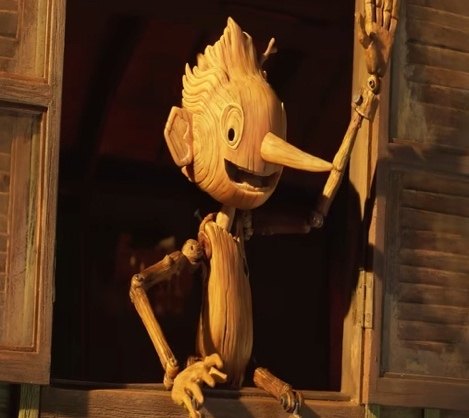
There are more than five films about Pinocchio. Most people believe the best one is del Torro’s ‘Pinocchio’. The film takes the book’s atmosphere of death, violence, cruelty, and cheating and adds to it. Thus, the film mainly adds one thing and emphasises it – war. War is very important in the film. Even Pinocchio is born because of war. And, when people learned that Pinocchio is immortal, they didn’t say, ‘Let him be with sick and elderly people, or do work for the community, or perform shows and sit in a museum’. Instead, they said, ‘Let him fight a war for our country’.
Due to the importance of war in the film, it also adds elements such as religion, hardship and the frightening version of the Blue Fairy. The militaristic character always performed the Nazi salute when meeting people. This is the brutal world of the novel developed to a logical conclusion. And the strange thing about the Blue Fairy in the book – she is a beautiful, young girl – is changed in the film, where she seems to be something like fifty-years-old, and definitely not someone you want to be friends with. It might be that way because of Jesus’s mother. In paintings of her, she is associated with the colour blue and is not friendly-looking. Maybe the director wants to try something new?
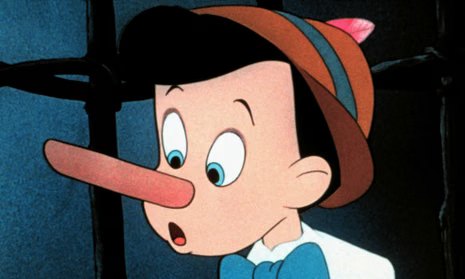
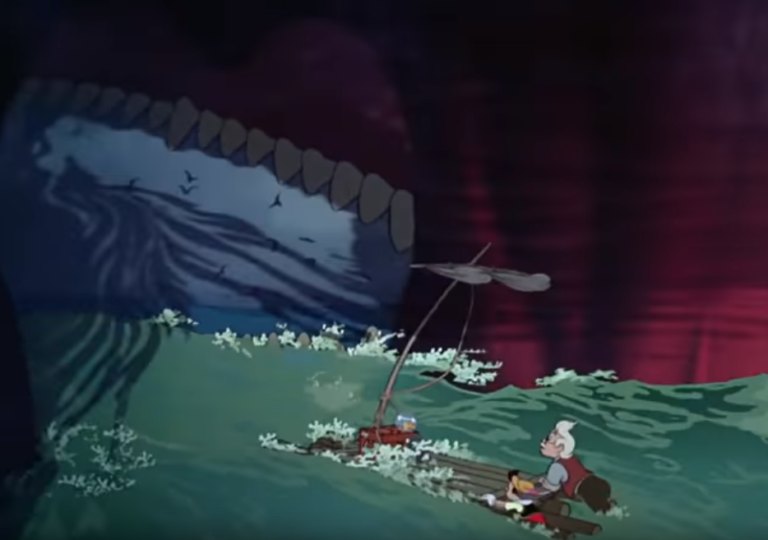
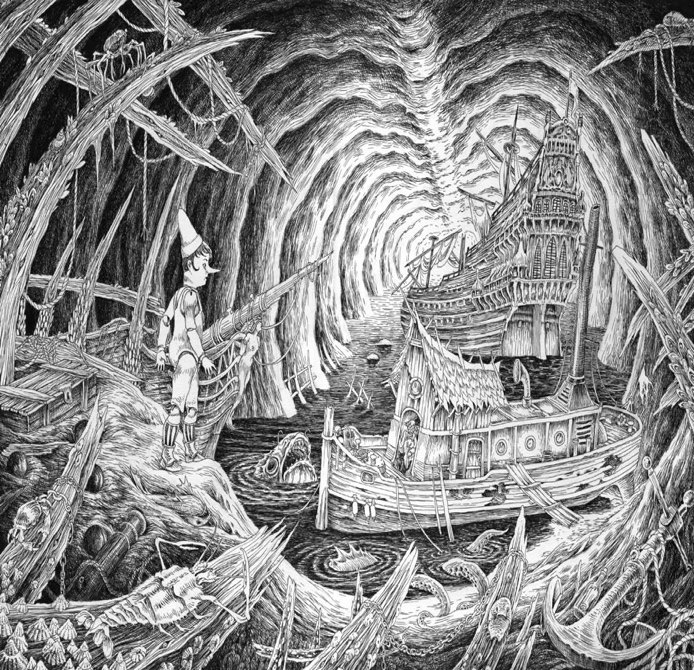
There is also a Disney film about Pinocchio. If you only watch the beginning, you would think it was a friendly, happy and gentle film made for small children. But if you finish watching it, you would know that it becomes more angry and scary, and even rather frightening. The scene where Pinocchio and Lampwick become donkeys is frightening. There is other terrifying stuff, too, especially in Playland. The film gets more serious as it goes on, such as when Pinocchio and Geppetto escape from the whale’s mouth, which is a kind of rebirth.
‘Pinocchio’, no matter which version you read or see, is far more than a cautionary tale or story for children. It is a serious novel and a serious film, talking in a deep way about death, violence, cheating, war, and other similar dark topics. Overall, it’s a very interesting story.
Derrick, Grade 5
A cautionary story or tale is a tale that tells what children should or shouldn’t do. ‘Pinocchio’ the novel shows this by telling children to not tell lies, otherwise their noses will grow longer. But the novel does more than that by adding the idea of death, making it a dangerous story and using the Blue Fairy to make children afraid as well as not telling lies.
The novel shows us the life of being human – that we must die and are able to be cruel. Life is full of greed, death, cruelty, violence, and cheating. The author shows greed on page 39, saying, ‘How wonderful,’ shouted Pinocchio, jumping with joy’. This shows how Pinocchio is greedy and thinks he can earn more money without working. The book also shows violence when he meets two murderers and they hang him from an oak tree. This shows how violent the world can be and how bad it is. And the novel shows death. When Pinocchio is eaten by the shark and he almost died before he escaped. This shows that real people, real humans, will die at some point and that death means you lose your favourite people.
The novel also shows cruelty and cheating. The fox and the cat cheated Pinocchio just because they wanted his money. They act like they were good people and pretend to be disabled. With cruelty, the novel shows how the kidnappers and murderers wanted to kill Pinocchio for money. The world is cruel to be cruel just because of money and power. Therefore, the novel shows how the world really is and how hard it can be to live in the world – not everyone is good and some can be evil.
In the del Torro film, there is more nuance than the novel. It added the idea of war. At the beginning of the film, Geppetto was living happily with his son, Carlo. One day, they went to the church and found a fir cone. They wanted to go home but Carlo and the church were destroyed by an airplane dropping bombs. This explains how the world is so harsh and cruel. War is the inevitable result of this cruelty. There must be war and death. After Carlo’s death, Geppetto was in despair so he built Pinocchio. This explains that if there was a war, there must also be death, and death will cause despair and grief to someone. Afterwards, the Blue Fairy makes Pinocchio come ‘alive’. She is an important character. She makes Pinocchio immortal, which means he cannot be a real boy as every real boy must die. Then, Geppetto was afraid of this because he lived with people who believed in fascism and religion – they would think that Pinocchio was his daemon. So, in the film, when Pinocchio entered the church, everyone was afraid, disappointed and afraid. After seeing that, the fascist leader commanded Pinocchio to go to school, but Pinocchio wanted to earn money so he went to the puppet master and trained with him. This shows how Pinocchio was greedy and also curious. When Geppetto found him, the show was over and he really wanted to take him home. When he asked Pinocchio some serious questions, he answered with lies and his nose grew longer. This is a warning about telling lies. Just as Geppetto was taking him home, he fought with the puppet master and Pinocchio is hit by car and dies. Of course, he wasn’t really dead because he can respond and live again, but it needs time. The Blue Fairy’s sister appears and tells Pinocchio the rules about responding to death. He needs to wait for a certain amount of time. The Blue Fairy is blue because Jesus’ mother, Mary, is also connected to the colour blue. This shows that death is long and sad.
When Pinocchio finally responded and came alive again, everyone was surprised and knew he was immortal. So, the fascist leader saw the Pinocchio could never die and wanted him to become a soldier and enter the war. Also, there are no women training to be soldiers and no women in the film. Except for the Blue Fairy, this shows a society that doesn’t like women or thinks that they are worthless. In the war, people die. There is a lot of crying and shouting. It’s shown to be very cruel and harsh, even worse than normal life. Pinocchio almost dies again and then falls into the sea, where he is eaten by a shark. He finds Geppetto there in the shark’s stomach but they can’t escape. But Pinocchio thinks of a way. He tells lies and his nose grows into a tree that they can climb up and escape. But as they do this Pinocchio dies again. This time, when he sees the Blue Fairy’s sister, he doesn’t want to wait the right amount of time before responding to his death – he needs to save Geppetto immediately. So, he becomes mortal, saves Geppetto but really dies. The cricket wishes his friend could become immortal again and so he is brought back to life one more time. This explains that with dying, your life could have no meaning.
There are two famous film versions of the Pinocchio story – the del Torro one and the Disney film. The Disney film is more gentle and more funny, though it is also frightening at the end.
There is no killing and no kidnapping, and the cat, the fox and the puppet master are funnier, even when they do things to Pinocchio. But every version of ‘Pinocchio’ also has a frightening side. So, when the boys go to Play-Land, it suddenly becomes cruel and terrifying. The man who takes them there turns into a brutal person. Even Pinocchio’s escape is frightening, especially when he is eaten by the whale. Again, he meets Geppetto in the whale’s stomach. They eat tuna fish together. Pinocchio makes fire and smoke, causing the whale to cough, and they escape. But in saving Geppetto, Pinocchio dies, which is the frightening part of the film. In the end, the Blue Fairy saves Pinocchio and he responds by being brought back to life.
In conclusion, ‘Pinocchio’ the novel was not only a gentle cautionary book. It also tells children about the world’s cruelty and how hard it can be to live. In addition, this is true of the future, when children become grown men and women. And it is also true of the del Torro and even the Disney film. The scary and frightening parts were when Pinocchio turned into a jackass and when he was eaten by the shark/whale. The films look at what it means to die. This makes the story more than a warning story for children about how to behave. It says something about life and the world we all live in.
Evan, Grade 5
The Supplement 4, p. 6The Supplement 4, p. 6
A cautionary tale is a kind of story that makes kids behave. This novel shows this idea by having Pinocchio being ‘naughty’ and this in the end having consequences. But this story doesn’t only talk about this. It also has ideas like being reborn, transformation, religion, etc. I will talk about these things later.
The novel ‘Pinocchio’ by Carlo Collodi shows us being human and about life by talking about death, cruelty, violence, cheating and greed, amongst other things. These are all negative things in the book, which shows death, for example, by having a dog and a snake die. Although it contains the idea of death it is not so important as it is in del Torro’s film. The idea of cruelty was shown by the Fire-eater. He wanted to put Pinocchio into the fire for his dinner. This is cruel because Pinocchio is no ordinary wood. Violence is also described in the book. Like when Pinocchio had his fight with the ‘bad boys’ in his school. Also, the fox and the cat represent cheating. They tricked Pinocchio and took his money. Pinocchio himself symbolised the idea of greed, because he lost his money wanting more money.
There are also other topics to consider. When Pinocchio was spat out by the big shark it was like he was being ‘re-born’ as when he was eaten, it was like death. But when he gets out, it’s like he gets his own life again, a new one. Transformation is also shown. There are both physical and mental transformations. The Blue Fairy had the physical change. She was once a girl but she turned into a woman and, later, even a goat. Pinocchio turns from a piece of wood into a wooden boy into a donkey and, then, to a real boy. He is always changing physically. He also turned from a ‘naughty’ boy into well-behaved one. While all this is happening, Pinocchio is shown living in a very harsh place. People are generally bad and he is sometimes unlucky. This is what life is.
The del Torro film expands on the idea of death. It does this partly through the story being set during a war. In this, many people die, including Carlo and the puppet-master. Also, it connects with the writer of the novel, Carlo Collodi. It’s as if the film allows Carlo to die on purpose. The film is also very intense, increasing the feelings that are in the novel. The characters look and act in a more intense way, too.
This film is also very religious. It has a kind of connection with Jesus’ mother, Mary. The Blue Fairy is blue, which connects with her as Mary is also associated with the colour blue. In addition, many of the characters give a one-armed Nazi salute, which happened in World War Two. This shows that Pinocchio’s world could easily become very fascistic, like Hitler’s.
In the Disney film, the characters are not so scary at the start but they gradually become more intense and serious. For example, when Pinocchio goes to the pleasure island and turns into a donkey. Also, when he is eaten by ‘Monstro’ and dies. The film qui ckly becomes not as pleasurable as it was at the beginning. The Monstro episode also symbolises being reborn. It’s a scary moment and shows how much Pinocchio has changed.
Now, in conclusion, I can say that both films and the novel can’t ignore the idea of death. Even the Disney film has Pinocchio die in the end. In the story of ‘Pinocchio’, the idea of death is very important. It lies behind much of the story and is one reason why it is much more than a cautionary tale.
Nathan, Grade 5
The del Torro film of ‘Pinocchio’, which includes Carlo and Pinocchio being immortal on the other hand, changes the plot completely. The villains of the story are changed from the fox and the cat into the evil puppet master and the monkey. The setting was also changed to Italy during World War II. That could also be showing the negative side of the world again, as the ‘history’ of ‘Pinocchio’ has been changed.
The reason for Pinocchio’s existence in the story was to remake Carlo, the original son of Mr. Corn Head, who had died in the war. This shows death and its sadness in a very specific way. This film adds one more character trait to Pinocchio: bravery. This trade is shown in many ways. First, Pinocchio had stood up for what was right when the puppet master was beating up the monkey and almost killing it. And other scene is when he risks his own life to save the lives of Mr. Corn Head, monkey, and the talking cricket.
The story of Pinocchio may sound actually very simple to readers if it was only told in the way of the positive and negative aspects of the world, but actually there are a few touches by the author to make the story much more real. First of all, kindness. Kindness is the bridge that holds communities together. Without kindness, everybody would be self-centred, and there would be no friendship in this world. Kind characters include the blue fairy, Mr. Corn Head and Pinocchio. The blue fairy is purely and absolutely kind, and might be connected to the idea of Jesus’ mother. On the other hand, even though Mr. Corn Head may be senseless, at times his love Pinocchio is indescribable. He protects him and risks, everything for him, even including his very own life. Last but not least, Pinocchio himself. His traits are kind of similar to Mr. Corn Head's. He may be ‘crazy’ at times, but he is a person (or a puppet) you can trust your life with at dangerous moments.
However, not all characters are positive and some can be negative, like the envious people in the story. Some examples are the fox & the cat (in the original book) and (for the del Torro film, which is set during the war) the son of the evil officer and, for the Disney film, the cat. For example, the fox and the cat envied the gold coins Pinocchio got for his bravery. Therefore, they lied to Pinocchio and took the gold coins for themselves. This shows their envy for riches and maybe even power in the world. For the second example, the evil officer’s son was envious of Pinocchio getting all the adults' attention and being immortal. Therefore, when the parents are talking, he tells Pinocchio to set his feet on fire. For the third example, the cat was envious at the treats the fish gets and had always tried to eat it while the fish felt like it was in no state of danger as long as it was with Mr. Corn Head. This is what the traits lead to – being hurt, causing pain, and even death.
Another negative trait is selfishness. Almost everybody in the story is selfish or self-centred. An example in the film is when the evil puppet master keeps all the money for himself instead of keeping his promise and giving half of the money to Mr. Corn Head. This is being very selfish because he only cares about himself instead of an old man who can't look after himself very well. Therefore, instead of helping Pinocchio and Mr. Corn Head he keeps all the money for himself. Another example is Pinocchio being very selfish and killing the talking cricket just because he blames him, which even has good reasons including talking about Pinocchio getting his father into jail and not being obedient. This is absolutely selfish because there is clearly no reason he should do that, notwithstanding the fact that the talking cricket is actually doing the right thing.
Lastly, the last character trait is the optimism of the characters. There are a few characters who are actually very optimistic, including Pinocchio, Mr. Corn Head and the blue fairy. As a purely kind person, the blue fairy is very optimistic about Pinocchio. She believes that Pinocchio is a good kid no matter what he might have done. Well, Mr. Corn Head was very optimistic and persistent at trying to find Pinocchio. He even believed that he could make a boat and row across the ocean just to find his lost son. Pinocchio, at the last, was optimistic in a kind of strange way. He had seemed always happy in the various stories and had always believed that he could do anything so long as he had ‘feelings’. However, that was mostly because he has only been on the earth for a few months or years, and had little knowledge about the way the world worked.
A discussion of the story ‘The Grown-Up’ in Ian McEwan’s ‘The Daydreamer’ and the ways
in which the other stories in the book prepare Peter for what happens in the last tale.
In the story ‘The grown-up’, Peter just quickly and suddenly ages 10 years. He first gets dressed in the clothes on the chair. But all around the breakfast table no one takes notice of him, and only Gwendoline glances up at him. In the hallway, he called his assistant at the laboratory. When he is finished on the phone, he goes to his laboratory. And when he finishes work, he goes to kiss and fall in love with Gwendoline. Other stories are just set at that moment, but this story is all about the future, which Peter dreams about.
The Supplement 4, p. 11
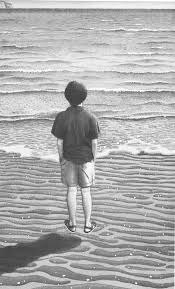
As a grown-up, Peter realizes that adult life is not that boring. There is more to it than just looking at the newspaper! This picture is Peter looking at the sea and when Peter finishes the dream, the picture is shown because it suggests Peter looking forward to his future. Peter has this very realistic daydream because when he was playing with his sister Kate, he saw his parents and the many grown-ups looking at newspapers and not talking, which makes Peter think that all of the adults’ life is like that. Happy children and can’t see there is more to their lives than this.
In ‘The Dolls’ story, Peter eats so much chocolate and was lonely so he has a particular kind of daydream. In the daydream, the dolls broke Peter’s arm and kick him. He also learns not to be so mean to everyone in ‘The Cat’ story. Peter doesn’t want to go to school so he has this daydream. In this story, people learn that the cats life is a hard one. And in the story about the baby, people always don’t want the baby to touch things and they come to hate the baby. In the dream, Peter changes his body with the baby and learns that the baby’s life is not so easy after all because the baby can’t talk and has to be carried everywhere.
So, in these three stories, the main thing Peter learns is that other people’s lives are also hard. In another story, he wants everyone to vanish in the dream. All the people do vanish in his dream. But Peter learns that was without other people, he can’t do anything. And in ‘The Bully’, he learns that maybe the way one person looks is not where they are in their heart. The same in ‘The Burglar’, where Peter learns that what people do is not always what people want to say.
Brayden, Grade 4
Peter daydreams about the grownups and learns a moral. First, he thinks that being a grownup is not interesting. They just like reading books and newspapers, talking, walking, and doing chores. Like Peter, I think it is boring too. But he begins to understand that as an adult, there is another world to experience. He sees that it is actually quite interesting. Peter daydreams he is Gwendoline’s boyfriend. Together, they hold hands, take a walk, drive in Peter’s car, and even kiss. Peter looks out at the sea and thinks about his future. He realizes that being an adult is not as bad as he first thought. Peter is the oldest of the young children and closest in age to Gwendoline and the adults. For a few moments he understands that he will become an adult and understands a little of what it means.
In the other stories, Peter learns several morals. In ‘The Dolls’, Peter learns that he can’t leave Kate. Being the doll is actually very awful. In ‘The Cat’, Peter feels that the cat’s life is not that simple. They fight to guard us until he dies. And in ‘Vanishing Cream’, Peter learns that he can’t be lonely, and not everything is for playing. In ‘The Bully’, Peter learns that sometimes you just can’t believe your eyes and should look more deeply at things. In ‘The Burglar’, Peter learns that dreams can be real and in ‘The Baby’, Peter learns that babies also have a hard time in their lives. All of these stories tell us about empathy.
Lionel, Grade 4
Peter said that being a grown-up is not very good and just looking at newspapers and books. That’s not much fun, Peter thinks. But then he saw Gwendoline, an older girl who is close to being a grown up. Maybe, Peter thinks, he will become a grown-up one day and he doesn’t like the idea of also being an adult. So, he is thinking about this when it is bed time. Then, in the morning, he finds out that he has somehow become a grown-up, which gives him a taste of a grown-up’s life. Suddenly, he finds it is not so bad, for he can do different things – like having a girlfriend.
ln ‘The Vanishing Cream’, Peter learns that everyone is valuable and useful. They are all people – his mum and dad can make food for him and his little sister, for example. But Peter uses the vanishing cream and they disappear, something he regrets. In ‘The Bully’, Peter thinks that the bully is very bad but one day he had a party and Peter sees that the bully is kind of ‘safe’. Then, at school, the bully again same to Peter, who said he wasn’t afraid of him. In his mind, his perspective to the bully had changed. ‘The burglar’ is about theft in Peter’s neighbourhood. Many things have been stolen. Peter thinks that an old nasty woman down the street is the thief but one night he had a dream. That dream is about the nasty woman being the thief but when he woke up his dad said their house had been burgled so Peter’s dream is a little bit the same as in the real world. In all his dreams, Peter comes to realise something new and important about people and the world he lives in.
Tico, Grade 4
The question is, 'In what ways is ‘The Grown-Up’ the natural conclusion to the stories in ‘The Daydreamer’? '. I think this means the end of Peter's childhood.
In the first few stories, Peter has abundant imagination skills. He imagines turning into a cat, imagine the dolls becoming real life, and many others. But in the last story, he dreamed about becoming an adult.
The feeling of Peter is weird after he turns to an adult. The author, Ian McEwan, writes that Peter feels every movement of himself is harder to do than he was a child. After he went downstairs, he gets to try coffee. The description of the taste is foul but he tries to look no different to the other adults, so he picks up the paper by his plate and finds out that feel it's not so boring after all. Soon, he gets to know every story and every person in the paper, so the author might want to let the readers knew that even though children hate the things that 'adults' do, when they actually become an 'adult', they also get to do the things they once hated and don't think that's weird when they do.
I think the meaning of a 'grown up' is when a person doesn’t want to or can't act as a child, and they know they are not a child. This is a person turning to an adult. The whole book uses this story to end with because when a child turns to an adult, the action of daydreaming ends.
The American Revolution, which evolved between 1763 and concluded with the ratification of the Constitution in 1787, was undoubtedly one of the most significant events in human history. It is often cited as a turning point of great political and social importance. It dismantled imperial rule and established a new political order based on representative government and republican ideals. Yet there remains an argument about the degree to which the Revolution was truly “radical.” The American Revolution might have been genuinely radical and progressivist in its institutional and ideological outcomes: it created independence, republican government, and a written constitution. However, the radicalism was produced incrementally. Its path was pragmatic, uneven and circumstantially opportunistic. Moreover, it often failed to extend its ideals to women, Indigenous peoples, and the enslaved. It offered radical administrative change rather than comprehensive radical enlightenment.
The Supplement 4, p. 15
Administratively, the most radical outcome of the Revolution was the creation of an entirely new form of government based on the idea that power should come from the people, not a monarch. This was a revolutionary shift from the British and, indeed, almost all systems of government at the time, which were in the hands of a single person or an empowered elite. Authority was invested almost absolutely in the monarchy and the inheritance of power.
In the Declaration of Independence, Thomas Jefferson declared that “all men are created equal” and that governments should get their power from the “consent of the governed.”1 Instead of relying on inherited power or royal appointments, the new system introduced written constitutions, a separation of powers, and regular elections. The U.S. Constitution of 1787 built on these ideas by creating a federal government with clear limits and checks, meant to prevent any one person or group from gaining too much control.
The Revolution also radically expanded the concept of political participation, even if its implementation might have been imperfect. Before the war, voting was mostly limited to wealthy landowners. But after independence, several states, especially in the North, started lowering or removing property requirements for voting. This allowed a much larger number of white men to vote and run for office, the specified ‘white men’ being both a sign of progression and, through the lens of history, a relatively unradical, conservative fault line – a redefining and broadening of ‘the elite’. However, this did mean that ordinary farmers and artisans could now take part in the political process, thus creating a political culture where debate and civic involvement became common. This was a bold, reformist move, directly challenging the hierarchical and aristocratic structures that dominated Europe, and paving the way for a separate path for this newfound nation.
Yet despite these radical transformations, the Revolution’s progress was often reactive and pragmatic rather than visionary. In 1763, few colonists sought independence; their demands focused on representation within the British Empire, not separation from it. The Stamp Act Congress of 1765, for example, petitioned for “the rights and liberties of the free and natural-born subjects of Great Britain” rather than proposing a break from the Crown.2 Even the Continental Congress initially sought reconciliation, sending the Olive Branch Petition to King George III in 1775.3 1 Eric Foner, Kathleen DuVal, and Lisa McGirr, Give Me Liberty!, 7th ed., vol. 2 (New York: W.W. Norton & Company, 2023), A-4 to A-9 2.American Battlefield Trust, “American Revolution Timeline,” American Battlefield Trust, July 17, 2018, https://www.battlefields.org/learn/articles/american-revolution-timeline. 3 American Battlefield Trust, “American Revolution Timeline,” American Battlefield Trust, July 17, 2018, https://www.battlefields.org/learn/articles/american-revolution-timeline.
It was only after repeated rebuffs and escalating military conflict that independence became an aspirational goal.
The gradual shift toward radical ideas shows that the revolutionaries didn’t necessarily start with a bold plan; they developed one as events unfolded. In many cases, colonial leaders raised their demands only after British resistance left them with fewer options, meaning the Revolution’s radical turn was more of a reaction to British affronts, like the insensitive imposition of taxes, rather than part of a sustained, consistent long-term strategy. Military conflict, too, played a major role in shaping the Revolution’s increasingly radical direction. Early successes, like the surprising American victory at Saratoga in 1777, boosted morale and gave colonists real hope that independence was not just possible but achievable.4 Saratoga also helped secure a critical alliance with France, whose military and financial support proved essential. Without French involvement, the Revolution might not have succeeded.
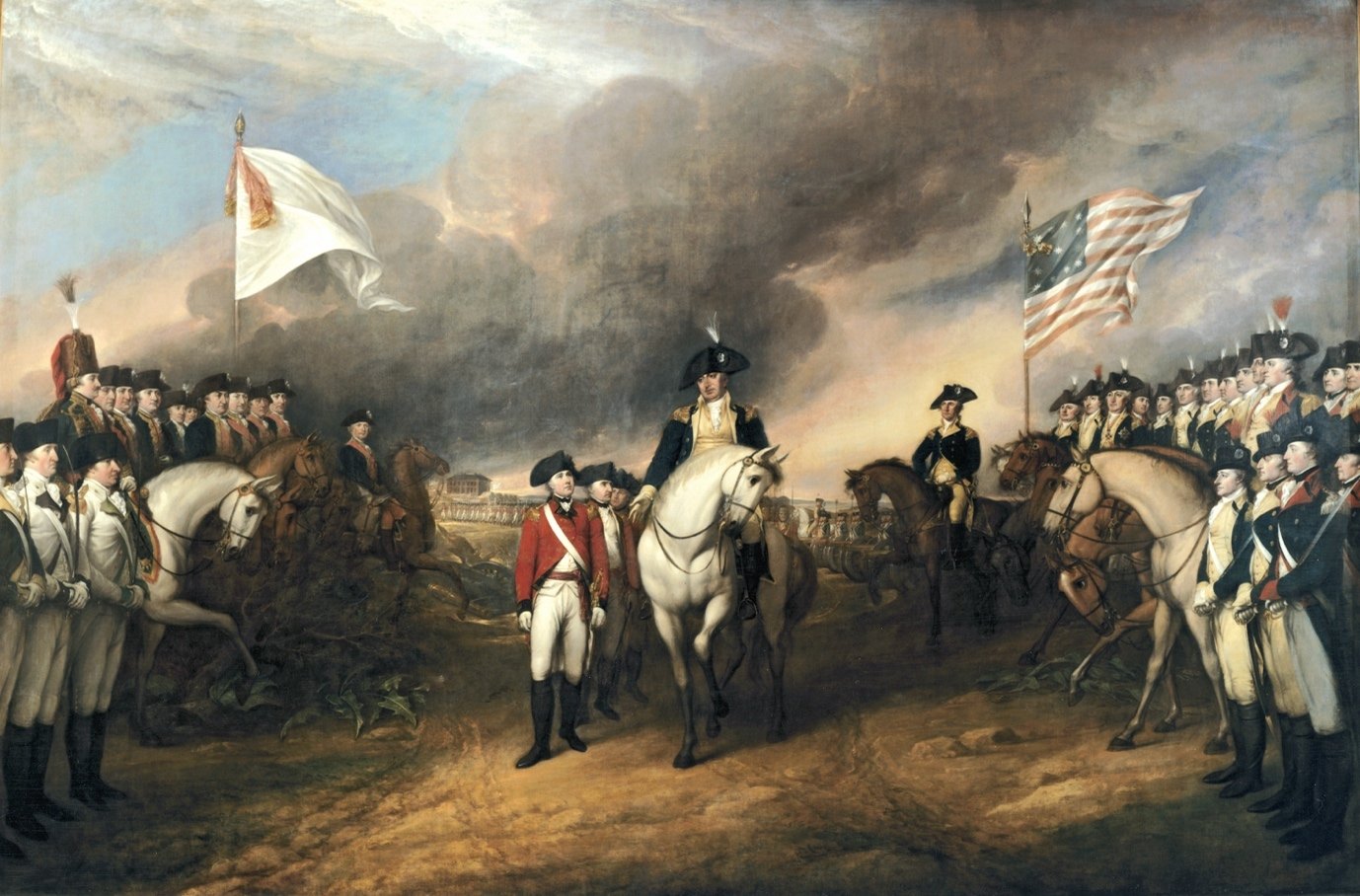
As the tide of war began to turn, the colonists’ ambitions expanded. By the time George Washington’s troops forced Cornwallis to surrender at Yorktown in 1781, the movement had evolved from seeking reform within the British Empire to demanding full independence and building an entirely new political system.5 The French, increasingly open to the notion of revolution and in any case instinctively enthusiastic about undermining British influence, undoubtedly helped to shape revolutionary expectations in America.
This turning point also reveals how much the Revolution depended on external factors: foreign aid, battlefield luck, and British missteps. These events show that radical outcomes didn’t come from ideology alone; they were often the result of pragmatic decisions in response to changing circumstances. In that sense, the Revolution was shaped as much by necessity and opportunity as by a bold revolutionary vision. 4 YaleCourses, “19. War and Society,” YouTube Video, YouTube, March 18, 2011, 10:26, https://www.youtube.com/watch?v=fzd06DRvRKA. 5 YaleCourses, “19. War and Society,” YouTube Video, YouTube, March 18, 2011, 33:50, https://www.youtube.com/watch?v=fzd06DRvRKA.
None of this should detract from what was certainly a bold and at times genuinely radical revolutionary movement: it dismantled monarchy in favor of popular sovereignty, expanded political participation, and laid the ideological groundwork for future democratic movements. However, its nuanced evolution, dependence on and reaction to circumstances, and lack of inclusivity to all members of society make it less radical than might be supposed. In addition, the disconnect between the Three-Fifths Compromise of 1787, which granted disproportionate political power to white slaveholders is one example of a compromised radicalism. There is something noble but incomplete about the American Revolution that frames radical extremism and thoroughgoing progression without having absolutely instituted such things.
Maxwell, Grade 11
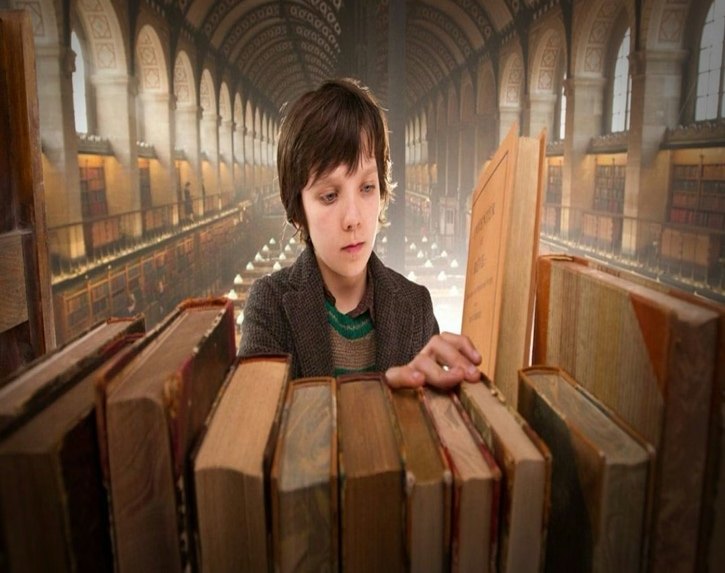
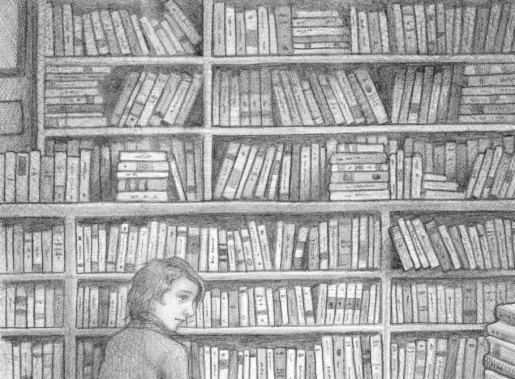
‘The Invention of Hugo Cabret’ by Brian Selznick is a wonderful novel that is told partly in images. As well as having to say about film history, it concerns itself with the links between dreaming and film-making, the nature of mechanical life, and magic.
Discuss some of the ways the novel ‘The Invention of Hugo Cabret’ uses the character of Georges Melies to explore the connection between film and dreaming.
In ‘The Invention of Hugo Cabret’, Georges Méliès is a grumpy train station toy shop owner. He gets mad when Hugo steals gears, but he’s secretly a former filmmaker who made magical movies like ‘A Trip to the Moon’. Hugo and Isabelle help him rediscover hi s love for filmmaking by finding his old film reel. The book is about a young boy named Hugo, who lives secretly in a Paris train station, fixing clocks and trying to repair a broken automaton his dad left him. To fix it, he steals gears from Melies, who is also the grumpy toy shop owner. With Méliès’ goddaughter, Isabelle, Hugo uncovers the automaton’s secret and helps Méliès rediscover his past as a movie magician. Méliès combined his magic skills with filmmaking to make stunning illusions. His go-to trick was stop-motion: pausing the camera to move props or actors, then filming again, making it seem like things vanished or changed. His 1902 classic ‘A Trip to the Moon’ used model moons, painted backdrops and actors to build a vivid fake space trip. Like magic, it made audiences believe the impossible. Even modern films like Harry Potter follow this idea—we know broom flying uses wires but still feel the wonder he started.
Magic is fake even though everyone wants to believe in it! Melies created movies and films but before that, he was a magician. Magic and films both involve illusions. They both make the audience believe something that seems impossible. People are tricked into believing something that is not true. This makes the audience believe something impossible or fantastical can really happen.
Films are like dreaming. In films and dreams, we can feel emotions. Films and dreams both bend time and space. For example, in the film ‘The Invention of Hugo Cabret’, Isabelle and Hugo walk back to Isabelle’s house from the station. In real life, it might take 10 minutes or more, but in the film, it only takes 3 seconds! Also, both dreams and films give us an experience that lets the audience feel like they’re actually inside the film/dream. The experience is very intense and film does this by adding various sounds and music at important places in the film. In addition, films can show fantastical things. An example of this is in the film of the book, ‘Hugo’: when Isabelle accidentally dropped the box of Melies’ drawings, they flew all around the room like a snow blizzard. All these things make films as fantastic as dreams.
The book ‘The Invention of Dreams’ (Part 2 Chapter 4) says films and dreams both feel real even when they’re not. Georges Melies knew this best—he made old films with tricks, like making the moon “eat” a rocket, to make them dreamy. Hugo goes to the library to find a book that helps fix his broken robot (from his dad). In it, he finds a quotation that says, ‘This connection with magic helped immediately understand what the new medium of film was capable of’.
Lots of films have dreamy moments. In ‘Harry Potter and the Goblet of Fire’, the Triwizard Tournament’s underwater task is intense – you hold your breath as Harry swims fast to save his friend, and your hands clench when sharks swim nearby. In ‘Harry Potter and the Prisoner of Azkaban’, the Time-Turner lets Hermione and Harry go back in time – that bends time and space, just like a dream where you jump to a different moment. And ‘In Harry Potter and the Philosopher’s Stone’, the Mirror of Erised shows Harry his dead parents, which is a surreal, dream-like image, since it’s something he wants more than anything but can’t have in real life.
Films let us “dream” while we are awake. They’re intense, bending time and space into unfamiliar shapes, and they also present audiences with weird , fantastical images. Melies started making dreamy films, and Hugo learned about this too. That’s why films like Harry Potter feel so special.
Alice, Grade 5
The Supplement 4, p. 20The Supplement 4, p. 20
In the book, ‘The Invention of Hugo Cabret’, the author uses and introduces a character in real life, George Melies, to be the main character in his novel. He was famous for making films and magic. The author also informs us about the ambitious achievements in his whole life and the book tells us about our identities, that we can have multiple identities. This shows that everything can be combined together. For example, in films, people can do different things at the same time, just as same as in ‘The Invention of Hugo Cabret.’ It seems impossible to live inside the station clock, but in films, you can! Films are also a kind of illusion. Movies and films are showing us illusion like magic and make everything seem to be ‘real’, which is the purpose of illusion.
The story changed when Hugo went to the library and read the book, ‘The Invention of Dreams’. The book says that George Melies died in the war, but actually he did not. Hugo revealed the true identity of George Melies. Melies finally admitted that he was first a magician and then made films. It was one of the most fashionable things to do at the time, so he went to make films. His films were famous but were given to the shoe factory because of the war and nobody needed his films anymore, trapping him in the toy booth. But because of Hugo, Georges Melies wanted to try again and pick up his film-making dream. So, he enjoys being honoured by the French Film Academy.
I think films are like dreaming through their intense experience. For example, in films, people can do things we cannot do at the same time. The same as dreams. In dreams, you never know that you are in a dream because your brain tells you that you feel like it’s real, so you don’t ever think about it. Films also bend time and space, just like in ‘The Invention of Hugo Cabret’. When Hugo sees the automaton, it reminded him that his dad told him about the automaton and what it could do. I will use the film ‘Interstellar’ as a similar example. The story talks about an astronaut that went through a black hole and went to different 3D and even 4D time spaces. Once the astronaut was in a 4D space, he could look at different ages of his daughter at the same time.
In the chapter ‘The Invention of Dreams’, Hugo goes to the library and reads the book with the same title, ‘The Invention of Dreams’. It explains how dreams are made. This chapter is when the story starts to change into the falling action by revealing the real and true identity of George Melies. This leads to us predicting the next few chapters and gives us a suspense that makes us want to read the next paragraph.
Magic, Films and Dreaming in ‘The Invention of Hugo Cabret’
Some thoughts about films and dreams.
‘The Astronomer’s Dream’ is a film by Georges Melies about a person who dreams about planets, and queens, knights and other things besides. It is a story that is full of strange pictures. Strange images like a moon with emotion, people disappearing and then reappearing. The background suddenly changes into a knight or a moon.
The images are strange because it's a DREAM! When you dream, basically, you dream about strange and funny things and when you wake up you are often miserable and have a funny feeling about the dream. You wake up thinking, ‘Was that real or not?" If you dreamt about your parents or friends, you can't stop letting yourself ask, ‘What happened yesterday? Did those things really happen?’
This links in to Hugo looking at the book ‘The Invention of Dreams’ in library. It’s there that he and Isabelle find out that Georges Melies (or Papa Georges) was actually a film-maker. He made many movies to inspire everyone. The book says the most important things about films are imagination and curiosity. For some reason, Georges Melies stopped making films because maybe something bad happened so he worked in a toy shop & started to make to make money alone. He is shown to be very sad about this. He invented dreams in his films – like ‘The Astronomer’s Dream’ – but in the end his own dreams became a sad nightmare.
Dreams and films are similar in many ways. First, with time & space. In dreams, you think the time is very short but in real life it is much longer. In a film, something that happens in two seconds can take much longer in real life. So, films and dreams play around with time and space because they want to make it more interesting. Also, of course, they are both full of strange images.
I had this dream where I was in this hotel and one morning I went surfing with Tom and Jerry! We also hung out at the mall. I bought a puppy there and named the puppy ‘Hepon’. He went to a competition & won! I was so happy and Hepon jumped into my arms. Suddenly, I was transferred to my home and I was washing my hands. Then there was a bug. I wanted to catch it but it jumped on to my hand stuck there. I was terrified. Like films can be, this dream was very crazy but somehow made sense.
Chloe, Grade 4
I think that if you lose your purpose, you will be broken because when you don’t have a goal, you have nothing to do – only sleeping and eating. And if you get depression, the condition will get worse. Maybe you won’t be able to stand it anymore. You will be broken and you might harm yourself.
I agree with Hugo, because when you don’t have any goals, you will lie flat, and if you do that every day, you will feel depressed and broken, like Papa Georges.
In his dream, Hugo saw the key of the automaton. He picked it up but it was on a train track in the station and the train couldn’t stop. It ran over Hugo and crashed out of the station’s entrance. The second dream was about Hugo hearing noises and his body turning into the automaton’s body. The automaton was staring at him. Suddenly, the room was filled with gears and machinery. And, then, Hugo woke up. It’s like he felt he was being overwhelmed by things in his life and was losing his own sense of purpose.
In one of my dreams, I became a light bulb. It was because the day before, in craft, I was making a sundial and shone light on it for a long time. I remembered the light bulb and so I became one. The same with Hugo – he was thinking that his life was broken so he dreamed about the same kind of thing.
Grant, Grade 4
In chapter 6 (Part 2), Hugo says, ‘If you lose your purpose... it's like you're broken." I think this means that everyone has a job. If you lose your job, you will be very poor and just like you’re broken. I think Hugo says this because he wants to remind Isabelle of Papa Georges. Also, Hugo likes fixing clocks, so he doesn’t just say you will be poor. Instead, he says ‘broken’.
I think I disagree with Hugo, because he says everyone has ‘a’ purpose. But I think a person's purpose can be two or even three things, not just one – though work can also be one. Anyway, you can have many purposes, so I disagree with Hugo.
In Hugo’s double dream, he dreams about being in the train station and finding the heartshaped key on the railway line. So, he jumps down and gets the key, even though the train is coming. Hugo can't jump away in time, so the train overshoots the railway tracks and then crashes through the glass and breaks. The second dream is about Hugo turning into the automaton and being trapped is some kind of machine.
Once, I had a nightmare about many doors and not being able to find the way out. I think this dream was very nonsensical because the door's size was pretty different. And in my dream, l didn’t walk towards or try to open any of the doors. I didn’t open any door because I was very afraid what might be behind it. At the end of my nightmare, I just remember walking forward one step – and then everything ended!
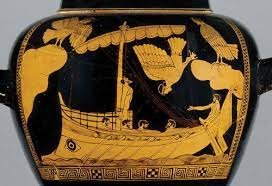
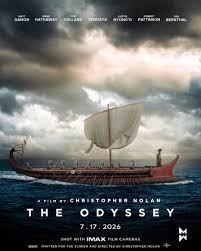
Homer’s ‘The Odyssey’ was composed in the 8th or 7th century BCE by Homer. It tells the story
of Odysseus, who has been away from home for twenty years. Ten of those were spent fighting the Trojan War – which is the subject of ‘The Iliad’, which precedes ‘The Odyssey’ – and the other ten were consumed by Odysseus’s journey back to his home at Ithaca. Although Homer tells us why the return took so long, he is really most interested in what happens when his hero sets foot on home soil again after such a lengthy absence. It is the template for all homecoming stories, some of which are also considered in the pieces that follow.
Some Thoughts about Homer’s ‘The Odyssey’
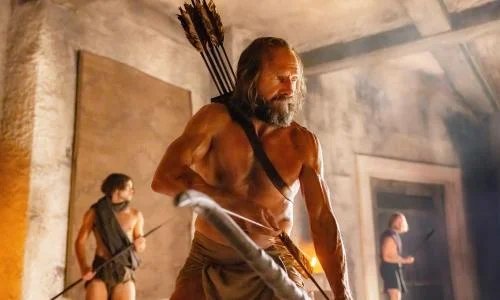
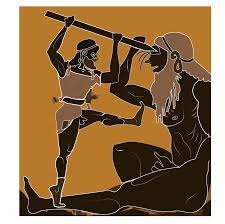
In ‘The Odyssey’ by Homer, Odysseus fights in Troy, then spends 10 years trying to get home to Ithaca. He faces monsters like Polyphemus and storms from gods. Meanwhile, his wife Penelope and son Telemachus fend off greedy suitors. The last five books show his return, which is that he hides as an ugly beggar and meets with Telemachus while killing the suitors. With Athena’s help, he wins back Penelope and his kingdom. Homer highlights this homecoming, which is Odysseus showing his true identity and proving himself as a husband and a father (even if he is not a really good one).
The Supplement 4, p. 26
Even though Odysseus finally made it back to Ithaca after so many years away, he didn’t rush straight home. First, he was scared: because tons of greedy men had taken over his palace, and tried to marry his wife, Penelope, and steal his kingdom. He didn’t know who to trust, so he didn’t want to show his real self yet. But his wife and son who had stayed loyal all those years, with his son not even knowing him. Odysseus’s own character played a part too. He’s super clever and careful, not the kind to run into danger without a plan. He also felt like he didn’t fully belong anymore, like a stranger in his own land after being gone so long. Argos was the only one who recognized Odysseus right away, even though the dog was old and weak. Argos’s love showed Odysseus that someone still cared about him, and it gave him the courage and also a little bit of fury to finally face his home and fix everything.
Odysseus was a brave man who missed his home very much. He fought monsters and sailed stormy seas, so he earned the right to go back. When he got home, he looked like a messy beggar. Mean suitors were in his house and corrupting his resources, while laughing at him. Penelope said that whoever strung the big bow could stay. The suitors tried and failed, but Odysseus strung it and started shooting all the suitors down. He then purged all the people and the bad memories and succeeded in having his revenge and got victory in the end.
After dealing with the suitors, Odysseus has more to do. First, he meets Penelope. She isn’t sure it’s really him, so she tests him. She asks about their tree bed. Odysseus knows the bed was made from a tree that’s still part of the house. This proves that Odysseus is really himself. They understand each other deeply, so they reunite for the first time in nearly 20 years.
Odysseus also talks to the dead soldier Agamemnon in the underworld. This shows Odysseus is a great hero too, just like Agamemnon. And then Odysseus kills the suitors’ families. After he gets back with Penelope, he reunites with his father, Laertes. This happens after meeting Penelope because he needs to make things right with his dad, just like he did with his wife. It is good that he came back to save his home.
Homer’s epic ‘The Odyssey’ is mainly concerned with Odysseus’ mental transformation, and he doesn’t need to change to his old self to be welcomed home. At first, Odysseus was proud and impulsive. After tricking the giant Polyphemus, he bragged about his name, angering a god and dragging his journey home out for ten years. But those tough years changed him: he grew patient and smart, disguising himself as a beggar to spy on the suitors taking over his home instead of fighting recklessly, and he now cared more about his family than fame. The people who waited for him, which is his son Telemachus and his wife Penelope, confirmed it was him by testing about the tree bed, proving his heart was still the same even if he is changed.
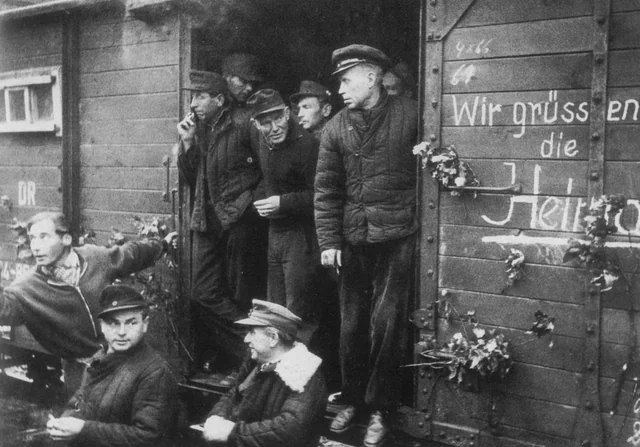
Returning soldiers often change a lot after wars. In the film ‘The Deer Hunter’, Michael comes back from the Vietnam War quieter and more distant. He can’t enjoy hunting with friends anymore because his war has caused him to be changed. He could not jut bear to go to the party or his girlfriend’s house. He couldn’t kill any living things anymore, either. His family and friends are happy to see him, but they could not understand his pain. Similarly, Paul from the ‘Heimat’ story, a German soldier, feels like a stranger. Friends and families greet those soldiers cheerfully and sort of welcome them back home, but the soldiers’ trauma and new perspectives make it hard to fit back in. Those two stories of struggle to get the normal feeling of being home back to these two guy’s minds, because there is only one true home for a person.
In conclusion, Odysseus wants to go back home to get back his power and meet his loved ones even after 20 years while taking revenge on those suitors who corrupted the entire island. As in the Greek word ‘Nostos’ means home, and nostalgia means to miss home and to have the desire to go back to home or going back to safety. The movie ‘The Return’ shows Odysseus as wanting to go back home because he wants to have another life but also feel nervous about his own wife and son not recognizing him and treating him in a cold manner. However, I believe that it doesn’t matter whether your wife or son knows you. It is that you have the right to go back to your own house and get back your rights and privileges even if it might hurt for your family members neglecting you.
George, Grade 6
The book ‘The Odyssey’, by Homer, is really mainly about home and the return to home. In the story, a lot of things have happened before the homecoming journey of Odysseus. Such as the Iliad and the Trojan war. Odysseus hasn’t been to his homeland for twenty years. In this time, he spends most of his time with violence and war. In the meantime, his wife (Penelope) waits for his return.
During his homecoming journey, he faces a lot of obstacles. For instance, the lotus eaters which kept some shipmates from leaving the land; Calypso, who fell in love with Odysseus and kept him for a long time; the cyclops, in which a lot of shipmates were eaten; the problem of sailing in the roaring sea; and the underworld, where he meets his dead mother, Achilles and the prophet Tiresiss, who could see the future. These situations reveal that Odysseus desires to go home, sailing continuously and doesn’t stop even though overcoming the challenges would risk his life.
After all the difficulties of the home return journey, he finds himself back on the land of Ithaca, but he doesn’t go straight back to home. Why? Because he knows that he is different from the young mighty Odysseus, to the Odysseus who looks weak and old. And going straight back to home may cause confusion. Beside this point, Odysseus also has to deal with all the suitors living in his home comfortably all the years he was gone, causing Penelope to leave with no choice. He has to earn the trust of Penelope, let Penelope know that he is Odysseus, earn the right to be in his place again, and deal with his father too. When Odysseus was walking through the palace his old hunting dog recognizes him after all this waiting and slowly dies in front of him. This can show that all these years his family waits for his return and things are not the same and ordered when he was still in Ithaca.
When Odysseus first arrives home, he does not immediately expose himself, but disguise s himself as a beggar instead. He experienced humiliation and abuse from the suitors. Long after, Penelope holds a contest to string Odysseus’s bow and shoot through the axe’s heads to find a new king. The bow represents Odysseus’s unique strength and skill. Only Odysseus can be the true master of the palace. The suitors have eroded his fortune and threatened his family and rightful place. By killing them, can erase chaos and ease Penelope’s suffering. Preparing for reclaim himself the throne.
After the slaughter of the suitors, Odysseus tells the old nurse and others to clean the chaos that had been made, and clean the spots on himself too. Odysseus helps himself into his and Penelope’s room where Penelope questions and asks him to do things (To see if he was really Odysseus). For instance, when Penelope asks him to move the bed, on page 461, line 206, he says, ‘Woman your words, they cut me to the core! Who could move my bed? Impossible task, even for some skilled craftsman- unless a god came down in personal quick lend a hand lifted out and moved it somewhere.’ This reveals that he is the true Odysseus, who knows really clearly of the things behind this bed, that they sleep together before Odysseus left. The significance of this Great rooted bed is the relationship and understanding between Penelope and him. And the fact that only Odysseus himself know.
When the suitors were all slaughtered, one of them ended up in the underworld where he met Agamemnon (another dead Greek hero) and talks to him, about why he is here and what Odysseus did to him and all the suitors. In results, Agamemnon did not like how he said this and disagreed his point of view. Instead, he said Odysseus had made the right choice and how Penelope was also a really good wife (unlike his own wife when he returned). Their conversation especially Agamemnon’s perspective, gives a statement that affects the reader to believe that slaughtering the suitors was the right action for Odysseus.
Returning back to the live world, Odysseus reunion with his father was very different from the reunion with his wife Penelope. He goes to the old cottage-like place and reveals himself to his father in a sad scene. Finally, I believe that the reunion of Laertes was after the reunion of him and Penelope because the book wanted to put the two joyful reunions to show what happiness of the return of Odysseus brought.
Tying together all of the things written above, the essential question for this paragraph is: In what ways has Odysseus become the kind of man he was before and in what ways he might have changed? Odysseus has something to the core that he had before he left. Something similar that was written in paragraph three was the great rooted bed. Through this, Penelope can know that this is the real Odysseus and how he is the only one that knows about this. Another skill that Odysseus still kept is the party trick he does in the time before he left. He could bend the bow and also shoot through those arrow heads which was almost imperceptible to the suitors who tried to bend it. These examples all show the old Odysseus, but the next part will be how he had changed. For instance, his looks had been changed, from being a muscular, strong and young Odysseus to someone who looked old and shabby. Because of this, Penelope does not recognize him at first until the big reveal.
Beside the story of Odysseus coming back home, there are some other common films, such as ‘The Deer Hunter’, which shows Michael’s homecoming after the US war in Vietnam. Also, ‘Heimat’ shows the German soldier returning home. The ‘Deer Hunter’ starts with the banners and party welcoming Michael but he can’t take this much so decides to spend the first night in the motel. And return the first thing in the morning to his girlfriend’s house when all the other guests have left. By contrast, in ‘Heimat’, the German soldier Paul returns home by first working on the iron anvil with his father. Then he sees his mother and relieves himself in the same old place he did when he was younger. These two short films all is about the home returning but they have different ways and scenes of return.
Home should be where the heart is. Never were words so true. ‘My heart’s far, far away, home is, too.’ This is one line in the song ‘Home’ from ‘Beauty and the Beast’. Based on this phrase, I believe that home is like the shelter which you can feel safe and secure. And it means to me that home is a harbour that I can count on, and be myself. In my own life so far, home hasn’t been changed physically. Beside this point, I think that the balance between continuity and change will not be equal as time goes on. There will be times where we will leave or live and stay in the original home.
Overall, The Odyssey teaches us that home is where we belong. Odysseus’s return journey is overwhelming and deserves to be respected. It also shows what nostalgia can bring to you. Telemachus’s leaving at the end, I think, shows the story reminding us the journey will be passed on to Telemachus. He needs to explore his own adventure independently. Hopefully, he will come home as his father made it despite all the difficulties.
Jasmine, Grade 6
‘The Odyssey’ is a story about a man named Odysseus who is trying to get home after a long war. He has been away for many years and faces lots of dangers on his journey. In his journey, he meets strange creatures and must use his cleverness to survive. In the end, he returns to his family and becomes king again. The story shows how important it is to be smart, loyal, and determined when facing challenges.
When Odysseus comes back to Ithaca, he feels really broken. In the underworld, his mother says he has a ‘heart of iron’ because he's been gone for so long. It's been hard on everyone. Achilles tells him that his journey has been super tough. When he finally gets back to Ithaca, everything is different. His wife Penelope is older and has been waiting for him for so long. His son, Telemachus, is now a grown man. And there are a bunch of strangers in his house, trying to marry his wife.
The Supplement 4, p. 31The Supplement 4, p. 31
Odysseus feels like a different person, and he knows the people he loves have changed too. All these things make him feel bad; this is the reason that Odysseus didn’t go straight to his home after he comes back to Ithaca.
When he is walking to his house, there is a black dog sitting beside the road. Odysseus sees that dog and goes close to it. The dog also notices that this man is Odysseus, and the dog, after recognising his master, dies. In this part, it seems like the dog is waiting for Odysseus to come back, cause after he sees Odysseus the dog just dies. Maybe the purpose for the dog living in this world is to see Odysseus and identify him for the last time.
How Odysseus earns the right to return to his home is something that only he can do. Penelope tells the suitors she will marry the man that can string her husband’s bow, so all suitors go and try. Everyone thinks that the only way to string the bow is by strength, but only Penelope and Odysseus know that certain skills are needed when stringing it. After everyone tried, no one can string the bow. Then Odysseus comes forward. First, he puts the bow into the fire, wave it through the flames. And then, he puts the bow across his legs, and uses his skill and succeeds in stringing it. Odysseus can do this because of his muscle memory, so he can do it very easily.
The thing going on is Odysseus comes back to Ithaca dressed as a beggar to see if his wife Penelope still loves him. Odysseus slaughters the suitors and Penelope helps him clean up the blood on his body. Then Penelope tests him by asking a servant to move their special bed. Odysseus knows the bed can't be moved because he made it from a big olive tree. When he explains this, Penelope knows he's really her husband. After some time, in the film ‘The Return’, Odysseus goes to find the bed when he and Penelope married. He sees there is a door behind the loom and just barges through the door and walks on the stairs to the top of the building. The bed is a part of the tree, so Penelope cannot move it away. Odysseus knows this. She can only hide this bed from other’s vision. The bed is very important because it shows their strong love and how Odysseus stayed true to her even when he was away for a long time.
In the story of ‘The Odyssey’, Book 24 talks about a dead suitor talking with Agamemnon in the underworld. This shows how bad the suitors were. Agamemnon was killed by his wife and her lover, and he talks about how Achilles was honoured even after he died. This makes the suitors look even worse because they did bad things like trying to marry Odysseus' wife while he was away. This helps explain why Odysseus had to kill them. Odysseus meets his father, after he meets his wife, Penelope. This is because in the old Greek world, men were in charge. Odysseus had to show he was the boss of his family before he could see his dad. It also makes the story flow better. After being away for so long, Odysseus first needed to fix things with his wife and show he was in control of his home. Then he could go to his dad and be the strong leader of his family.
Even though Penelope didn’t see Odysseus for twenty years, she still recognized the characteristics of Odysseus. Such as Odysseus can easily string the bow, and the scar on his leg is also a special detail that can let Penelope notice that this man is her husband. Odysseus has been fighting against the enemy for twenty years, so he definitely wants to go back to his wife. But when he goes back, he sees that so many men want to let Penelope marry them. This causes catharsis in Odysseus as all his feeling towards them comes out, like killing all those people, and so on.
The first thing that Penelope recognizes Odysseus is do a contrast between ‘old him’ and ‘new him’, so this is the reason that Penelope says: ‘You look like him’. In twenty years, Odysseus has changed a lot, such as the style that he does things, and he will choose to fight against other that speak nicely to others. But in Odysseus’s subconsciousness and muscle memory, his action to do things will look similar in the past even though it is done in a totally different style.
This connection between an old and new person is quite common in stories about returning soldiers who have had life-changing experiences. In the film ‘The Deer Hunter’, Michael is a soldier. He gets back to his home; he doesn’t want to let his girlfriend know that he is back is that he thinks that he is a stranger. In the morning, Michael knocks the door where his girlfriend lives. The reason that he doesn’t just straight walk into the room is that he thinks he is no longer a member of this home. He thinks he is a stranger. After a few days, he goes up into the mountains to hunt deer, which is his hobby, but he chooses to not kill the deer because he has seen so much violence in the war, and he don’t want to see this again in his hometown. In another film called ‘Heimat’, the German soldier Paul Simon returns home after World War 1. He sees his father and his father sees him but his dad didn’t say anything to him. Paul silently helps his dad work in the blacksmith’s forge. The reason of this is his dad want to make sure that this is or is not his son. Because his dad notices that his son knows how to do those works, he recognises him. Again, the acceptance between family and returning soldier is shown to be gradual. It is never immediate.
Home means a lot of different things. For me, home is where I feel safe and happy. It's the place where I can be myself and do what I like. When I was little, home was all about playing with my toys and having fun. As I got older, I started to like reading and drawing, so my home changed a little. I put up posters on the walls and got more books. Now, I need a space to do my homework and try new hobbies, so my home has changed again. But it still feels like home because it has some old things that remind me of when I was little. I think it's important for home to change with us, but also to stay the same in some ways. It should be a place that helps us grow and yet still feels cosy and familiar.
In my writing, I talked about how home is a special place that changes as we grow but still feels the same. Home is where we feel safe and happy, and it's a big part of who we are. For Odysseus, home was important even after being away for so long. The word "nostalgia" comes from the Greek word ‘nostos’, which means going home. Nostalgia is when you miss the past and want to be in a place that feels familiar, like home. But sometimes, we also want to go on adventures and see new things. In the movie ‘The Return’, Telemachus leaves at the end, just like his dad Odysseus did. This shows that people can want to go home and want to leave home at the same time. I feel this way too. Sometimes I want to stay in my cosy home, but other times I want to go out and explore. Home is important but so is having new adventures.
Ethan, Grade 8
After Odysseus kills the bad suitors, he has the disloyal maids disappear, then hides the news to avoid chaos. When reuniting with Penelope, he’s still a beggar – Penelope doesn’t believe him at first, so she tests him by saying she’ll move their bed. But Odysseus says the bed can’t move! It’s built around an olive tree, a secret only they know. That’s how Penelope knows it’s really him. They’re both smart and loyal: Penelope waited twenty years. Odysseus stayed true, too. Later, the suitors’ families want revenge, but Athena stops the fight to make Ithaca peaceful again.
In ‘The Odyssey’, the conversation with the dead suitors and Agamemnon in the underworld is important because it reveals their misdeeds from the suitors' own perspective. Such as occupying Odysseus's house, wasting the island, and pressuring Penelope to remarry. This dialogue justifies Odysseus's killing of the suitors. To reunite with his father Laertes, Odysseus goes to Laertes's farm, pretends himself as a traveller to test his father's love, and then reveals his identity. The reunion with Laertes occurs after the reunion with Penelope because ancient Greek society was male-dominated, and the family followed a sequential order: Penelope had protected Odysseus's home and throne for twenty years. She is significantly important to Odysseus, without Penelope’s protection of home and throne, Ithaca will soon fall into the suitor’s power.
Odysseus had changed. His appearance had changed and his mind had changed, too. Odysseus was no longer a honourable hero that fought battles; his mind was already lost in the ten years of wars and the ten years of journey back to home. Odysseus became a person caring nothing, feeling hollow, desperate, and became an ‘older’ Odysseus. Being an ‘old’ Odysseus is not the way that Odysseus wanted to go back into his home, but he must accept it. He had lost many things; identity, honour, and the right to be back home. But he also has the trust of his family, this supports him to kill all the suitors. People will accept the changes of Odysseus; their perception of Odysseus will never change. Odysseus is always that man, brave, fearless, unbeatable. For example, Odysseus’ bow – no one can bend the bow and put on the string. The dog that died after Odysseus touched it. Numerous clues reminded us Odysseus is the true owner of Ithaca, not the cruel suitors.
‘Returning soldiers’ coming back to their homes commonly arrive with no news at all, act calmly, have an exciting emotion, but also needing to hide the strongest part of their feeling. Returning soldiers are often deeply changed by war, and their friends and family’s reactions to them can be mixed – happy but also confused. In the film ‘The Deer Hunter’, Michael, a US soldier who fought in the Vietnam War in the 1970s, comes home very different from the person he was before. War made him quiet, distant, and haunted by terrible memories; he can’t enjoy the simple joys he used to love, like hanging out with his friends or celebrating. His family and friends are glad he’s alive, but they struggle to understand why he’s so withdrawn – they don’t know the pain he’s carrying, so it’s hard for them to connect with him as before. Similarly, in ‘Heimat’, a German soldier returning from World War One, finds his home unrecognizable and feels like an outsider.
To me, home is not just a physical place, it’s a living, breathing concept that grows with you. It’s not about walls or addresses, but about love, connection, and adaptability. As we change, home changes too, sometimes maybe increase, sometimes will deepening. Home is wherever we feel loved, understood, and truly alive.
In ‘The Odyssey’, Odysseus’ twenty-year journey home affirms that home is rooted in love and loyalty, not just a place. His defeat of suitors, reunion with Penelope (sealed by their olive-tree bed secret), and reconciliation with Laertes highlight this – bolstered by the underworld dialogue justifying his actions. War and exile left Odysseus weary and changed, mirroring returning soldiers like ‘The Deerhunter’s’ Michael, who struggle with alienation. Yet his core courage and bonds with family endure, recognized through symbols like his unbreakable bow. Ultimately, home is dynamic: it adapts to our growth, welcomes us despite change, and anchors us in belonging—proving its bonds are unshakable.
Jaden, Grade 7
The Supplement 4, p. 36The Supplement 4, p. 36
‘The Iliad’ is an ancient Greek epic by Homer It recounts the final weeks of the Trojan War. The conflict begins when Paris, a Trojan prince, abducts Helen, the wife of a Greek king. The Greeks besiege Troy, but their greatest warrior, Achilles, withdraws from battle after a dispute with Agamemnon, their leader. When his close friend, Patroclus, is killed by Hector, Troy’s greatest warrior, Achilles returns, slays Hector, and drags his body in revenge. The epic ends with Hector’s funeral, leaving the war’s conclusion (including the Trojan Horse) for ‘The Odyssey’. This is about a man called Odysseus. He went to the Trojan war for ten years and it tells the story of his homecoming. Odysseus is now going home, but his wife doesn’t even know if he is still alive and there are a lot of suitors that want to marry her. Through Odysseus’s long journey home, he also met some challenges. Firstly, he is very smart, when he is in the Cyclops’s cave, keeping silent so that the Cyclops wouldn’t notice him. He is definitely in a very dangerous situation but he is also brave. He always goes on adventures and risks his life. However, even though he is a good leader, he shows a lack of concern for others. In the story, the Cyclops ate many of Odysseus’ people. He seems to not care, only wanting to live himself, and at last he did this by destroying the Cyclops’ eye. This action is also a show of his intelligence, but doing this is immoral. Homer sees the homecoming of Odysseus as important – there are twenty-four books in ‘The Odyssey’, but five of them talk about his homecoming to Ithaca, even though this only takes about a month of the ten years he has been away.
Additionally, over the past 20 years, Odysseus has been fighting wars and seeing death. He is much changed and may not know how to communicate properly with people because he is alone all the time. When he gets home, he is not that ‘old Odysseus’. He starts completely new. No one will listen to him again and he needs to build his power form zero once more.
Throughout the twenty years of him away from his home, not only has he changed, but also his wife, the people he loves, and the whole Ithaca have become different people. Now there are a lot of people wanting to marry his wife, but his wife all disagreed them, because she doesn’t believe that Odysseus died. At the same time, his son is now a young man and can make decisions. Finally, when Odysseus gets home, he will also feel like a stranger because he didn’t meet all the people, his wife, his son, so lots of things have changed. Because of all of these, when he gets back, he didn’t go home directly. He is not ready yet to face his wife and his son, so he first lives on the island for a few weeks. Then, when he goes to the castle, he meets his old dog, who has been waiting for him the whole time. When the dog sees Odysseus, he recognizes his old master and immediately dies. This shows that everyone in Ithaca is waiting for him, and everyone is tired by the waiting. The dog is also able to show that the man really is Odysseus.
When Odysseus finally returns home and meets Penelope, Penelope has a feeling that he is similar to her husband. They are the same kind of people, but she doesn’t absolutely know that he is Odysseus. The Odysseus that returns is like a familiar stranger to Penelope. Penelope believes that the person in front of him went to Troy, because he is very alike to Odysseus.
Secondly, the bow is a symbol of Odysseus because only he can string it. So, Penelope uses this way to challenge the suitors, because she kind of knows that the man is like Odysseus and that if he really is Odysseus, he would be able to string the bow.
Additionally, when Odysseus completes the challenge from Penelope, he kills all the suitors, he has no mercy because he knows that if they are still alive, they will still want to marry Penelope and maybe want to kill Odysseus at some time, and it will be very dangerous. At the same time, they all wanted to own Penelope and her money, so these evil people couldn’t be kept alive. This shows that Odysseus is malicious and completely not merciful to anyone. Then, I think ‘purged his palace’ means that Odysseus is now gaining back what he had before, his people, his power, and his wife, when he comes back, he starts again from zero and needs to build his power and fame step by step again. Lastly, Odysseus has found himself through him killing the suitors and protecting his son, he should be a king, and protect his people, at the same time a warrior and a soldier, killing enemies. At the same time, by protecting his son, he also confirms a new role as a father.
After Odysseus slaughters the suitors, he goes upstairs and has a talk with Penelope about all the things that happened in these ten years. Then, Penelope tests Odysseus about the bed. Penelope told the servants to move Odysseus’s bed because she says that she is not sure that the man is Odysseus, but Odysseus knows that this bed cannot be moved because it is carved directly from an olive tree that is there. Odysseus was angry because Penelope should know that, but even though Penelope knows that, but this is a final test for Odysseus. This shows that there is a similarity of Odysseus and Penelope’s character that they are both sly, as Odysseus tells the Cyclops that his name is nobody, they all have the same kind way of thinking. At the same time, the bed is a significance for the closeness of Penelope and Odysseus. It is where they sleep together. The bed shows that finally they came back together after all the waiting, Penelope’s loyalty to Odysseus is all worth it.
The talk between the dead suitor and Agamemnon shows that the suitors are all bad people that just want the power and the money that comes by taking Penelope. Agamemnon says that what Odysseus did is totally right that he made all these evil people disappear. It also shows the loyalty of Penelope to Odysseus she can wait for twenty years for Odysseus and not marry any other men. Then, after Odysseus slaughters the suitors, he meets his father. Shortly, he told his dad that he’s back and that he killed all the suitors. They didn’t say a lot of things. Lastly, in the book, the reunion of Odysseus with Laertes happens after the reunion with Penelope because at that time it is a male-dominated society and the important things will happen last. This shows that Odysseus sees his father as more important that Penelope. At the same time, there is a lot of words describing how Odysseus got together again with Penelope because women they have more complex minds and always tests people, but men are simpler; men trust each other.
When Odysseus returns home and meets Penelope, Penelope has a feeling towards him that he is similar to her husband. They are the same kind of people, but she doesn’t know for certain that he is Odysseus. The Odysseus who returns is like a familiar stranger to Penelope. Penelope believes that the person in front of her went to Troy, because he is very alike to Odysseus. Odysseus has changed a lot throughout the ten years away fighting, either on his body, his looks, and his personalities. He has seen so much dying and cruel things. I think that he doesn’t need to become the ‘old’ Odysseus in order to be accepted back into his home because he only needs to prove that he is Odysseus and he is strong enough to rule over Ithaca and control the people. At the same time, people have changed while waiting for Odysseus, such as Penelope. Every day she is weaving and waiting for him. She is getting older and getting fed up with all the suitors; she is not having a good time. Additionally, Odysseus’s son grew up from a one-yearold baby to a strong man that can be independent. Every day he is trying to drive away the suitors. For Odysseus’s mother, because of the waiting for Odysseus, has already died. Lastly, only his father hasn’t changed a lot. Every day he has been waiting, and when he meets Odysseus, he didn’t show too much feelings.
The homecoming of Odysseus is similar to ‘The Deerhunter’. In the film, Michael just came back home from the US war in Vietnam. His friends and his girlfriend planned a party to welcome him back but he didn’t go because he isn’t ready to meets all the people. He has been in war for years and is used to seeing death without any entertainment and happiness. He then booked in a motel but he didn’t sleep on bed because every day in Vietnam he slept either on the ground or in mud. He didn’t sleep in bed for a long time and this makes him lost so he just sits on the floor looking at his girlfriend’s picture. Deep in his mind he wants to go to the party and wants to meet his friends, but he can’t because he isn’t used to having friends anymore. At the same time, in ‘Heimet’, when the German soldier returns home, when he meets his dad, they didn’t even say hello to each other, they started working iron together in the blacksmith’s forge. This is what the usually does, and doing this is like saying hello.
In my opinion, home means that the place has your family or people you love. They will give you a feeling of home. At the same time, it can also be where you grew up, it is a place that you are familiar with, and will make you feel warm. Additionally, I think home may not be where the heart is because there can be other places that you like to stay at such as a library. The thing I most value about home is comfort and my family, it can make me feel good. However, after a period of absence from home, I will feel that home is a bit unfamiliar, but my habits are still the same, and soon I will turn back to normal. Just like when we came back from a vacation – when I first got home the lights are all of, my cat and parrot is not there, the a/c is not on, and the whole home feels odd. However, in my opinion, home didn’t change me a lot.
In conclusion, the whole story of the homecoming of Odysseus is hard, and there is a lot of understandings of what home really is and how people change. Home should be a place that makes you comfortable and safe, it makes you feel relaxed at home. I think Odysseus still goes home after twenty years of war because he knows that his wife, his son and his dad are all waiting for him, at the same time the whole of Ithaca and the people there are waiting for their king to return. Nostalgia means remembering something wonderful. Getting home should be a good thing for everyone. Them, in the film ‘The Return’, Telemachus leaves at end of the film, this is like repeating what Odysseus did before. He wants to get out and see the world, and go on an adventure, but he misses his mom and Odysseus, these two opposite feelings can happen together.
Jason, Grade 8
‘The Odyssey’ is the follow up to ‘The Iliad’, which covers the Trojan War. This story follows Odysseus, who spends tem years trying to get back home after the war ends. Even though the whole story has 24 books, 5 of them focus hard on his final return to Ithaca. the story is about homecoming, but it isn’t just about showing up – it’s the heart of Odysseus’ whole journey, and Homer makes sure we notice that.
When Odysseus gets back to Ithaca, he doesn’t rush home right away, and for good reason. First off, his palace is swarming with suitors hitting on his wife Penelope and laying waste to his home. He also hasn’t seen his son Telemachus or his old dad Laertes in years, so he’s nervous about reconnecting. Plus, after twenty years away, he’s wondering if he even fits in there anymore. The dog was the first to recognize him, even when he’s disguised. Argos dies right after seeing him, which is very sad, because it’s proof that something is still remembered by him, even after all that time.
Even when Odysseus finally lands on Ithaca, he doesn’t just walk up to his palace and say, “Hey, I’m back!” He’s too smart for that. His home’s been taken over by these rude suitors who are all trying to marry his wife, Penelope, because they think Odysseus is dead. They’re eating his food, drinking his wine, and acting like they own the place. So, Odysseus has to deal with a whole mess: his wife, who’s been waiting faithfully but has had to be sneaky to keep the suitors at bay; his son, Telemachus, who’s grown up without him and is still figuring out how to be brave; his old dad, Laertes, who’s heartbroken and living like a hermit; and, of course, those annoying suitors. Plus, Odysseus himself has changed he’s seen so much, done so much, that he’s not sure if he even fits in anymore. That’s why Athena turns him into a beggar first. It’s not just a disguise; it’s a way for him to see how things really are and figure out how to get back what’s his. Oh, and his dog Argos? That’s a total tearjerker. Argos is the only one who recognizes Odysseus right away, even though he’s old and weak. He wags his tail, then dies happy. It’s like his loyalty proves Odysseus is really home, even if no one else knows it yet. It shows that home isn’t just a building—it’s the people and animals who remember you.
Odysseus doesn’t just take back his home; he has to earn it. He starts by pretending to be a beggar, putting up with the suitors laughing at him and throwing food at him. It’s hard to watch, but he’s waiting for the right moment. Then comes the big archery contest. Penelope says she’ll marry whoever can string Odysseus’s old bow and shoot an arrow through twelve axe heads. No one can do it except Odysseus. When he picks up that bow, it’s like he’s reclaiming his power. That bow is super symbolic: it’s something only he could use, so it proves he’s the real deal. And when he finally kills all the suitors? It’s not just revenge. It’s like he’s erasing the past ten years of chaos and making sure there’s a future for his family. He’s cleaning up the mess they made and taking back control. It’s harsh, but it’s also his way of saying, ‘This is my home, and I’m not letting anyone take it from me.’
After the suitors are gone, the real emotional stuff starts. Odysseus finally tells Penelope who he is, but she’s still not 100% sure. So, she tests him by saying she’ll move their bed into the hall to make a place for him to sleep. But Odysseus freaks out, because their bed is built around an olive tree that grows right through the bedroom. He built it himself, and it’s impossible to move. When he says that, Penelope knows it’s really him. That bed is their secret something only they would know. It shows they’re totally in sync, like soul mates. They’ve both been through so much, but that shared memory proves they’re still the same people who love each other. Her test isn’t mean; it’s how she makes sure she’s not getting tricked, and it shows how smart and careful she is. They’re both tricky, both loyal, and that’s why they belong together.
Later, in the underworld, a dead suitor talks to Agamemnon, another Greek hero whose wife killed him when he got home. Agamemnon’s all like, ‘Dude, you were lucky your wife was faithful, and you got to take back your home.’ That conversation kind of justifies what Odysseus did. It shows that killing the suitors wasn’t just about anger; it was about protecting his family and his home. If he hadn’t done it, he’d be like Agamemnon, i.e., dead because he didn’t deal with the problem. Then Odysseus meets his dad, Laertes. This reunion happens after the one with Penelope, which makes sense in that old Greek world. Back then, the father-son bond was super important it’s about family honour and passing on the family line. Odysseus tells his dad how he got back, and even shows him a scar he got when he was a kid. That scar is another secret thing, like the bed. It proves to Laertes that this is really his son. It’s a sweet moment, and it shows that Odysseus is still the same person his dad raised, even after all those years away.
So, what kind of man is Odysseus now? He’s changed, he’s seen monsters, sailed through storms, and learned to be sneaky and patient. But he’s also still the same: he’s still loyal to his family, still brave, and still wants to be the king of Ithaca. He doesn’t have to become the old Odysseus; he just has to be the real Odysseus the one who’s both tough and loving. And his family? They accept the changes in him. Penelope loves the clever guy who outsmarted the suitors, and Telemachus looks up to the brave dad who saved their home. It’s not about being exactly the same; it’s about being true to who he really is. The balance is that Odysseus is still himself, just with more experience. That’s what makes his homecoming work.
This idea of soldiers coming home changed is everywhere in stories. Like in ‘The Deerhunter’, Michael comes back from the Vietnam War totally messed up. He’s not the same happy guy he was before. His friends and family try to help, but they don’t really get what he’s been through. It’s hard for him to fit back in. Or in ‘Heimat’, Paul comes home after World War I, and everything feels different his town has changed, and so has he. He’s not sure where he belongs. It’s kind of like Odysseus, but without the happy ending. These stories show that coming home isn’t always easy. You change when you’re away, and the people back home change too. It’s about figuring out how to be together again, even when you’re not the same as before.
Jeremy, Grade 8
In ‘The Odyssey’ by Homer, Odysseus returns to his homeland after being sent to fight the Trojan war. After he defeated the Trojans, he went to fight Cyclops, a single-eyed monster, where he claimed to be ‘nobody’ and blinded Cyclops. When he left Cyclops alone painfully, filled with happiness and pride, he then said his full name and his parent’s name. Unfortunately, Cyclops went to tell Poseidon to curse Odysseus, so he was lost in sea for ten years before he could find his way home.
Odysseus’ home-coming represents reunion and escape from danger, violence, and loneliness. However, he cannot really reunite with his family because he is used to be in a mood full of anger and stress. Thus, he returned home and when he found out that there were suitors trying to marry his wife Penelope, he killed every suitor. This means that he still stays in ‘war mode’, and he is still aggressive towards and uncomfortable with everybody. He now does not belong to this family, because his way to figure out things and solve problems are not the same.
Odysseus needs to earn the right to return to his home. The suitors, when he returns, mock him and try to humiliate him. However, he has forgotten how to fight during the ten years spent returning home. He got hit but then he pushes back at one of the suitors and kills him. This is the first stage of the reunion with his family. Then his wife decides to test the suitors and use a specific task to decide who will marry her. She says if someone can string Odysseus’ bow and shoot an arrow clean through the twelve axe heads, she will marry that person. The other suitors failed, and thought it was impossible, but Odysseus tried and successfully strung the bow and did the trick. Afterwards, he slaughtered every suitor, meaning he is erasing the past and future, because of what the suitors wanted to do and their behaviour in his house.
After killing the suitors, Odysseus finally reunites with Penelope – but she does not believe it is him at first. Penelope tests Odysseus by asking her servant to move their marriage bed, a trick that only the real Odysseus would see through. As Homer writes, Odysseus reacts angrily: ‘No one could move that bed, for it was built around an olive tree that grew in the courtyard’ (Book 23, line 193). This moment shows how similar Odysseus and Penelope are – both are clever and careful. Penelope uses her wits to protect her home, just as Odysseus uses his to survive his journey. Their ability to understand each other’s tricks proves they are soul mates. The bed itself is a powerful symbol: it was made from a tree rooted to the ground, just like their love and their home in Ithaca are rooted to each other. By passing Penelope’s test, Odysseus proves he is not just a warrior returning from war, but the husband she has waited for – someone who shares her heart and her connection to home.
The slaughter of the suitors is justified through a conversation in the underworld between a dead suitor and Agamemnon, another Greek hero from the Trojan War. Agamemnon was killed by his wife and her lover after returning home, so he praises Odysseus for dealing with the suitors. He says, ‘Odysseus did well to kill those men—they wasted his home and tried to steal his wife’ (Book 24, line 206). This shows that the suitors’ actions (taking over Odysseus’ house, eating his food, and pressuring Penelope to marry) were wrong, and Odysseus’ revenge was fair. After reuniting with Penelope, Odysseus goes to find his father, Laertes, who has been grieving for him on a farm. Laertes does not recognize Odysseus at first, but Odysseus proves his identity by describing the orchard Laertes gave him as a child: ‘You gave me twelve pear trees, ten apple trees, and forty fig trees’ (Book 24, line 353). The reunion with Laertes happens after Penelope because the story takes place in a male-dominated society. In ancient Greece, a man’s first duty was to his wife (to protect his home) and then to his father (to honour his family line). By reuniting with Laertes last, Odysseus completes his homecoming – he has restored his marriage, his kingdom, and his family bond. This final reunion shows that homecoming is not just about returning to a place, but about healing relationships with the people who matter most.
Odysseus wouldn’t necessarily need to be his old self to reunite with his family. He can balance his identity by his old self of body, and his new self of character. At first, his wife didn’t even recognise him. She thought he was another suitor. After she recognises the scar on his body, and the trick he used to do, she then realises that it was him, even though he changed throughout. She accepted the change of him. She would not suddenly divorce with him just because.
Returning soldiers is a common theme in film and literature. The returning soldiers’ characters were moulded and remade by the war, giving them unexpected and sometimes aggressive behaviour towards things.
In conclusion, Odysseus’ homecoming in ‘The Odyssey’ is not just returning to a house – it’s about healing and reconnecting. War changed him, making him angry and different, but Penelope and Laertes accepted the new him. For soldiers today, war also shapes their behaviour, but ‘The Odyssey’ show home is the people who love you, no matter how you’ve changed. True homecoming is finding your place with the ones who matter most.
Fundamentally, ‘The Odyssey’ is about a soldier returning after a long absence due to war. The following piece is an extract about a German soldier’s homecoming several years after the end of World War 2. The man, Waldemar, has been held in a Russian prison and now, after not having seen his wife and daughter – Anni and Iris – for eight years, he is finally on his way home. Like Odysseus, he is a much-changed man and contemplates what it will be like to be at home again. How will he cope with this sudden transformation in his life? In addition, part of the narrative shifts to his wife and daughter. They also contemplate the soldier’s return, though from a different perspective.
On the whole, Waldemar preferred travelling in cattle carriages rather than the Stolypin wagons, even though the latter had been specially adapted for the transportation of prisoners. The Stolypin variety were ordinary wagons that had been refitted. They h ad bars at the windows and featured a long iron fence, which separated individual compartments from the corridor. Though the cattle carriages were more rudimentary – few had a stove, for example, and the only toilet was a crudely cut hole in the wooden floor – they were bigger and somehow less like a jail.
The Supplement 4, p. 46
The throng of prisoners inside the wagon pressed Waldemar firmly against the door, especially when the carriage lurched to the right. It wasn’t necessarily a bad place to be. Outside, through a large crack, the only available window on the outside world, he looked at the clouds parting. Though there was no direct moonlight, merely a feeble glow, he was able to make out trees, fields and occasional buildings as the train clanked slowly and gracelessly through the countryside. Of the sixty or so he calculated were wedged into the wagon, he had probably the best view of them all. Naturally, the vista meant nothing to him. He was only now – after more than a week of clumsy, lurching travel – getting used to things and beginning to work out what it all meant.
There was also the clean air, knifing in, something he could feel on his face and taste with his tongue. Perhaps he was a little cold at night, though nothing he wasn’t used to, and now curiously refreshing. He had become so used to finding beauty, or some disfigured hybrid of loveliness, in ugly, harsh surroundings, that being confronted with the real thing, such as a glimpse of bright-coloured flowers or even a simple ploughed field, was an unexpected cause of anxiety. Though he had grown generally oblivious, he was still unthinkingly alert, and no reader of signs, no matter how unwitting, could absolutely resist the unfamiliar, the image of a meaning that, unsettlingly, couldn’t be there.
It was said that prisoners who had thought of nothing else but freedom were strangely reluctant to experience it. The sense of something coming to an end, no matter how hideous, was almost unbearable. Prison had become precious, valued because it was part of the prisoner, and if he valued his life, his very existence, then he had to embrace the camp. But this was not how Waldemar thought. He had learnt not to spend his time contemplating freedom. After a year of captivity, the concept of release was more or less meaningless to him. Life had simply become a haze of undifferentiated moments, none more sharply defined or desirable than another.
While others would wake in the night, groaning at the awfulness of their predicament and yearning for something different, Waldemar simply accepted whatever fate dumped before him. A slightly more generous ration of salted fish was received with the same indifferent lack of emotion as the reality of starvation; sunshine and warmth with the same disinterest as frost and bitter cold; an apparently genuine offer of friendship with the same apathy as perpetual loneliness. For Waldemar, even life and death had become almost the same thing, much less imprisonment and freedom, which were merely the interchangeable details of a single, unvarying existence. Nothing mattered. Or at least, nothing beyond the next laboured, heedless intake of breath or muted, painful yawn.
As he surveyed the unfamiliar landscape, he thought they must be somewhere inside Germany, or the ‘Deutsch Democratic Republic’ as the guards frequently reminded them as the melancholy train rumbled westward. ‘There is no Germany,’ one of them laughed, as he heaved the wooden doors aside during a brief stop. He was a vast, grizzled man who seemed to have been with them the whole journey, certainly since Moscow. He also taunted them about the destruction that returning Germans could expect to see, even though the war had ended more than three years ago. ‘And don’t suppose your families will welcome you back,’ he added. ‘Your mothers and wives and daughters have been with the Americans and the British…and enjoying it! If they’re still alive.’
The doors were open for less than two minutes. The Germans were not allowed to step down from the wagon and Waldemar assumed the halt was simply to allow a little fresh air into the carriage. Inside, the atmosphere was weighty, and the smell stupefying – somewhere between the smell of rotting vegetables and bodily decay. Many of the men were actually asleep, dozing on their feet, clamped upright by the close proximity of the throng, held rigidly upright by the three or four people who encircled him. They were the lucky ones, too tired to do anything else, breathing without thought or fear, sleeping away their final, dormant days as prisoners. But Waldemar had no energy for anything, not even sleep.
When the guard hauled the doors back together again and the train pitched forward, gathering speed, he once more put his face to the crack and felt the cold air cutting into his cheek, attempting to persuade himself to think beyond the present moment. At some point, he knew, he must address the fact that he would soon be a free man and that a family – his family – would be awaiting his return. This much he knew, and he could, at least for the moment, conjure an acceptable image of Anni, stolid and unsurprising, an adequate simulacrum of the real thing. The trouble always began with Iris. But whenever he thought of his daughter, he could only envisage her as a young girl, swimming with him in a Hamburg canal, and the memory seemed irrational, suddenly imperfect, useless and unnecessary. Moreover, introspection was a treacherous business.
The mere recall of the canal brought back vivid though imprecise impressions of the time he’d spent crouching in a small cell, little more than a metre square, water splashing methodically, purposefully, onto the top of his head. At one point, someone in the camp – another German, a man on the make – had accused him of being in the Waffen SS. The guards had tried to extract a confession and placed him in the ‘special’ cell for twenty-fours, eventually hauling him out only when they became bored. Instead, they turned their attention to the informer. Poor Jurgen. He’d only wanted more food, looking to trade information for bread, exchanging death for a crust. He didn’t know what he was doing. The guards put him in the cell until he confessed to being in the SS. Then they shot him. Afterwards, for good measure, one of the Ivans knocked Waldemar’s teeth out with a rifle butt – apparently for no reason, though there probably was one, inconspicuous and hidden from the victim, maybe something to do with the guard’s private life, or the fact that he was drunk, or simply because he felt like hurting a German.
And all this from recalling the time that he’d swam with his daughter in the canal. Waldemar had learnt never to question what happened to him. Good luck and bad luck determined fate; that was all. So, he knew better than to meddle with his memory. One thought always, invariably, leading to another.
Soon, however, he would be compelled to enter unfamiliar territory and properly consider his return. Soon, life would flood back into his consciousness, whether he wanted it to or not. Soon, he’d no longer be able to believe that he would be chained to the camp for the rest of his life. He’d heard other men talking about their homecomings and certain phrases had offended him, occasionally seemed terrifying, particularly those concerning the possibility of renewed attachment and the expectation of happiness: I’ve missed them so much…or, soon, we’ll be a proper family again…or, we can get back to the way it was before the war . Was he obliged to somehow transform into the kind of happy person who could annihilate history?
Another word, frequent and recurring, that suggested nothing but pain, unhappiness and distress, was love.
In optimistic moments, he tried to convince himself that he was suffering from no more than an aggravated form of fastidiousness, which was bound to pass. Certainly, the thought of meeting Anni and Iris, the image of them all collapsing into one another’s arms at Luneburg station, expecting tears of exhilaration and joy, only had the effect of making him shudder. Even the idea of being touched by someone else, touched in a meaningful way, was repulsive. In the abstract, he liked the notion – but that was as far as it went. If only he could arrive at that euphoric state through some sort of alchemy. Then the future could begin. But he was no longer capable of relaxing into intimacy.
He withdrew his cheek from the crack and was immediately alert to the smell of the replenished rottenness emanating from deeper inside the wagon, of dampness and sulphurous crap, of mould and bacterial gaseousness, all shaken into a single, dogged, nauseous flatulence. The train swayed on. Still awake was a tall man a few metres away, staring hollow-eyed at the ceiling, apparently deep in thought, though when Waldemar looked again, he saw that the man was standing with his trousers down, pissing against those around him and even, occasionally, onto the floor. Still awake was a small rat-faced man on the other side of the carriage whose leg, raw with a film of recently disgorged blood, was badly inflamed. He was in too much pain to sleep and coughing dryly as a crow. Still awake was a man with red hair who had started to recite poetry, mumbling the words to himself, and from time to time smiling at the successful completion of a difficult verse.
Otherwise, everyone was asleep.
Waldemar dipped his hand into his pocket and pulled out a small crust, all that remained of his food. Prisoners had been released with five hundred grams of bread for every day they were expected to be in transit. They’d been given enough for five days and already this was the seventh. Or maybe the eighth. He put the scabby crust between his lips and manoeuvred it cautiously around his mouth, when necessary, rerouting it to the areas where he still had teeth. Then, chewing without pleasure, he craned forward and once more peered through the crack. The moon came up above the leaden mass of clouds, briefly illuminating the terrain. He glimpsed a barren field, even now pock marked with a series of disfiguring depressions, probably caused by shelling and over the years, through neglect, attaining a dispiriting sense of permanence. A Panzer tank lay helpless and rusting by one of the larger potholes, a pointless antique. A scruffy banner still hung limply between a couple of telegraph poles. ‘We welcome Stalin’s army!’ it said. This used to be Germany, Waldemar thought. This used to be the best and safest place on earth.
Meanwhile, Anni was asleep again but breathing evenly. She’d been looking through the window of the bus and had just slumped to the side of the seat as they were nearing Dahlenburg. Though there was a breeze outside, the thin warmth of the morning sun, cutting through a shell-blue sky, was piercing enough to make Anni shield her eyes and, soon enough, lull her into a light sleep. Though Iris was sitting beside her, she preferred it this way, being alone with her thoughts and contemplating the next few hours in relative seclusion. There was something absurd about present circumstances, an unspecified thing that didn’t quite tally and which she needed time to consider, time to make sense of. In less than two hours, at a little past midday if the official notification was to be believed, her husband – Waldemar – would be arriving at Luneburg Hauptbahnoff. Of course, she hadn’t seen him for eight years, several of which had been spent believing he might be dead. That was strange enough, perhaps, though on the scale of things, not especially outlandish.
Over time, most of her countrymen and countrywomen had become emotionally silent, their hearts snared by a stalemate of indeterminate length. And though she disliked this state of suspended animation, it had, at least, achieved the patina of normality. She had grown accustomed to inertia. Notwithstanding the conspicuous signs that her hair had turned greyer – making her more like Henni – and her solid features even more durably unspectacular, inside, and not even so deeply inside, she was frozen solid.
The question was, how should she behave? How ought she to conduct herself? What, now, was her marital duty? It was a perplexing matter. She did as much as she knew how. That morning, she’d made up the double bed, bringing up her sister’s best quilt from the basement, laying it carefully on top of the newly laundered white sheet, and placing a pot of kitchen mint at the end of the bedding. She’d forsaken her habitual black and dressed instead in an old grey chemise with a white collar, despite thinking it looked too much like a formal uniform to suggest anything other than a remote, rather methodical kind of greeting. And when she discovered a long-forgotten pot of rouge and rubbed a little of the dry powder into her cheeks, she was conscious of play-acting, of being tactical in a way that no longer made any sense. All this prompted her to wonder what it was she would most like to be doing. She knew, immediately. She saw herself back in the apartment at Rothenburgsort, at five o’clock or thereabouts, wooden spoon in hand, vegetables and mushrooms and pork frying in a pan, waiting for Waldemar to return home from his daily shift, while a young Iris sat at the kitchen table, grappling with the kind of problems that could actually be resolved. At the time, admittedly, she’d felt a little unfree, her life terminally entangled with a good, uncomplicated man, a boxer who’d managed to spend a little time with Adolf Hitler, and a precocious daughter who knew the names of all the kings of Germany, could speak English, and was, even then, showing signs of wanting more than her parents could give her.
How extraordinary, it seemed to her, that she had ever felt such discontent. Now, she desired nothing more than a return to those days. She should not have complained, even so noiselessly.
Exploring some aspects of the love between the two main characters in Shakespeare’s ‘Romeo and Juliet’
In Shakespeare’s ‘Romeo and Juliet’, love, death and rivalry are the three main themes. We are always astonished by how fast and vicious the love of Romeo and Juliet is and the tragedy that follows.
Romeo and Juliet are from two rival families, the Montagues and the Capulets, who hate each other. They have been fighting for years against an ancient rivalry that no one remembers exactly how it started. One day, Juliet’s family throws a party, and Romeo and his friends join it. They meet during a special dance and fall in love immediately. They rendezvous with each other late at night and Romeo climbs up to the balcony to meet Juliet. They marry the next day (in secret) with the help of Friar Lawrence.
Romeo and Juliet falling in love so rapidly and quickly isn’t just about liking each other. The exact time they met helped a lot under the circumstances that they were both in. Let’s look at that.
First, Romeo is in love with the idea of being in love. He is in courtly love with Rosaline, so the idea of romance and being together with someone is already gnawing at him. When he goes to the party, Romeo is already in love searching for Rosaline. In the circumstances, Romeo is at the age ready to love and has wanted to taste the sweetness of falling in love. This makes Romeo ready to fall in love.
The Supplement 4, p. 53The Supplement 4, p. 53
Now let’s look at Juliet. Her parents have brought the topic of marriage up in her mind and it is bothering her. She hasn’t thought of love before and isn’t really ready for it. However, she knows that she will marry, so is exploring this whole region. Her parents want her to marry Paris. She doesn’t want to marry him because Paris is so much older and doesn’t spark any interest in Juliet. In her eyes, Romeo is a much better alternative. With Romeo’s humour, care and his looks, he captures the heart of young Juliet who has just been told she has reached the age of marriage, searching for love. She wants to rebel against the duty of marrying Paris as an expression of freedom/youth and to tell her parents that she is capable of choosing her own love. In this way, the idea of handsome young Romeo captures her heart and makes him the perfect choice to express the above. With her parents putting the idea of marriage into head at first, she quickly falls in love with Romeo.
Now let’s look at the place where they meet. The party is loud and wonderful. Adults of different age are there – people are dancing, drinking and singing, and everyone’s having a blast. The place is very social. On one end, Romeo is anticipating in love, waiting to see Rosaline. He is taking a big risk by going to the Montagues house to attend the party, so in his mind he wants to make the risk worth it by receiving love. He is at a noisy party, wearing a mask where no one identifies him, so he doesn’t really need to be himself and can feel free to pursue his eager for love. On the other end, Juliet has been put in the head the idea of marriage and is concerning to not finding an appropriate or better choice than Paris. She seeks a better young man. In this ideal circumstance, the two people are vulnerable to falling in love at that specific time.
In addition, Romeo is a friend of Friar Lawrence and he finds him immediately after the nighttime meeting with Juliet. With the hope of bringing the two families together, Friar Lawrence agrees for them to get married. The support further encourages Romeo and Juliet and tells them that their decision is right and marriage is possible.
At the start of the play, we are already told that Romeo and Juliet are going to fall in love and then die in the end. In this part of the story, the author is making the readers feel that this is part of fate. Furthermore, Romeo says after killing Tybalt in a fight, that ‘I am fortune’s fool’, which means that he is a fool in making the decisions, or meaning that fortune is playing with him. This further signifies that Romeo and Juliet will face a tragedy since the decision to get married so quickly is a foolish one.
Ivy, Grade 7
Romeo and Juliet’s quick marriage is one of the most famous parts of Shakespeare’s tragedy. It happens because of their strong love, pressure from society, and the long fight between their families – the Montagues and Capulets. In Verona, marriages were usually planned for money or power, not love. But when Romeo and Juliet meet at the Capulet ball, they fall for each other right away. Romeo even forgets his old crush, Rosaline, and says, “Did my heart love till now? Forswear it, sight! For I ne’er saw true beauty till this night.” Their love is forbidden, which makes them want to marry fast to keep their bond safe. Shakespeare uses this hasty marriage to show how love can make people act without thinking, and what happens when you go against family and social rules.
Romeo’s quick temper and rush to act are key reasons for their fast marriage. Before he meets Juliet, he’s deeply sad about Rosaline, who doesn’t love him back. But the second he sees Juliet, he drops that sadness and claims he loves her. This shows he often confuses strong attraction with real love. Marrying Juliet also feels like a rebellion against the feud between their families – he’s not just marrying the girl he likes, but going against the fight that’s torn Verona apart. When he asks Friar Laurence to marry them quickly, he doesn’t listen to the friar’s warning that “violent delights have violent ends.” Romeo can’t slow down his feelings to think carefully, so marrying Juliet right away is just how he naturally acts.
Eva, Grade 7
In many ways, no one is to blame for what happens in ‘Romeo and Juliet’. It’s fate and destiny that decides what happens. Everything is controlled by fate and what happens is just following a path that has already been laid down.
Romeo and Juliet’s families hate each other but Romeo secretly loves a girl called Rosaline. He goes to a party that is held by the Capulets to meet Rosaline but he met Juliet instead and they fell in love instantly, starting the main part of the story.
If Romeo hadn’t gone to the party, he would have just continued his peaceful life. But his emotions and fate take control, so when he sees Juliet, it leads to events that cause a bad ending. If Romeo’s emotions hadn’t got the better of him and conquered his mind, he would have done the right (or sensible) thing when he first met Juliet.
And for Juliet, she is being forced to marry a man named Paris, even though she has no feelings for him. On the same day, she met Romeo and she he married him, partly so she wouldn’t have to marry Paris.
The relationship between them is very complex and the story tells us that we are all controlled by fate or destiny. In the end, we can’t change what these things will lead us towards. Even if you believe you can change your destiny and still be in control of your life, the play says this won’t happen. I think we are like puppets and an unknown force or creature is controlling us. It might look like we write our own futures but maybe they are already written for us. What we do is just walk through what has already been written.
So, I think that fate controls us even if we don’t know it. With Romeo and Juliet, it’s their fate and destiny to meet each other and all they do is just follow the path that their emotions gave to them without thinking. Even towards the end of the play, Romeo and Juliet can’t admit the truth and Juliet tries to fake death to hide the truth. When Romeo saw Juliet in the grave and thought she was dead, he killed himself. And when Juliet woke up, she is too late and killed herself, too.
King Kong is a legendary figure. Although the 1933 film was the ape’s starting point, there
have been many attempts to reshape his story. One of these is Anthony Browne’s book, which follows the original narrative quite closely and adds often mischievous illustrations to lighten its tone.
King Kong: creative writing
I roar as my eyes lock onto her. She is small and fragile, strung up between two wooden poles like a trembling bird. The humans’ yells fade. All I see is her scared eyes. I’ve never felt this pull before, not with the other beasts of Skull Island. I yank the poles apart and lift her gently in my palm, careful not to crush her tiny frame. The jungle is my home, and I take her deep into it and away from the loud, greedy humans. This one is mine to protect.
Then I smell them – Carl Denham and his men, slinking after us like rats. Their boots thud on the log bridge, and rage boils in me. How dare they chase what’s mine? I slam my fist on the log, watching them scream and fall: I won’t let them touch her.
A dinosaur’s roar tears through the trees, its jaws snapping for her. Red haze blots my vision I hurl myself at it, fists slamming into its scales, teeth sinking into its neck. When it falls, I tum back to Ann – safe in my arm. My chest rumbles softly with relief. She’s small, but she’s mine, and I’d tear the island apart to keep her safe.
Eleven, Grade 5
The Supplement 4, p. 57
As Ann was carried off the ship by the people from the village, she felt frightened. Even though she was scared, she was still calm. For example, she counted six men who were taking her away. Two of them held her tightly by the arms. Two others led the way. They had long, sharp spears. The last two men were behind Ann, checking that no one from the ship was following. Although there were six men, she still looked for a way to escape. But there were none.
Quickly, they reached the village. Ann looked behind her, hoping that someone would rescue her. She tried speaking to the man who was taking her away. ‘Where are you taking me?’ she said.
But there was no reply.
Soon, they came to a big stone table. Without even looking at her, the man took her arms and tied them to two big wooden blocks. Then, they left her alone. This was the most frightening thing of all because after the man had left, there was complete silence.
Even the birds had stopped singing.
Ann looked up at the sky. Nothing. All of a sudden, she heard a crashing sound. It was coming from a long way away. She could see trees moving as something smashed through. Without warning, she saw a huge, black shadow.
Even the sun disappeared.
That was the moment Ann became terrified…
Jayden, Grade 4
I see Ann. She is special. She seems very different to any of the other people I have seen. I was looking at her and I couldn’t take my eyes off her. I pick up the woman and take her to the jungle. I see the men standing on a log bridge. They are chasing me because they want to get the woman back. But I won’t let them! I was angry and wanted to make them go away. I wanted to hit them. I shouted to the men and shook the bridge. Many of them fell off and died. I really wanted to protect the woman. She is very special. Then, I was attacked by a dinosaur that was even bigger than me. But I beat the dinosaur and picked the woman up, again being careful not to hurt her. Then, I took her back to my cave.
Ashley, Grade 4
Some notes on writing from King Kong’s perspective and a short piece about the meaning of the book’s ending.
1. Notes• Kong sees Ann• Kong picks Ann up• Kong takes her into the jungle• Kong sees the mean following him – the are on a bridge which is a TREE
KONG: I saw Anne and my eyes were full of shine for her beauty. ANN: She saw Kong and thought that he was ugly and dangerous. KONG: I picked up Ann carefully – she was precious – and took her into the jungle. I see the fear in her eyes.
The Supplement 4, p. 59The Supplement 4, p. 59
ANN: Kong picks her up – she can feel that he is being gentle with her. KONG: I realised I was being followed by Carl Denham and his men so I made a plan to attack them while they were crossing between two mountains on a log bridge. ANN: She also realises that the men are following her and Kong. How can they rescue her? How frightened is she? How does Kong know she is frightened? KONG: I was attacked by a dinosaur and beat it in a fight. How did I do this? What was I feeling? How violent was the fight? ANN: She understands that Kong is trying to protect her. How does she explain this to Kong? Does he understand?
2. At the end of the book, Kong is killed by aeroplanes firing bullets into him. He falls off the top of a very high building and is dead before he hits the ground. However, Denham says, ‘Oh no. It wasn’t the aeroplanes. It was Beauty that killed the Beast.’ What it means is that Kong liked Ann and his death was caused by him wanting to be with her.
For example, on the island he was only captured because he wanted to get Ann back and chased after her. When Denham said that it was Beauty that killed the Beast, he meant that Kong kept putting himself in danger because he liked Ann. In other words, Kong wouldn’t have caught if it wasn’t for Ann. She was the reason for Kong’s death.
Vocaloid and the Cultural Phenomenon Centred on Hatsune Miku
Introduction
1. Vocaloid
• What is Vocaloid? It’s a singing-synthesis software developed by Yamaha. Its basic function is to synthesize a ‘real’ singer’s voice, recorded as samples, which can then be used to produce vocal parts through the Vocaloid engine
• What are the benefits? It allows greater freedom, flexibility and, arguably, appropriateness in music production—producers can without inhibition choose a particular vocal style, e.g., Hatsune Miku uses Vocaloid as its engine
• How does it work? When loaded into a Digital Audio Workstation, Vocaloid can be used in song production. The voice banks are made by different companies, e.g, Hatsune Miku is made by Crypton, and Gumi was created by Internet Co., Ltd.
The Supplement 4, p. 61The Supplement 4, p. 61The Supplement 4, p. 61
• Is Vocaloid the only software that can do this? No – not now. In recent years, many small companies have developed the same or similar functions in their products, e.g., CeVIO, SynthV, and ACE • Why am I interested in Vocaloid? My personal interest began in my elementary school years. In 2010, three years after Hatsune Miku (a Vocaloid singer) released “Levan Polkka”. It became popular among students—almost everyone knew it. It was one of my ten favorite songs on my MP3 player. At that time, we didn’t know either that it was produced by Vocaloid or was the synthetic product of a reproducible technology; we only knew it sounded ‘good’
• How has my attitude to Vocaloid changed? With hindsight, I now realize that Vocaloid songs were something everyone listened to and talked about. It was a cultural phenomenon, part-conditional on the communality of fandom and celebrity as much as anything else
• Did this understanding change my attachment to Vocaloid? Sort of. But rather than desensitizing me, the technical revelations actually provoked fascination: how could a computer-generated singer evoke such apparently genuine human emotions? My genuinely human emotions!
• So, what interests me now? I want to explore how knowing that a non -human, manufactured, business-driven template of the Hatsune Miku virtual avatar could still continue to conjure up the passion, intensity and warmth normally associated with authentic feeling. Insight did not shatter my illusions. Why not!?
2. The background of Hatsune Miku’s relationship with Vocaloid
• Vocaloid was first released on March 5, 2003, at Musikmesse, the Frankfurt International Music Fair (“20 Years of Vocaloid History”)
• It is based on the Musical Instrument Digital Interface (MIDI) format as its technological foundation. MIDI was established in 1983 by Yamaha, Roland, and Kawai (“The History of MIDI Collection”)
• The Vocaloid software alone couldn’t make songs; it needed the voicebank to sing the part. Only with the voicebank could the Vocaloid speak its voice. Yamaha partnered with Crypton, a well-known music-effects company, to produce the voice banks. In other words the voicebank is created by using a real person’s voice to generate a data base of vocal fragments
• These ‘fragments’ are part of Hatsune Miku. Crypton worked with Tokyo Arts Vision Company, which provided the voice samples for the voice banks. Miku’s voice was from voice actress Fujita Saki (“Fujita Saki”). This voice was selected for its strong idol-like quality and cuteness
• Hatsune Miku was released on August 31, 2007. Her character features green hair and double ponytails, and tech-related accessories. Miku was designed to be a digital singer composed only of numbers 0 and 1 instead of human emotions. With its cute IP design and simple worldview, it attracted many music producers
• Is Hatsune Miku more than a voicebank? Yes. The producers of songs gave Miku the power to move people and the capacity to discover meaning. As USC Media Arts mentions: “The music-software avatar Hatsune Miku is often hailed as an icon of participatory culture.” The producers projected their love, their regrets, and their dreams through Miku’s voice. They tell their own stories through ‘her’. Even though Miku can only technologically copy and paste these emotions, a specific song nevertheless reflects an emotional intensity and generates an insinuated or implied ‘unique meaning’, not only to the producer of the music but also to people who resonate with the song
• In what ways can Hatsune Miku provoke emotions? Miku is not only a computer computer-produced voice, or a set of data in iteration, but also an emotionally relevant cultural icon, representing or embodying freedom in creation. Hatsune Miku might be an eternal foreigner in the code space, but she can also speak, recreate or replicate our voice through a mutual, inter-relationship process
• What does all this mean? It establishes a human foundation or premise in the core components of both software and avatar. These are the foundational elements that can be exploited and made convincingly, compellingly persuasive by their users
So, now you know something about Vocaloid and Miku. But how can these things be turned into convincing or genuine emotions? That’s what I’ll talk about next…
The Beholder’s Share in Miku and Vocaloid
• What is ‘the beholder’s share’? It relates to the notion that a cultural consumer’s personal experiences, knowledge and prejudices play a pivotal role in creating ‘meaning’ from art, in whatever form that art might take. It suggests that every person (or perhaps more relevantly, each individual) brings a unique interpretation to a work, making the consumer – that is, the viewer or listener, and in the case of Miku, both viewer and listener – a partner in the creative process. The key element to consider here is that perception is seen as an active process of interpretation, not merely passive reception
• How does the beholder’s share work? By establishing cultural perception as a scientific discipline, and grounding it in psychology and sociology, the cultural historian Alois Riegl was able to show that what is experienced “depends on who is looking and who taught him to look”. In other words, there is meaningful and distinctive dialogue between the cultural artefact and the person who is encountering it. The beholder’s participation is effectively the beholder’s share
• Ok – so how does that work for me with Miku-Vocaloid? Here’s one song I remember especially well: “I’ll Miku Miku You”. It was released on September 20th, 2007, by Kamo Tsuruta and was an especially important and iconic song for Miku. It was only posted 20 days after Miku was first released. and Miku herself is the main focus of the song. “Quickly install me in your computer,” she says, and “Stop staring at the outer packaging.” This song uses a very soft and thin vocal tone and tells the story of how people first met Miku – it was like Miku was talking directly to me. Miku also also seemed to have a character, self-deprecating and intimate, with lines like, “I don’t sing well, but I’ll do my best.” This straightaway won me over. The song also admits that Miku is only a software plugin: this perceived honesty is what makes her special. I forgave Miku everything for being straight with me! Miku was asking me to be on her side, which I was happy to do
• Did the music also help? Yes – definitely! The catchy melody, minimal instrumentation, rhythmic drums, gradual build-up, and eventual ‘chorus lift’ were familiar to my naïve understanding of how pop songs worked. Miku seemed to know the kind of thing I already liked and delivered a replicated but differently-packaged version of it. More specifically, I associated it with working. Listening to the song while studying lifted my mood, improved my efficiency, and made me happier. In other words, I was doubly beholden, both on a predictable pop song sort of level and also because of my personal studying habits. Miku sang – and I was in!)
• Any other examples? Of course. How about the song “The Disappearance of Hatsune Miku”? In response to a social backlash on November 8th, 2007, producer CosMo published ‘The Disappearance of Hatsune Miku’. Information about Miku was disappearing from major search platforms. Therefore, there were worries that Miku might be disappearing from public view. “The Disappearance of Hatsune Miku” expresses a collective anxiety, using a fast rhythm to simulate despair and systemic overload. At the start of the song, the singing voice sings 8.4 notes per second, which is well beyond human limits. This extreme speed, a proven signifier for unease and fearfulness, perfectly embodies the desperation and frustration about Miku’s potential disappearance. It’s a farewell song in which Miku says she can never become human and has no legacy. When she sings “Everything that I believed in turned out to be such a stupid fantasy”, Miku summons up a knowing sense of her fans’ anxiety but also my own individual and private feelings of unspoken desperation and inadequacy. As with “I’ll Miku Miku You”, my sharing – the beholder’s share – is both predictable and assumed. My emotions are genuine no matter how they are provoked (The Disappearance of Hatsune Miku Music Video Youtube)
• And others? Sure. What about “Levan Polkka”, which I used to sing with my classmates when I was in primary school. And “Melt”, which describes the bittersweet emotions of adolescence – i.e., pure and sincere, full of sentiment, containing lyrics like, “Melt, breathless feeling, touching your right hand, my trembling heart”
So, the beholder’s share allows individuals to participate in the perception of a song, meaning that his or her real emotions are actually part of the song?! Yes…that’s correct. It’s a two-way process. My real is also the song’s real.
The Contribution of the Online Vocaloid Fan Community
• Can this idea be extended to other areas of the Miku -Vocaloid experience? Yes. Vocaloid-related information can be found mainly on two websites: Niconico and YouTube. The two Vocaloid-related websites (Nicenico and YouTube) are designed for sharing Vocaloid information. Niconico records the specific play count of each piece. There is huge interest in both
• How do fans get involved with these websites? Well, one example is that the producers often have two names—one official name they register as, and another nickname given by fans. For example, Wowaka’s nickname was “EscapismP”, inspired by his mention of “escape reality” in one of his early songs
• So, how does that involve us? The online Vocaloid fan community carries a real sense of joint participation and connection – it invites the Miku-Vocaloid consumer to engage in a constructed virtual world. More than this, the ‘beholder’ participates in, and becomes part of, a created world • Go on…Emotions, though apparently subjective (and individual) are never purely subjective. The neuro-biologist Eric Kandel, in developing the work of Alois Reigl, makes the point that there is such a thing as an emotional ‘consortium’, i.e., that we communicate and share with each other the creative process. In a sense, we are able to turn perception into a form of storytelling, a shared narrative in which we model the world and our responses to it through a form of online, collusive chronicling. To put it another way, as Kandel says, “A central idea in the biology of aesthetics is that the artist creates a virtual reality of the world in much the same way that the beholder’s brain does”
• Can you say that in a different way, please? I think so. The film ‘Inception’ tells us that we create at the same time as we perceive. This is what’s happening when we are listening to or watching Miku-Vocaloid. Also, we know we are part of a larger community that impacts our perception of the songs
How do Live Performances help Miku-Vocaloid’s authenticity?
• What do live concerts add to our Miku-Vocaloid experience? The culture of Hatsune Miku has given rise to concerts and live performances. This is the logical and next step in the process. It’s also something that has been done by other musical acts, notably Abba. Performances are made possible by holographic projection technology. The 3D model of Hatsune Miku is projected onto a real stage in the arena, with exquisite lighting design and gorgeous costumes. Hatsune Miku changes her outfit between each song. The immersive environment creates the illusion that Hatsune Miku has been brought to life. She performs in the form of a singing and dancing avatar – in other words, as an idol, a construct we are all familiar with
• What’s it like going to these concerts? Great. We hold glow sticks in Miku’s signature color and waves them to the rhythm of the song. We even chant “call” phrases So, concerts take my emotional investment in Miku-Vocaloid and further reinforce the intensity of my feelings. But they also give us a good time. That’s the key.
Is there much criticism against the authenticity of the Miku-Vocaloid experience?
• Yes. There have been rumblings
• What worried them? Some believe music should only be performed by humans saying Vocaloid cannot convey the soul of a song or express emotions. As one listener in Lee et al. (2022) noted, “There isn’t something deep or substantial, there’s no emotion so I’m not moved [...] It’d sound more natural if the machine does adlibs or intentionally has trouble singing or barely sings in certain parts” (Lee et al. 737)
• How would you respond to this? The two -way process between song (Miku) and beholder (me!) ensures that the emotions are absolutely genuine. It’s like words on a page – they evoke feelings even though they are mechanically produced
• What else? Songs don’t only depend on the performer’s voice but also on the lyrics, the chord progression, etc. It is, therefore, incorrect to say that Vocaloid is emotionless. In fact, some of the emotions expressed by Vocaloid are difficult even for huma ns to articulate. “The Human Touch in the Machine: Emotion and Expression in Vocaloid Music” (Mori 145) supports my claim by saying: “Vocaloid is a ‘performative instrument’ rather than a simple ‘vocal simulator.” Emotions are expressed through parameter control (dynamics, micro-pitch bending, tempo rubato, etc.). “Emotion lies not in the singer but in the creator’s design and intention of the sound.” When this is allied to the beholder’s share, the passion is undeniable. So there
• Any other dissenting voices? Some listeners fear such forms of music, believing that AI could replace human singers. Therefore, the producers blended Vocaloid with anime and idol culture, effectively by-passing the ethical dilemma. They built the first Vocaloid idol singer – Hatsune Miku!
Explore the philosophical implication of Christopher Nolan’s film ‘Interstellar’
The Supplement 4, p. 69
Christopher Nolan's ‘Interstellar’ (2014) is a film that perfectly merges grand science fiction narrative with complex philosophical issues. It not only tells the epic journey of humanity searching for a new home but also challenges the audience's inherent perception of the nature of time and space through its subversive narrative structure and cinematic language. The film’s core revolves around former pilot Cooper, who must travel through a wormhole to save Earth's civilization, which is being engulfed by dust storms. As film students, we can clearly see that Nolan does not merely discuss the philosophies of Kant, Plato, or Nietzsche through dialogue. Instead, he ingeniously uses techniques such as camera movement, Mise-en-scène, and sound design to concretize abstract philosophical concepts into a stunning cinematic experience. This approach effectively guides the audience to consider: Is the spatio-temporal framework on which we rely merely a limitation of human perception?
The narrative framework provided by the film naturally leads our discussion toward six core philosophical issues, each closely tied to specific filmmaking choices. The nature of time and space (Kant) is the biggest driver of the narrative, constantly threa tened by the perpetual changeability of reality (Hegel) via physical phenomena. This cosmic-level challenge forces humanity to re-examine the way we perceive reality (Plato) and raises moral considerations regarding the higher-order human. Against this vast backdrop, Cooper's every choice, whether entering the black hole or transmitting a message, becomes a practical case study for examining the evolution of freedom and free will. In these crucial plot points, Nolan often employs rapid editing or IMAX close-ups, using visual and auditory impact to force the audience to synchronously experience the character's philosophical dilemma.
The film's subversion of the nature of time and space is primarily embodied in the Time Dilation phenomenon on Miller's planet, which directly challenges Immanuel Kant's view that space and time are the a priori framework of human experience. On Miller's planet, the crew performs a mission lasting only one hour, yet twenty-three years pass on Earth. In handling this sequence, Nolan deliberately uses non-linear editing and stark audio-visual contrast. When Cooper returns to the spacecraft, the camera rapidly cuts between the video messages he watches of his son aging, forming an intense montage sequence. This sequence uses the visual effect of accelerated time to create enormous emotional impact, transforming an abstract law of physics into the cruel reality of ‘lost life’, vividly demonstrating that time is not an objectively, uniformly flowing river, but a subjective dimension that can be warped by gravity.
Regarding the way we perceive reality, the film cleverly alludes to Plato's Cave through the contrasting cinematography and Production Design of Earth and space. On Earth, the scene design features low saturation and earth-yellow tones, often using closed-off compositions with medium or close shots to create a sense of oppression, of being ‘blinded’ by dust storms and limited information. This ‘Cave’ reality prevents humanity from seeing the true possibilities for survival. Only when Cooper enters space does Nolan switch to the IMAX wide format, using the infinite darkness of the universe and the magnificent details of the planets (such as the cloud textures of Jupiter and Saturn) to present ‘truth.’ This visual transition from the confined small view to the expansive wide angle guides the audience through a cognitive leap from the ‘Cave’ to ‘Truth’.
In harmony with Plato's critique of fixed perception, the film also explores the perpetual changeability of reality, aligning with Hegel’s view that reality is a constantly evolving, selfnegating dialectical process. The film's art direction and setting depict Earth as a decaying, anti-intellectual society, which is itself a negation of ‘stable reality’. For instance, in a school scene, history textbooks openly claim the moon landing was a lie. This totalitarian set design and narrative detail indicate that humanity's reality is collapsing not only geographically but also spiritually. The deterioration of the Earth's environment (Thesis) forces humanity to selfnegate and move toward the universe (Antithesis), ultimately seeking a Synthesis (the continuation of human civilization) under a new spatio-temporal framework, thus responding to Hegel's assertion of reality's dynamism.
The film explores the complexity of the Higher-Order Human or Nietzsche's ‘Übermensch’ philosophy through the character of Dr Mann. Dr Mann is hailed as humanity's hope, representing the peak of intellectual evolution. However, when his moral flaws (selfishness, fear) are exposed, Nolan uses a series of tense close-up shots and quick, unbalanced tracking shots to capture his desperate struggle. This stylistic treatment transforms the abstract moral degradation into a concrete narrative crisis, proving that true ‘Übermensch’ evolution requires not only wisdom that transcends space and science but also the moral will to transcend primal instincts. Mann's failure highlights that only ‘They’ (the advanced humans of the future) who created the wormhole, through a double transcendence of morality and the time dimension, deserve the title of ‘higher-order species.’
Cooper's journey from a farmer bound on Earth to ultimately mastering time is the most intuitive manifestation of the evolution of freedom. In the film's opening, Cooper's freedom is restricted by the physical space of Earth; he can only drive a pickup truck in the dust storms. However, when he pilots the ‘Ranger’ through space, his Agency begins to erupt. This evolution of freedom culminates in the staging of his entry into the black hole (Gargantua): he voluntarily disconnects, using his action to strive for the ultimate freedom that transcends fourdimensional spacetime. Nolan uses a switch from expansive establishing shots to close-ups within the cockpit, utilizing the contrast in spatial awareness to emphasize that Cooper's every voyage is a breakaway from physical limitations—an action where human free will continuously expands its boundaries in the universe.
When Cooper finally enters the five-dimensional space (Tesseract), the film presents the final discussion on free will versus determinism. Nolan employs highly imaginative visual effects and art design, concretizing time as a ‘bookshelf’ one can walk through and touch. This "bookshelf" design is itself a deconstruction of time, allowing Cooper to navigate within it. Although this five-dimensional space might be a deterministic trap set by ‘They’ to save humanity, Cooper's ultimate choice – communicating with his daughter Murph via Morse code through the dimension of gravity – is still an autonomous act based on love. Therefore, the film’s visual presentation ultimately argues that even under the most stringent physical limitations, human emotion and free choice can still become the Efficient Cause for changing reality.
In summary, ‘Interstellar’ successfully combines hard science, metaphysical theory, and ambitious filmmaking techniques. Through clever use of the IMAX aspect ratio, sound contrast, non-linear editing, and unique art design, Nolan transforms Kant's philosophical problem of space-time and Hegel's view of dialectical evolution into a cinematic reality that the audience can perceive and experience. The film's ultimate philosophical stance is optimistic yet complex: it acknowledges that human cognition and physical reality are limited and constantly changing, but it also demonstrates through Cooper's journey that human free will – especially the will driven by the power of ‘love’, which transcends time and space – is the key to overcoming these limitations and ensuring the continuation of civilization. For film students, this film is a textbook example of how to use cinematic language to deconstruct the most profound philosophical propositions of the universe.