supplementnoun 1 the handout is a supplement to the officialmanual. addition, supplementation, additive, extra, companion, add-on, accessory, adjunct, appendage, appurtenance. 2 the single room supplement is$30. surcharge, addition, increase. 3 a supplement to theessays. appendix, addendum, endmatter, tailpiece, codicil, rider, postscript, addition, extension, coda, sequel. 4 our specialsupplement is packed with ideas for healthy hair. magazinesection, pullout, insert, special-feature section. verb most of the families in the villagesupplemented their incomes by working in the wool-spinningmills. augment, increase, add to, boost, swell, amplify, enlarge, makelarger/bigger/greater; complement, roundoff, complete; widen, broaden, expand; British English top up.
Welcome to the third edition of ‘The Supplement’.
As described in the introductions to the first two editions, “the selection of included writing [in the magazine]…won’t be systematic or structured, or even the ‘best’ of the students’ writing. It’s simply designed to give a sense of the things that have been done…”
However, a few people have asked whether the selected writing is ‘authentic’ or ‘true’, by which we suppose them to be curious about the editing process and to what extent the students’ work has been changed, tweaked, ‘improved’, corrected, or otherwise made good.
In response, it might be useful to say a few words about editing and the methods thereby employed in ‘The Supplement’.
First, in any published work, it would be inconceivable for an editor not be involved. Even T.S. Eliot’s famous long poem ‘The Waste Land’ had an editor (his fellow poet, Ezra Pound) to whom Eliot actually dedicated the final reworked version. Even the best writers have their work wrenched, pulled and bullied into shape.
Second, I think some kind of minimum requirement that must be met before writing can be presented to an audience. Respect for the reader is a precondition. And for us, that minimum requirement involves basic things like spelling and punctuation, and – to a degree – structure. The writing must feel and look ‘accurate’.
And third, the editing does, occasionally, involve reshaping a sentence or changing a few words. Very, very occasionally something has been added by the editors to make sense of what has already been said. Inventions are rare but from time to time necessary. Having said that, the pieces you read emanate from the named student and are absolutely his or her work, albeit with the kind of modifications described above. Enjoy them!
The Implications of the Land of the Dead in ‘The Amber Spyglass’
Pieces on The Land of the Dead chapters in Philip Pullman’s ‘The Amber Spyglass’
‘The Amber Spyglass’ is the third novel in Philip Pullman’s trilogy, ‘His Dark Materials’. As such, the students have themselves been on a journey through the other two novels. The material has become increasingly adult and challenging, almost as if it was taking into account the evolving maturity of its readers. One of the things that happens in the third novel is a voyage the two protagonists, Lyra and Will, have to make through the Land of the Dead to make contact with another ‘dead’ character. This naturally leads to considerations about death and human mortality, some of which are expressed in the following pieces.
Incidentally, the first essay is an AI-generated piece. We show it here as an example of what this kind of writing looks like – sort of perfect though without any semblance of character or originality. It is relatively sophisticated but somehow lacks ‘life’.
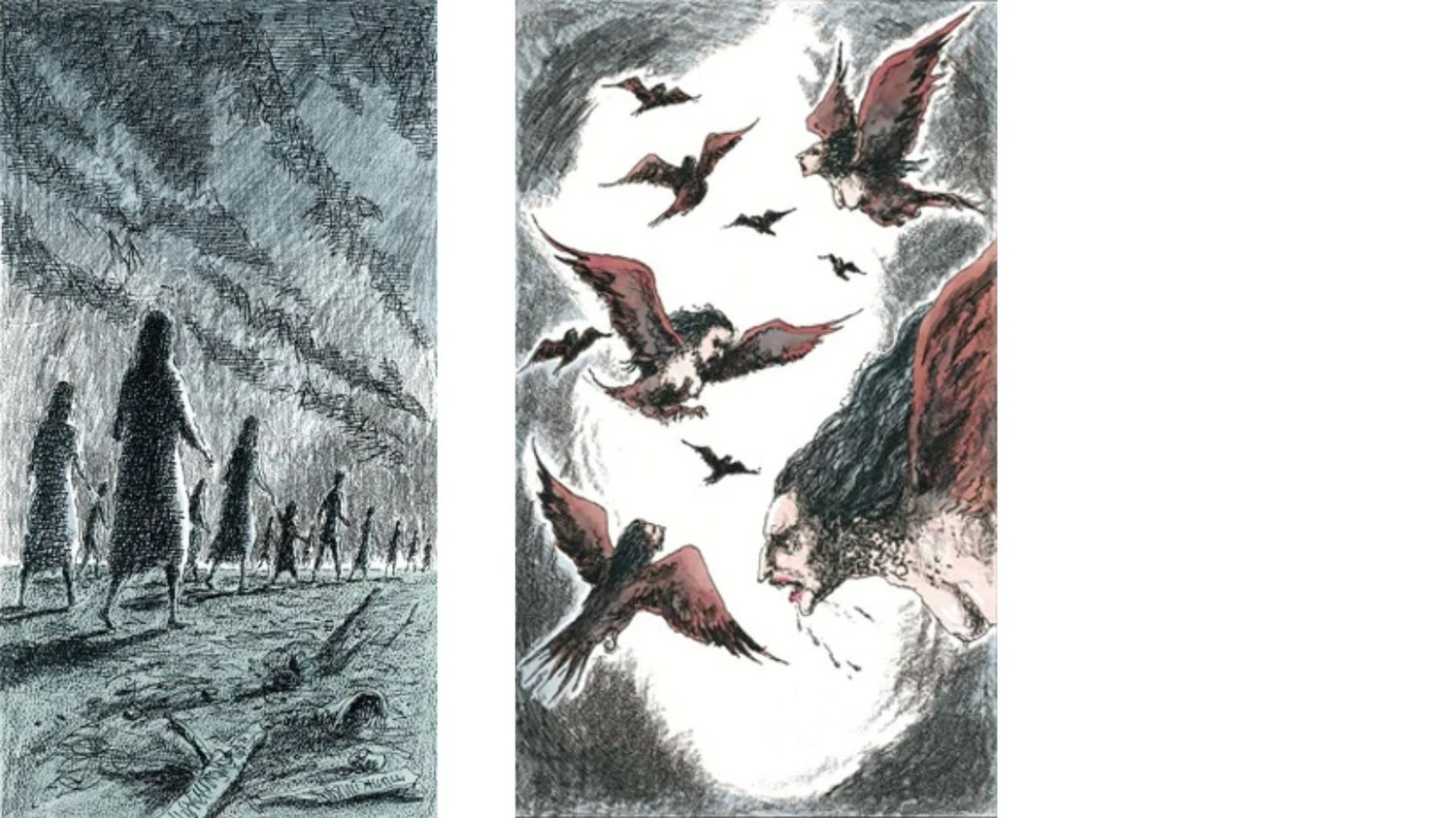
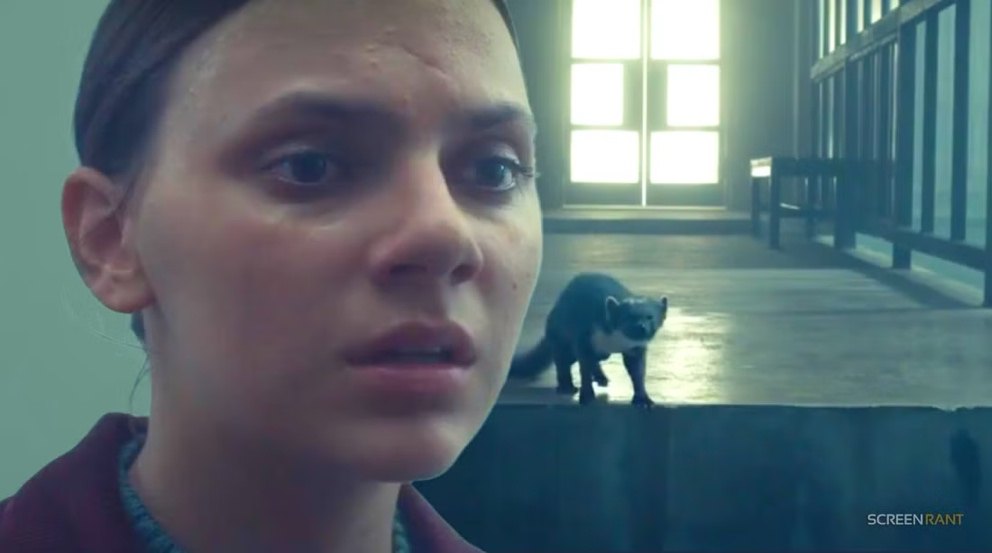
The walking dead and the harpies in the Land of the Dead
The Supplement 3, p. 2
“In Philip Pullman’s ‘The Amber Spyglass’, the Land of the Dead emerges as one of the most haunting and meaningful settings in ‘His Dark Materials’. This bleak, shadowy realm serves as a powerful metaphor for humanity’s deepest fears about mortality, regret, and the consequences of living under oppressive systems. Unlike traditional depictions of the afterlife in religious texts, Pullman’s underworld isn’t a place of divine judgment but rather a prison shaped by human emotions and institutional control. Through this imaginative landscape, the author challenges readers to reconsider ideas about freedom, memory, and what truly gives life meaning.
The Land of the Dead is described as a vast plain where countless souls wander endlessly. These spirits remain trapped in a state of sadness, weighed down by memories of their past mistakes and missed opportunities. Pullman uses vivid imagery of fog, crumbling cliffs, and rivers to create a sense of emotional paralysis – a direct contrast to the vibrant, ever-changing world of the living. What makes this setting particularly disturbing is how it reflects real-world anxieties. The souls aren’t tortured by external forces but by their own inability to let go of guilt and shame. This mirrors how people in our world often become prisoners of their past, allowing regret to prevent personal growth.
Central to the story is Lyra’s courageous mission to liberate these trapped souls. Her role as a "second Eve" – a reference to symbolism – takes on profound significance here. By leading the dead out of their gloomy prison, she doesn’t just challenge the rules of the afterlife; she confronts the Magisterium’s entire system of control. This powerful religious organization, resembling authoritarian institutions throughout history, maintains its power by promising salvation while trapping followers in fear. Lyra’s act of rebellion shows that true freedom comes from rejecting artificial embracing of self-determination. The scene where souls dissolve into glowing particles of Dust becomes more like a metaphor.
The concept of Dust plays a crucial role in understanding Pullman’s themes. Representing consciousness and free will, Dust flows toward those who think independently. In the Land of the Dead, its absence explains why the environment feels so lifeless. When Lyra begins sharing stories from the living world, her words literally generate light and energy, demonstrating how creativity and human connection feed the soul. Initially symbols of punishment, they transform into guides when Lyra negotiates a new purpose for them: instead of inflicting pain, they now preserve human stories. This shift emphasizes Pullman’s belief.
Pullman’s vision of the afterlife shares similarities with other works exploring mortality, such as the film A Matter of Life and Death (1946), where memories give meaning to existence. However, his approach is distinctly modern. By rejecting the idea of eternal punishment or reward, he argues that our lives gain value through the choices we make and the relationships we build. The liberation of the dead isn’t just a plot device – it’s a call to action for readers to examine real-world systems that use fear to control behaviour.
Ultimately, the Land of the Dead sequence encourages profound reflection on how societies shape our understanding of life’s purpose. Through Lyra’s journey, Pullman suggests that embracing uncertainty and accepting mortality can be empowering rather than frightening. The novel’s message feels particularly relevant today, as young people increasingly question traditional narratives about success, morality, and what happens after death. By imagining an afterlife where stories hold more power. The novel ‘The Amber Spyglass’ leads to deeper thinking in many different categories.”
AI-generated
Explore the implications of the Land of the Dead in ‘The Amber Spyglass’
The land of the dead in ‘The Amber Spyglass’ is a gloomy and sombre place such as a concentration camp, where people are fed dark memories by the harpies. They instil a sense of shame regarding what you have done in your life, causing individuals to remain stationary, relinquish hope, and lose the will to escape. The dead are constantly in a state of guilt and remorse. Similarly, in Greek mythology, the Underworld bears resemblances to the description in the book. The river Styx, situated in the Underworld, is literally composed of acid. Charon ferries the dead across the river in a boat, transporting them from the gate of the spirits to the actual domain of the dead, which is also gloomy. The implications of the Land of the Dead are that dead people are doomed to exist in a state of perpetual dread and guilt.
In ‘The Amber Spyglass’, Lyra has taken the choice to go to the Land of the Dead. She persuades Will to accompany her, luring Will there so he can communicate with a lost loved one, his father. Lyra also believes the blow to the Magisterium would be unbearably big because of the massive influx of Dust caused by the ghosts, which would pose a significant threat to the Magisterium. Dust is wisdom, and wisdom can let people rebel. So, if the Magisterium wants to completely control people, Dust needs to be destroyed. Therefore, if the ghosts come out and the Magisterium’s control fails, then people will all rise up in rebellion.
Lyra explained that people will reform with their particles being put together. It is as if people in the dead are shells, while the real particles are still on earth. The thing is like the quantum theory on a macroscopic but not microscopic level. Therefore, it means that those people are souls and their bodies diffuse into thin air, but still ‘exist’. Once their soul goes into the living world, all the same atoms come together in the exact same property when people are living.
Her stories remind everyone about the fun of being in the living world, about the joy and benefits of feeling warmth and hope with sunshine. This lets them think that going back is actually a good idea and persuades them to disobey the harpies that discourage them from facing real life. Meanwhile, the harpies are not pleased with the idea of the ghosts breaking out. They have been assigned the task of keeping the ghosts confined by making them feel remorseful about their past actions during their lifetimes. In fact, Dust is also particles. They cannot be seen and are similar to the ‘Dark Materials’ in our universe. The only difference is that Dust is like an all knowing encyclopedia. With the use of appropriate instruments such as the alethiometer, one can gain insights into both the past and the future. Its consciousness compels Lyra to journey to the land of the dead. It not only aids her in achieving success but also proves to be highly valuable in numerous other aspects. Therefore, the Magisterium hates Dust.
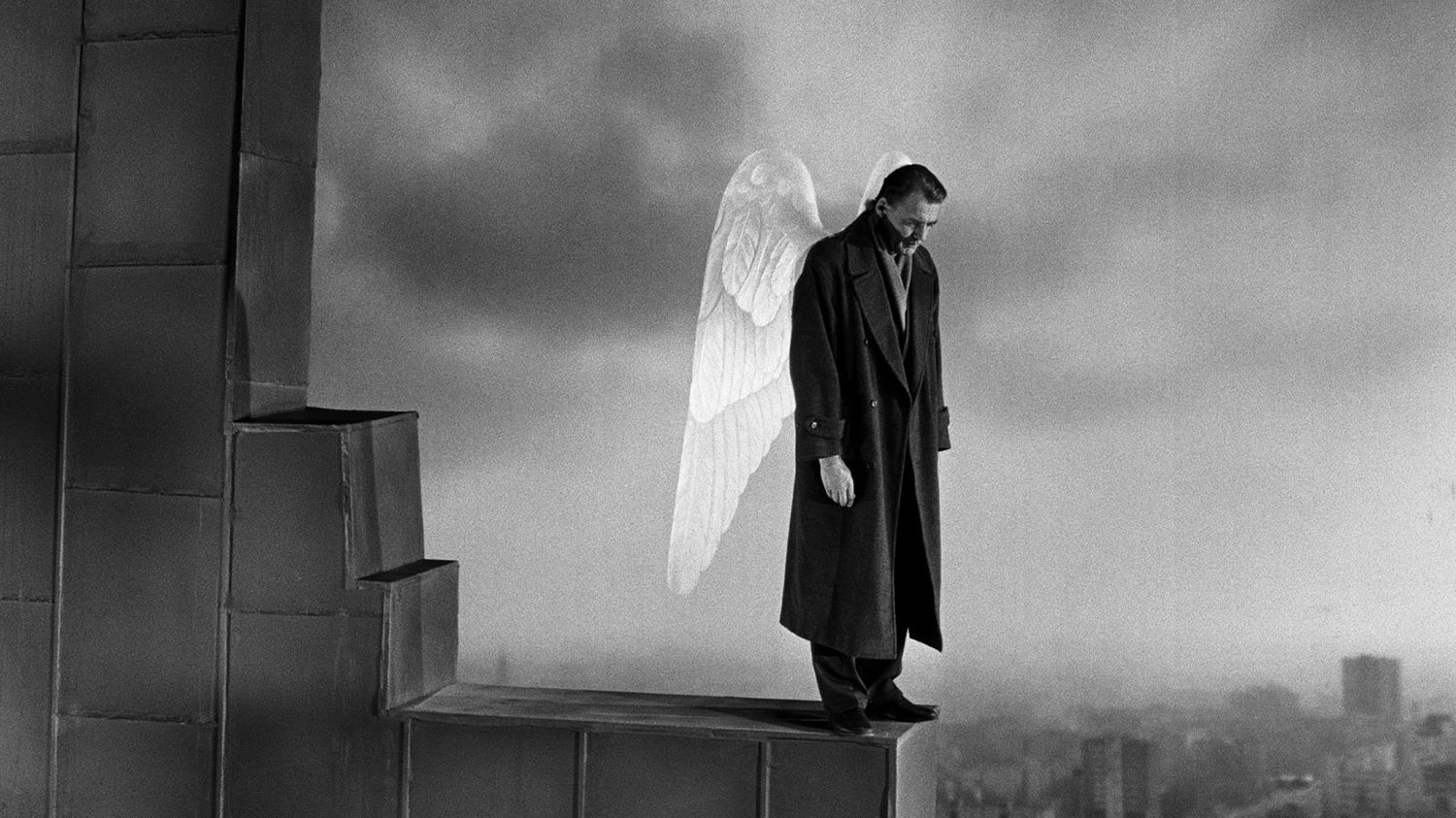
The angel who wants to be mortal in Wim Wenders’ film, ‘Wings of Desire’
The Supplement 3, p. 6
In the three films ‘A Matter of Life and Death’, ‘Wings of Desire’ and the Japanese film ‘After Life’, different perspectives about the differences between life and death are shown. In ‘After Life’, people can choose one memory from their life. That memory gets made into a film they can remember. It’s a special way to think about the afterlife, focusing on personal memories.
Also, paintings tell us about the afterlife. Stanley Spencer’s ‘The Resurrection’ shows the dead coming out of their coffins. This is like the idea that the dead can come back to the world of the living. In ‘The Last Judgment’ it is different. Here, people are punished for the bad things they did when they were alive. So, these two paintings give us opposite ideas of what the afterlife might be like. One showing the concept of people coming back from the dead and the other telling about no matter what you do in life, you will always be punished because people will always make mistakes. With these two concepts of the paintings combined, ‘The Amber Spyglass’ shows a dark and gloomy place, which serves as punishment. Inside, harpies remind people of sin that people did in their lifetime in order to keep people from escaping from death. However, Lyra’s breaking out from the concentration camp-like place called the Land of the Dead is similar to the painting ‘The Resurrection.’ It shows people being raised from dead and their atoms, combining together, making them alive and gives them the power to feel life. In other words, there is a connection between our lives and our deaths.
Finally, I will explore my own ideas about the afterlife. The dead people will go to a dark and gloomy place with the items that have been buried with them. Afterwards, their heart is taken and looked at by a god. Those who have lived a life of honesty and have a commendable reputation will be permitted to proceed. If not, then they will instantly fade away. To those who pass the first test, they will be allowed to go to what sort is a five-dimensional place. In this realm, they can perceive the activities of their living relatives and bid them a final farewell in dreams. Afterwards, those relatives will put their hearts in a lake. How much the heart weighs represents how good the person is. And if your heart has sunk to the bottom of the lake, your heart will dissolve and the soul is reborn into the living world. I think the heart and soul are connected. They're two parts of the same thing that keeps going through life and death. It’s like the heart holds all the things you did and felt in life, and the soul is the part that lives on after you die. Together, they make up who you are, and they keep changing as they move between life and the afterlife.
George, Grade 5
In ‘The Amber Spyglass’, the Land of the Dead is full of people who have forgotten their lives. Lyra tells them stories and tries to remind them of the rich, eventful lives they once lived.
By this means, and by giving them hope, she intends to lead the dead into the outside world, and for them to take their places there once more. Meanwhile, the harpies are doing the opposite – they constantly remind the dead of the bad things they did in their lives, causing the dead to feel guilt and be paralysed by remorse.
Once the dead souls get back to the living world, they will become a part of that world, which is a form of dust. Lyra doesn't yet know this part but she gives those death souls hope, so they can become a part of the world, which is also another form of freedom.
In the book, the author wrote that the dead are always remembering their sins, which makes it easier for the magisterium to control them. With the control, the people in the magisterium can always keep the balance between the world of the dead and the living, which prohibits the dead’s chances to be reborn in another way. The people in the dead world have forgotten everything from when they were alive; the memories of life are vague. So, in this case, they will forget that there is a world that full of happiness. They don't understand why they were there and do not even think about the possibility of 'going back' to the living world.
On reflection, and prompted by Lyra, they remember that living is full of fun and vitality, because when a person is alive, he or she can do anything. Things will not be unchanged and life is full of variables, which might be good or bad, but people can get used to these shifts, creating something new that we can call feelings and thoughts. These things make the living world colourful, vibrant, and full of hope.
On the other hand, and by contrast, being in the land of death is boring, tiresome and always the same. People lose any feeling and the ability to think. They experience only hopelessness and darkness, which proves the sense people have that the world of the dead is black and white, a kind of non-life without hope.
In my own thoughts, I think the afterlife is just pure white, with your own memories inside. It is very clean and tidy with nothing but memories, like a pure coloured room, staying yourself inside – very quiet, with no feelings.
So, Lyra tells stories about the things that are alive. On the one hand, she advises the ghosts to go with her and follow her back to the living world. But on the other hand, she is also helping them forget the dark memories of living.
The reunion of Lyra and Roger gives me a feeling like a dramatic reunion, which drives the next part of the plot. Roger is the one reason Lyra came to the death world, so he is also an important character.
One of my guesses is that the harpies are also normal things in the land of death. They might be one of the followers of the Authority, or they might been enslaved by the Authority, because one of the harpies that flies down doesn't attack Lyra, even though she is taking the people in the land of the dead away. So, they might just work for the Authority, but without being really convinced by its arguments.
This state of 'living is colo urful, death is black and white' depends on people's own understanding and experiences. Inherent in human thinking is the sense that living is full of fun and is colourful. Therefore, making the earth colourful is totally normal. When people are dead, although they won't have pain any more, being in that place means they will have lost their feelings and emotions.
I think the meaning of the land of the dead is that it's just a place to keep the balance between death and the life, which enables the magisterium to control the living world more easily. Thus, the maker of this 'death world' is the Authority.
Serena, Grade 6
Lyra has to leave her daemon behind when she travels to the Land of the Dead
First, I think the land of the dead in ‘The Amber Spyglass’ is just a prison. Trash is piled all together, making the atmosphere gloomy. The land was so dark that even the subtle knife couldn’t cut through as it was too deep below the ground. The land of the dead was full of untidy tents, and it will be just like a dirty maze – hard to find the way you’re going, hard to travel in. People have full dark, sad, depressing memories, and are constantly reminded of them by the awful harpies. People will forget hope, become depressed, and not be able to move. Therefore, this version of the afterlife will be a disaster for people.
Because Lyra is able to read the alethiometer, and because she is also the new Eve, the Magisterium wanted to destroy her. Also, Lord Asriel wants Will Parry, the knife bearer, as the knife can easily tear all things apart, even Iorek’s metal, which he was able to cut in half.
The Supplement 3, p. 11
If Lyra and Will aren’t able to escape from the Land of the Dead, the Magisterium will win the fight and have control of the world. On the other hand, Lyra can destabilize the Church’s power if she and Will can escape, thus offering hope to Lord Asriel. The role of Lyra in the Land of the Dead is to open a portal for the dead between worlds and creating Dust, which the Magisterium refuses to believe in. The church is afraid of Lyra’s actions and the choices she might make. Lyra doesn’t listen to orders often, she has her own thoughts, and this why she’s known as Eve, disobeying a command made by the Magisterium.
In my view, when people escape from the afterlife, they will turn back to their normal form. Lyra also said that hope will replace all the doubts of the dead. When they escaped, there would be a bigger change of winning the battle against the Magisterium. Lyra said that the small particles of Dust the dead will bring into the world would bring optimism to everyone in the land of the dead.
The harpies tell you all the guilty things in your life, and keep repeating it to make you feel miserable about the choices you have made. When they told of your shame, your face would be pale white and you would lose confidence. But if you were not listening to what the harpies said, like Lyra, you could break the spell, and the harpies will not bother you anymore.
The link between particles and dust are that they all are produced by adults and in the living places. If you’re in the land of the dead, the dust will be gone. In my own thinking, a daemon is made by dust and particles, because when someone dies, their daemon will disappear by turning into millions of small pieces like dust. Developing my thoughts, the picture Lord Asriel gives can clearly see that the small particles, i.e., Dust, are most attracted to an adult's body, just like the daemon’s pieces.
Lyra reminds the dead of the happy things in their pasts and makes some other funny, lighthearted observations. She also told them not to give up on hope and talked about meeting with Will, repeating, “not to give up on hope.” In this way, more and more dead people came to hear the story, and many people believe in Lyra. Even when the harpies came to make Lyra stop her speech, she continued her stories. Despite the harpies screaming at her, she still calmly asked for the creatures to leave. She said, “What is your name, you must have one?” This confused the feelings of the harpies, making the creatures feel guilty and causing them to fly away.
Life is shown in colour, or without much colour, but heaven is shown in black and white, because life is happy and cheerful. Green represents prosperity, blue means sadness, red shows vibrant feeling, and so on. Heaven does not have a feeling. Because you’re dead, you don’t have feelings. You don’t have thoughts, either, and just listen to the instructions the commander gives you. This is also, basically, something that happens in the film ‘Wings of Desire’, which tells the story of an angel that wants to be mortal and experience life. In the book, Lyra saw that ‘souls’ in the world are viewed as a threat. They are shown in black and white managing to represent in the afterlife, and the only colour is black and white.
In Greek mythology, Charon rides his boat across the River Styx, moving around the real brightening world and journeying to the dark-sided hell. The Land of the Dead is based on this boatman, taking the dead people in boats into the land of the dead. There was a big comparison between the two worlds. One world is full of bright, shiny color, and the other world is a disaster – its castles are burning, nothing is beautiful, nothing shows hope, and the world of the dead is depicted as a prison!
The belief in the afterlife will control people doing things. Some countries might say that if you don’t behave well, its god will punish you when you’re dead and you will go straight to hell. This story might influence people’s behaviour, playing on their fears.
I believe that after life you will travel to two worlds. Even if you behave well in the real world, the devil will choose you, so you will be in another world like a jail and will be working every day and night for some kind of devil. Because it is the world of dead, nothing will be happy for you. The only happy thing is that if you work very hard, the devil might give you a chance to go back to your world and start again as a new person. But if you don’t behave well in life, you might not even be in the world of dead – you will just disappear into the universe.
The painting ‘The Last Judgement’ by Stanley Spencer shows something similar – that people can be reborn after death because they are able to change. Even though they might have sinned and are even born in sin, they can be redeemed. Spencer’s characters wear clothing to cover their guilt. God might be angry and he may punish people but there is a chance to be saved.
Michael, Grade 5
The idea of what happens after we die has fascinated humans for thousands of years. From ancient myths to modern stories, people have imagined places like the Land of the Dead described in Philip Pullman’s ‘The Amber Spyglass’. This dark, quiet realm requires the dead to cross a river guarded by harpies, creatures who remember every detail of a person’s life and scream their sins aloud. The Land of the Dead is both terrifying and oddly peaceful, representing a transition between life and something unknown. Stories like this show how deeply humans want to understand what happens after death—and why cultures around the world have created so many different answers.
In ‘The Amber Spyglass’, the Land of the Dead is a place of shadows and silence. The dead must cross a river to reach it, but harpies which are angry bird -like creatures, control the journey. Their cruelty makes the Land of the Dead seem like a punishment, but it’s also a place of reflection. The harpies force souls to face their past, making the afterlife feel both scary and meaningful. The story suggests that death is not just an end—it’s a time to confront people’s choices. This reflects real-life beliefs where the afterlife is often a mix of judgment and peace, like how some religions promise heaven but require facing past mistakes first.
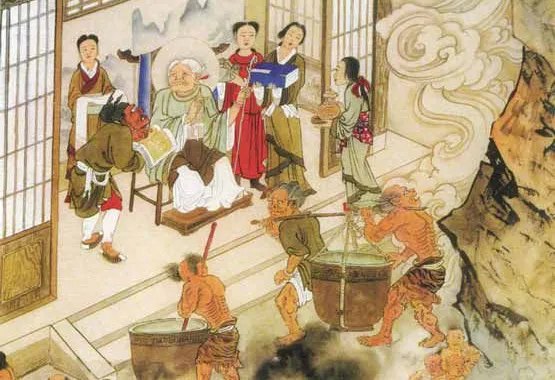
People’s ideas about the afterlife depend on their traditions. Many religions, like Christianity or Islam, teach that good deeds lead to heaven, while bad deeds send people to hell. This belief acts as a guide for people how to live, encouraging kindness and avoiding fouls. In Buddhism, people are reborn as new beings based on their actions in previous lives. The goal is to break this cycle and achieve peace. A Chinese folktale says the dead are given a soup called Mengpotang that erases their memories. Some choose to refuse it for they wish to keep their memories of love, pain, and life. These beliefs help people make sense of loss and give meaning to life. They also show how fear of punishment or hope for reward can shape behaviour. For instance, avoiding evil deeds to escape hell, or doing good to improve future lives.
Mengpotang: the soup of forgetfulness
Belief in an afterlife matters because it comforts us. It tells us that our lives have purpose beyond our time on Earth. For many, it’s not just about escaping punishment—it’s about knowing that love or justice continues. For example, parents who lose children might cling to the idea of an afterlife to feel connected. These beliefs also build communities. Religious rituals, like funerals or prayers for the dead, strengthen social bonds. Even cultures without a formal religion often have stories about spirits or ancestors guiding the living.
The afterlife is a mirror of human hopes, fears, and questions. ‘The Amber Spyglass’ shows it as a place of memory and judgment, while cultures offer stories from paradise to reincarnation. These beliefs give life meaning, shape moral choices, and help us bear with loss. Whether through harpies, heaven, or forgotten memories, the afterlife reminds us that how we live matters. It’s a reminder to act with kindness, seek peace, and cherish the time we have. After all, the choices we make here might echo far beyond our own lives—a legacy that continues, in some form, long after we’re gone.
In what ways is free will shown to be important in ‘The Golden Compass’?
In the novel ‘The Golden Compass’, free will is shown through several places and contributes significantly to the story. This essay will talk about what free will is and means throughout the story, how the Magisterium or the authorities in the book control people’s free will, the protagonist Lyra’s connection with free will and whether it’s possible to have absolute free will or not through various examples and plot events from the book.
Free will means what it sounds like, one’s personal will without anyone forcing with complete free rights. However, it is commonly thought that one can’t and will not have absolute free will because the choices we have is already very limited, so the choices we make are even more limited. For instance, we don’t have choices to whether go to school because it’s a must for us. So, the choices we later make is already because we must go to school in the first place, which doesn’t make it an absolute free will. Furthermore, I believe that no one has absolute free will, because our will or actions are already limited by the law and society, such as our gender, our name, our identity, what we can and cannot do.
In the novel, the Magisterium, which is a group of scholars and authorities together that take control of Lyra’s world, wants to maintain their power by limiting people’s free will to the most and their independent thinking abilities. Take Mrs. Coulter as an example, she works for the Magisterium, and spreads people’s rumor about the Gobblers, and promises others that she and the Magisterium will find them when she is part of the Gobblers and the children she lied to is going to be experimented. However, with her excellent lying skills and people’s trust for the Magisterium, they manage to fool everyone thinking that the Magisterium is looking for Gobblers and the Gobblers eats children. This is an example of how the Magisterium can fool people and make them believe whatever they say, which is a sign that people are losing their independent thinking skills. The Magisterium desperately tries to control people, so they don’t have their own mind or the ability to think. This is because they want to stay in control and not let people have their own say in social problems and think their own questions such as the existence of other worlds like what Lord Asriel is finding.
The main protagonist Lyra is someone like her father, Lord Asriel, who has much of their own free will and wonders about worlds beyond the one they’re living in. Lyra, as Lee Scoresby has said before, has more free will than anyone he has seen before. This is because Lyra has lived in Jordan College all her life without anyone telling her what to do, and she is not forced to do anything if she doesn’t want to. She can explore the rooftops, get out of lessons and trouble, drink wine, play with dead people’s tombs and roam around freely. True, she has the freest will anyone has seen, but even that, her fate is laid out in front of her, and she can’t escape the death of Roger, her pursuit of North, and the background of her family and her past. Although she has a lot of free will and choice in what she can do than most people, but she still can’t escape the destiny or path that’s laid ahead of her. She thinks she’s saving her best friend Roger, and bringing the Golden Compass to her father, but it’s Roger that she’s bringing to him, and this is part of the completion of her fate to further investigate in Dust and step into another world.
An important bit here to notice is that Lyra does all of this without knowing what she is destined to do or what will happen. This is evidently crucial because if Lyra knew that her father needs someone’s power of cutting off their daemon to activate the pass from this world to another, she wouldn’t bring Roger with her to him. If she doesn’t do that, she will be the one to die and suffer, which is not her fate. So therefore, Lyra can’t know about her prophecy because it will change what she does.
Free will is also a crucial point shown through other stories. In the story of Adam and Eve, Eve doesn’t have much of a choice when she chooses to eat the fruit or not. She knows that she is not supposed to eat it, but she does want to while fearing the consequence. With the snake continuously bugging her, and God’s warning, Eve is kind of torn between choices. However, she chooses to follow her own mind and do what she wants. At that moment, it symbolizes the coming of adulthood, when children don’t just listen to what adults or society tells them, they can choose what they want and doing things of their will. After they eat the fruit, they are no longer kids. Before, they were naked, careless, and innocent, but after eating the fruit, they gained the ability to know right or wrong, to make choices and to feel guilty. However, that is not what God wants, so God punished them for doing things out of their own free will.
A lot of characters are limited by free will. For instance, Mrs. Coulter is torn between her love for Asriel and Lyra, and her desire for power through the Magisterium. At last, she doesn’t choose to go with Lord Asriel, but how little free will does she have in that choice? As for other characters, such as the children and nurses that had their daemons cut off from them, they are like without soul or an inner self. An important thing to catch up upon is that the coming of adulthood means the settling of a daemon, which also means that the children is settling their character, identity, and belief. However, the Magisterium is testing a theory that if their daemons is cut off from them, they will never be able to reach adulthood, and therefore, never be able to gain access to knowledge, experience, and ability to make their own choices, which is what dust symbolizes, and what the original sin or Adam and Eve is. In that way, the Magisterium can forever control people and make them believe everything they say.
The problem of free will is overall a crucial point and topic in the book The Golden Compass and provides a view on authorities, adulthood and other worlds beyond.
Ivy, Grade 6
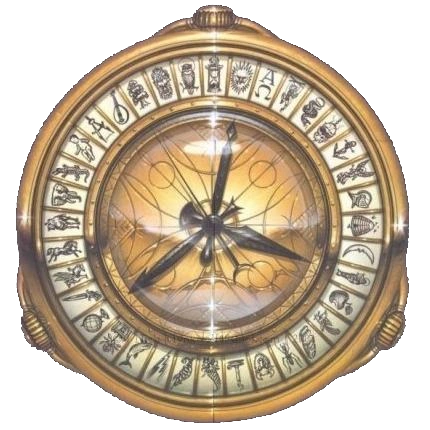
The alethiometer
In ‘The Golden Compass’, Philip Pullman shows that free will is very important. Free will means having the power to make your own choices, rather than being told what to do by someone else. This idea is shown through the characters, the choices they make, and the way the Magisterium tries to control people. The story shows that being able to choose for yourself is a big part of being human.
The Supplement 3, p. 20
The Magisterium is a powerful group in the story that wants to control everyone. They do not like people asking questions or learning new things. They are scared of Dust, which they think is dangerous because it is connected to knowledge and growing up. One example of this control is how they cut children away from their dæmons. This makes the children quiet and empty, like robots. The nurses who went through it don’t even seem human anymore. This shows that without free will and a soul, people lose what makes them themselves.
Lyra, the main character, is full of free will. She doesn’t like being told what to do and often makes her own choices. She sneaks into places, lies to get information, and even goes on a long journey to rescue her friend Roger. Lee Scoresby says Lyra has more free will than anyone he’s ever met. She learns to read the alethiometer, a special truth-telling device, without any help, just by using her feelings and her clever mind. She is brave, curious, and always follows what she believes is right. All of these things show that she has a strong will of her own.
But there is also a prophecy about Lyra — it says she will do something very important that will change everything. This makes us wonder: how can she be free if she is supposed to do something that is already decided? The answer is that she must not know about the prophecy. If she knew, she might act differently, and that would take away her true choice. The prophecy will only come true if she acts freely, without trying to follow it. This shows that even if something is predicted, free will is still important.
The story also makes us think about whether we can ever be completely free. People are often influenced by where they live, who they know, and what they’ve been taught. Lyra is shaped by her life at Jordan College and by the people she meets. But she still asks questions and makes her own decisions. This tells us that even if we can’t be 100% free, we can still choose what kind of person we want to be.
In Chapter 21, the story of Adam and Eve is explained. In this story, Eve chooses to eat the forbidden fruit, which brings knowledge and awareness. The Magisterium thinks this was bad and wants to stop people from making their own choices like Eve did. But Pullman shows Eve’s choice as a brave and important moment. She chose to learn and grow, even if it was scary. This shows how free will helps people become truly human.
Mrs Coulter, Lyra’s mother, is a complicated character. She is clever and powerful, but she follows the Magisterium and does bad things. At the end of the book, Lord Asriel opens a bridge to a new world and asks her to come with him. She refuses. This shows that she is still tied to the Magisterium’s control and is not brave enough to choose a different path. Even though she is strong, she doesn’t have as much free will as she could.
The story also shows what happens when people lose their free will. The children who are cut away from their dæmons are empty and sad. The nurses at Bolvangar are like machines with no feelings. Without their dæmons, they can’t think for themselves. Dust is important because it shows a person’s thoughts and soul. The Magisterium wants to get rid of Dust because they fear what it means — freedom, learning, and change.
In my own life, I think I have some free will, but not all the time. I have to go to school, follow rules, and listen to adults. But I can also make choices, like what hobbies to do or what books to read. I think free will means learning to make good choices, even when it's not easy.
To sum up, ‘The Golden Compass’ shows that free will is very important. It helps people grow, learn, and decide what is right. Lyra’s story, the actions of the Magisterium, the meaning of Dust, and the idea of prophecy all show that making our own choices is what makes us human. Even if we can’t control everything, our choices still matter a lot.
The Cold War was a fascinating yet hostile time for the world. World War Two had just finished with the joint enemy of the allies, the Nazis and fascism, defeated. The lack of a common enemy, ideological differences, and struggle for influence between the two most powerful allied nations, the communist USSR and the capitalist United States, culminated in the origins of the Cold War, a period of geopolitical tension and conflict between the two socalled ‘superpowers’ from 1947 to 1991. 1 One of the most significant and enduring consequences of the Cold War was nuclear proliferation, or the mass development of nuclear technology and weaponry, and its spread to countries that did not previously possess them. Although debates about whether nuclear weapons help maintain peace through deterrence are still controversial, nuclear proliferation during the Cold War reshaped global power dynamics by escalating tensions between global superpowers, prompting widespread fear and new international laws and treaties, but also promoting scientific innovation and a framework for international accountability and diplomatic negotiation. The effect of the Cold War on nuclear proliferation caused a contradictory reflex to both amass as many destructive warheads as possible with the explicit intention of not using them; thus, two mutually distinct even contradictory things happened simultaneously.
However, the relationship between the Cold War and nuclear proliferation is more nuanced and interdependent than this suggests. It's worth saying that the phrase ‘cold war’, originally thought up by the English writer George Orwell, foresaw something that didn’t previously exist. It would be wrong to think the idea of ‘cold war’ was a recognizable set of circumstances waiting to happen – that it was a pre-defined event that conveniently suited an emerging geopolitical
1 André Munro, “Nuclear Proliferation,” in Encyclopædia Britannica, 2019, https://www.britannica.com/topic/nuclear-proliferation situation. Thus, the cold war and nuclear proliferation are inextricably linked – to the extent that they owed their existence to the actuality of each other.
The roots of nuclear proliferation can be traced back to World War II and the United States’ development of the atomic bomb through the Manhattan Project. Driven by the fear that Nazi Germany might develop nuclear weapons first, the US mobilized unprecedented scientific and industrial resources to produce the bomb, which was successfully tested in July 1945. The subsequent bombings of Hiroshima and Nagasaki in August of 1945 not only brought about Japan’s surrender, but as many historians argue, also served as a geopolitical message to the Soviet Union, signaling US dominance in the postwar world.2 The atomic bomb did not merely end one war; it inaugurated a new model of power politics where possessing nuclear capability became a litmus test of global supremacy. This early intersection of nuclear weapons and political signaling was no accident—it was a calculated assertion of ideological superiority. Even before the Cold War officially began, the atomic bomb had become an emblem of strategic intimidation.
In an article in ‘The Atlantic’ magazine in 1947, Albert Einstein noted the destructive nature of the atomic bomb and said, “I am not saying that the United States should not manufacture and stockpile the bomb, for I believe it must do so; it must be able to deter another nation from making an atomic attack when it also has the bomb.”3 The significance of Einstein’s argument is twofold. First, that after dropping two of them on Japan there was no clearly defined viewpoint about the future of the atom bomb. And second, that the idea of deterrence was 2 Wikipedia Contributors, “Nuclear Proliferation,” Wikipedia (Wikimedia Foundation, November 12, 2018), https://en.wikipedia.org/wiki/Nuclear_proliferation.
3 Albert Einstein, “Atomic War or Peace,” The Atlantic, November 1, 1947, https://www.theatlantic.com/magazine/archive/1947/11/atomic-war-or-peace/305443/.
beginning to take shape. In other words, before the notions of deterrence and cold war had become policy, Einstein was pondering their joint possibility. Accordingly, the use of the bomb as a geopolitical tool was floated and laid the groundwork for a Cold War model in which nuclear power symbolized not only military superiority but also ideological legitimacy. More than this, it suggested that nuclear proliferation and some kind of cold or non-combative war were mutually necessary.
As what became known as the Cold War began to emerge from the escalating tensions between the United States and the Soviet Union, the United States' monopoly on nuclear weapons was short-lived. By 1949, the Soviet Union successfully tested its first atomic bomb. Thereafter, nuclear proliferation took its place among a full range of geopolitical tensions between the world’s two most influential nations, though as the most potentially consequential component of those tensions it effectively shaped the Cold War in ways that other areas of antipathy could not.
The development of nuclear weapons by the Soviet Union significantly altered the strategic landscape, as both superpowers now possessed the means to eradicate each other, leading to the doctrine of mutually assured destruction (MAD), which in turn shaped the Cold War. The term MAD only came to light in 1962, emphasizing the previously unspoken but ongoing, definitive and effective relationship between the Cold War and nuclear proliferation. The arms race intensified throughout the 1950s and 1960s, with both countries developing and stockpiling increasingly powerful nuclear weapons. For instance, the United States tested the first hydrogen bomb in 1952, and the Soviet Union followed in 1953.4 This mutual, tit for tat
4 André Munro, “Nuclear Proliferation,” in Encyclopædia Britannica, 2019, https://www.britannica.com/topic/nuclear-proliferation.
capacity for annihilation created an ironic and eerie form of security: the knowledge that any attack would guarantee a devastating counterattack served as a deterrent, yet also fostered a constant state of existential dread among global populations. Far from simply being destructive, nuclear weapons became paradoxical tools of global order. Their terrifying power forged a balance that paradoxically preserved peace through fear —an unnatural but undeniably effective equilibrium. Thus, it led to the development of a strange situation whereby weapons of mass destruction were frenetically manufactured with the explicit intention of not being used. In effect, the stockpiling of ‘hot’ weapons of war provoked a ‘cold’ war, not only defining it but also, arguably, actually calling it into existence.
One of the clearest indicators of the Cold War's contradictory influence on nuclear proliferation was the dramatic rise in the number of atomic weapons produced globally during this period. By the mid-1980s, the world held over 70,000 nuclear warheads, the vast majority possessed by the United States and the Soviet Union.5 This escalation was not solely motivated by practical military needs. Instead, atomic armament became a symbolic currency in the ideological battle between capitalism and communism. To possess more warheads was not simply to be better armed but to appear more dominant, more advanced, and more legitimate in the global order. This symbolism, along with mass media propaganda and support for the claim, was embedded and eventually integrated seamlessly into the world's political climate. For example, during the early 1980s, U.S. President Ronald Reagan’s Strategic Defense Initiative (often nicknamed "Star Wars") proposed a futuristic missile defense system in space (though never implemented), a strategic maneuver designed to intimidate the USSR and
5 Wikipedia Contributors, “Nuclear Proliferation,” Wikipedia (Wikimedia Foundation, November 12, 2018), https://en.wikipedia.org/wiki/Nuclear_proliferation.
highlight American technological dominance.6 Similar to the Olympics, the Space Race, and even cultural achievement, where feats of accomplishment in sports, science, and the arts were a source of national pride and superiority, nuclear proliferation was viewed as a contradictory and performative demonstration of strength. The Cold War was drawing weapons of mass destruction into a kind of competition, aiming to establish supremacy without actually fighting. This was the bizarre status of nuclear warheads during this period, as the essential ingredient in the creating, defining and sustaining of a Cold War.
However, the history of runaway arms development is half the legacy of the Cold War, with the collective action of nations for diplomatic restraint of nuclear dangers. Here, the two-faced nature of the Cold War is most evident. While the two superpowers built burgeoning arsenals, they also realized the doomsday threat of the weapons and engaged in extensive dialogue to reduce the threats. Key breakpoints such as the Partial Test Ban Treaty (1963), Nuclear NonProliferation Treaty (1968), and Strategic Arms Limitation Talks (SALT I and II during the 1970s) illustrate how fear of one another led to cooperation.7 It was a strategy based on rational irrationality: peace would be preserved only if each side believed any attack would lead to absolute annihilation. During the Cuban Missile Crisis in 1962, probably the most dangerous phase of the Cold War, the Cold War rationale was put into sharp focus. With Soviet missiles in Cuba and U.S. forces raising their readiness levels, the world stood at the brink of nuclear annihilation. However, this mutually assured destruction brought the crisis to a conclusion. Soviet submarine commander Vasili Arkhipov's refusal to allow the launch of a nuclear torpedo,
6 “President Reagan’s Address to the Nation on Arms Reduction and Nuclear Deterrence, November 22, 1982,” www.youtube.com, n.d., https://www.youtube.com/watch?v=qJSsONJpSB4.
7 “List of Weapons of Mass Destruction Treaties,” Wikipedia, October 23, 2022, https://en.wikipedia.org/wiki/List_of_weapons_of_mass_destruction_treaties.
despite significant pressure from his superiors, is often credited with averting World War III.8 This incident exemplifies how Cold War logic frequently hovered on a knife’s edge: survival depended on the restraint of individuals amidst overwhelming systems of aggression. Rather than negating the existence of nuclear weapons, these moments of restrai nt weaponized diplomacy itself. They transformed the global order, showing that fear could fuel cooperation as much as it sparked arms races. This was an extreme illustration of the uncanny effects of the Cold War on nuclear proliferation. Faced with the possibility of actually using warheads, which was previously the intention of developing an arsenal, catastrophe was averted through individual whim. This would have been unthinkable in a hot war, but made a kind of weird sense in a cold war.
These moments of restraint and negotiation did not negate the existence of nuclear weapons but created a political environment where their very presence demanded, even insisted on, diplomatic innovation. Organizations like the International Atomic Energy Agency (IAEA) emerged to monitor nuclear technology and ensure its use remained peaceful. This global oversight represented a new kind of diplomatic collaboration that transcended individual conflicts to address shared existential threats. The IAEA, established in 1957, played—and continues to play—a crucial role in verifying compliance with nuclear treaties and promoting transparency among nations.9 In this way, atomic proliferation helped build a foundation for cooperative global governance. In fact, there is plenty of evidence to suggest that nuclear proliferation was in reality chiefly responsible for the policies of peaceful co-existence that were increasingly apparent between the USA and the USSR, including the Ostpolitik initiative, in 8 Office Of The Historian, “The Cuban Missile Crisis, October 1962,” Office of the Historian (United States Department of State, 2017), https://history.state.gov/milestones/1961-1968/cuban-missile-crisis.
9 “List of Weapons of Mass Destruction Treaties,” Wikipedia, October 23, 2022, https://en.wikipedia.org/wiki/List_of_weapons_of_mass_destruction_treaties.
which the chancellor of West Germany encouraged greater co-operation and communication through the Iron Curtain.10
A primary source is George Orwell’s 1945 essay “You and the Atomic Bomb,” where he noted that the advent of nuclear weapons had created a new kind of geopolitics. Having coined the term “cold war” to describe this uneasy peace maintained through fear, as previously noted, he also pointed out that the bomb made conventional warfare among great powers almost obsolete. He wrote, “A state of affairs which was normal in the past has now become impossible,” presciently identifying the paradox of peace through terror, an oxymoronic though nevertheless verifiably actual state of affairs.11 The strange logic of the Cold War and its effect on nuclear proliferation was echoed in another key document, the 1985 joint statement by U.S. President Ronald Reagan and Soviet General Secretary Mikhail Gorbachev: “A nuclear war cannot be won and must never be fought.”12 This official declaration marked a definitive point in Cold War diplomacy, openly acknowledging the unsustainable nature of nuclear brinkmanship and echoing the contradictory logic of the times.
Nuclear proliferation during the Cold War also ushered scientific progress beyond politics and diplomacy. Specifically, the competition to develop increasingly sophisticated atomic weapons involved a massive investment of resources into physics, engineering, and computing. Cold War-related funding boosted research institutions, such as Los Alamos and CERN. 13 The
10 “Ostpolitik | West German Foreign Policy,” Encyclopedia Britannica, n.d., https://www.britannica.com/event/Ostpolitik.
11 Wikipedia Contributors, “Nuclear Proliferation,” Wikipedia (Wikimedia Foundation, November 12, 2018), https://en.wikipedia.org/wiki/Nuclear_proliferation.
12 Lesley Kennedy, “How Gorbachev and Reagan’s Friendship Helped Thaw the Cold War | HISTORY,” HISTORY, October 24, 2019, https://www.history.com/articles/gorbachev-reagan-cold-war.
13 National Air and Space Museum, “Speed and the Cold War,” airandspace.si.edu, July 7, 2022, https://airandspace.si.edu/stories/editorial/speed-and-cold-war.
resulting technologies had many peacetime applications in computing, energy, and even medicine sectors. For example, the shift towards computing was born in nuclear technology, initially manifesting itself as bomb developers required advances in computational theory to perform complex calculations such as trajectory and reaction. Thus, while much of the research was for devastating ends, the surprise creation of supporting scientific infrastructure allowed for innovation to emerge across fields. Again, we see the peristaltic action of the Cold War at play here – the simultaneous action of destructive potential and peaceful dividend exists together.
The end of the Cold War brought a swift and dramatic shift in nuclear policy. With the ideological conflict over, the case for maintaining massive nuclear arsenals was less compelling. The 1990s saw significant reductions in nuclear stockpiles through agreements like the Strategic Arms Reduction Treaty (START) and disarmament measures by Russia and the United States. Former Soviet republics such as Ukraine, Belarus, and Kazakhstan gave up their inherited nuclear arsenals, reinforcing the idea that atomic capability had been deeply tied to Cold War dynamics.14 Without the ideological and strategic framework of Cold War rivalry, the impetus to maintain massive arsenals diminished. In this sense, the Cold War was both the catalyst and the container of the nuclear threat.
In conclusion, the Cold War’s impact on nuclear proliferation was paradoxical. It drove the world to the brink of annihilation through an unprecedented build-up of destructive power, yet it also cultivated new forms of diplomacy, restraint, and international cooperation. In a 1990 article in ‘The Atlantic’, John J Mearsheimer wonders about the strange effect of the Cold War on global conflict in a piece titled, ‘Why We Will Soon Miss the Cold War’. In it, he says, ‘We may, however, wake up one day lamenting the loss of the order that the Cold War gave to the
14 Wikipedia Contributors, “Dissolution of the Soviet Union,” Wikipedia (Wikimedia Foundation, June 12, 2019), https://en.wikipedia.org/wiki/Dissolution_of_the_Soviet_Union.
anarchy of international relations’, thus acknowledging the strange, incongruous character of the Cold War, its reconciling of the irreconcilable,15 and the interconnectedness of nuclear proliferation with Cold War practices. While nuclear proliferation undeniably escalated global tensions and fear, it also created structures for accountability and dialogue, and inadvertently fostered technological innovation that would benefit the world in unexpected ways. Both things happened at the same time. The arms race and the peace treaties were not opposing narratives, but intertwined responses to a shared existential danger. Thus, nuclear proliferation did not simply shape the Cold War; it created it and thereafter defined its contradictions.
Bibliography
Einstein, Albert. “Atomic War or Peace.” The Atlantic, November 1, 1947. https://www.theatlantic.com/magazine/archive/1947/11/atomic-war-orpeace/305443/.
Encyclopedia Britannica. “Ostpolitik | West German Foreign Policy,” n.d. https://www.britannica.com/event/Ostpolitik.
IAEA. “International Atomic Energy Agency | Atoms for Peace and Development.” Iaea.org, 2023. https://www.iaea.org.
Kennedy, Lesley. “How Gorbachev and Reagan’s Friendship Helped Thaw the Cold War | HISTORY.” HISTORY, October 24, 2019. https://www.history.com/articles/gorbachev-reagan-cold-war.
——— . “How Gorbachev and Reagan’s Friendship Helped Thaw the Cold War | HISTORY.” HISTORY, October 24, 2019. https://www.history.com/articles/gorbachev-reagan-cold-war.
Munro, André. “Nuclear Proliferation.” In Encyclopædia Britannica, 2019. https://www.britannica.com/topic/nuclear-proliferation.
National Air and Space Museum. “Speed and the Cold War.” airandspace.si.edu, July 7, 2022. https://airandspace.si.edu/stories/editorial/speed-and-cold-war.
Office Of The Historian. “The Cuban Missile Crisis, October 1962.” Office of the Historian. United States Department of State, 2017. https://history.state.gov/milestones/19611968/cuban-missile-crisis.
15 “Why We Will Soon Miss the Cold War - 90.08,” www.theatlantic.com, n.d., https://www.theatlantic.com/past/politics/foreign/mearsh.htm.
Orwell, George. “You and the Atom Bomb.” The Orwell Foundation. Tribune, October 19, 1945. https://www.orwellfoundation.com/the-orwell-foundation/orwell/essays-andother-works/you-and-the-atom-bomb/.
Wikipedia. “List of Weapons of Mass Destruction Treaties,” October 23, 2022. https://en.wikipedia.org/wiki/List_of_weapons_of_mass_destruction_treaties.
Wikipedia Contributors. “Dissolution of the Soviet Union.” Wikipedia. Wikimedia Foundation, June 12, 2019. https://en.wikipedia.org/wiki/Dissolution_of_the_Soviet_Union.
www.theatlantic.com. “Why We Will Soon Miss the Cold War - 90.08,” n.d. https://www.theatlantic.com/past/politics/foreign/mearsh.htm.
www.youtube.com. “President Reagan’s Address to the Nation on Arms Reduction and Nuclear Deterrence, November 22, 1982,” n.d. https://www.youtube.com/watch?v=qJSsONJpSB4.
Maxwell, Grade 10
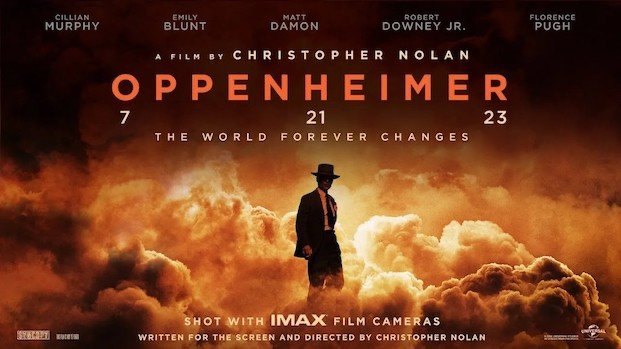
Poster for ‘Oppenheimer’, Christopher Nolan’s film about the origins of the nuclear bomb.
The following piece was written by a second-year undergraduate who wanted to put his thoughts and feelings into some kind of almost poetic order. It’s a loose prose poem, which moves around in time and space, only connected by the perspective of its narrator. It doesn’t have a specific title.
1. Before departure“Even though ten thousand people oppose it, I go.”— Mencius · Gongsun Chou Part OneAt the end of 2023, I gaze up into the night sky.A Gemini meteor shower streaks across it, sparkling and spectacular.A billion light-years beyond the stars, travelling through telescoped timeOn its five-thousand-year-long odyssey across infinity.And if time-destined is cyclical rather than linear,Then do I right now not look up at the same speck of starry sky as history’s great leaders oncedid?Thus, we take shared pride in the heroic and the civilized,Despite the universe’s narrative being no more than a minor footnote.One part tells of a prosperous, flourishing age, full of heroism and the fevered blood of youth,Of kings, marquises, generals, ministers, and the noble-born.Another part tells of dynastic decline, the collapse of empires, of sunrises and sunsets.The world repeats history’s pain.Reflective, ponderous time declines to wish it otherwiseAnd in an instant the splendored-starry sky sinks back into silence.It's 2030: I finally complete a self-evaluation.I no longer live within others’ appraisal of me.I hear myself echoing through heaven, no longer earthbound,And follow my heart’s desire – even though I take care not to cause trouble or break rules.
Then, fast-forward several decades...I’m still loyal to my feelings,I keep creating; I never stop.I use this as a platform to sharpen my awareness and perfect my behavior,To glory in my energy,To eternally expand my sphere of operations.It's 2102: already old though unable to grow much older.Even so, I have no intention of slowing down or going dark –I still cherish the quick-wittedness and sharp sensation of being human.Already old,I leave Makka Pakka,And move to Wuxidixi, a small town in the south,Where I will complete my final task,About reality being a story travelling through time.I have already written a fiction that overstays its welcome;I need to write something real to bring me back to earth.My time-machine mind returns me to Shanghai, one-hundred years ago...Scene of my childhood,Of compact discs, of French phoenix trees, of pop music,And of free souls independent from the tyranny of common thought.One day, I sank a foot into the inky-blue lightness of the shattered, shimmering sky,The floating clouds in Beijing,Which led me to think about that year and the way I skipped classes at a sci-fi conventionthere,By oversleeping at Hong Kong International Airport,
Thus, I, scampering all the way back to that far-away afternoon...
2. Arrival: the year 2025 Savouring this abundant meal, this untried friendship, and this life not yet doomed. The flight – once again, delayed. So, I missed the opening ceremony. Three hours ago, in twenty-degree Hong Kong, in the heat, I wanted to roam naked; Three hours later, in zero-degree Beijing, in the snow, I was miserable, a cold stray dog. After sorting things out, I rushed directly rush to my friend’s school, A whistling, chilling north wind blowing through me. We listened to a wandering minstrel singing "Castle in the Sky" And talked of stuff, past matters and dreams. Then, suddenly, I realized that I had abandoned myself. In order to seem like everyone else, I had knowingly and willingly sliced myself apart And willed into existence a sort of self-satisfied superiority That, to avoid pain, preened and plumed itself. Once upon a time, this kind of vanity made me comfortable. But even more than that, it made me fearful. Now, as if from a nightmare, I am abruptly awake, And discover what I really want, something long-buried and almost forgotten, Emerging like a bright, brilliant spring day from a dark, cold, bitter winter. The next day: I am wandering through a Beijing hutong with friends – A broad alley with a steampunk-style furnace, decorated with big red lanterns And shops alive with cats. In one, I talk with the lady-boss And we chat about sci-fi novels, what they might mean,
Keeping myself calm so that I don’t turn on the catsBecause, inside, my churning, agitated mood threatens to overturn my chill manner.I am not what I seem.For two whole days, I spew nonsense, a Gatling-gun spraying of hooey.I binge-eat and binge-drink,An orgy of recklessness and wild behaviour.When it’s time for the group photo, I feel ten pounds fatter.In the evenings, I vividly recall fragrant dumplings, aromatic fried chicken,Sumptuous mutton hotpot, delicious sticky rice rolls, and more.Everyone in the group photo looks happy.Later, the Beijing campus reminds me of my student days and I fish for memories,Which give me an uncanny sense of belonging and security,Gradually, I feel myself being steadily captured by the echoes of my past.Night falls.Once more, I find myself in a sentimental mood, lamenting the past.An old person tracing young memories really is an emotional thing.I pretend that I am around twenty-years old again,That I do not know the next time I will be in Beijing,Acting as if I was young and not yet found out by fate.To be or not to be, that is the question:Whether ‘tis nobler in the mind to suffer,The slings and arrows of outrageous fortuneOr to take arms against a sea of troubles,And by opposing, end them: to die, to sleepNo more...
— HamletAlthough I didn’t make first day’s opening ceremonyAnd was still sleeping when the second day beganI was able to catch the free lunch.Eating together with everyone shocked me.It was the first offline contact with the sci-fi fans.Before this, I felt sci-fi was a relatively niche fieldAnd to avoid being labelled ‘pretentious’I have admitted my hobby to only three people, acting like a timid sewer-rat.But now, all us rat people are togetherAnd we are transformed into ferocious tigers, agile leopards, fierce wolves,And, yes, docile sheep, too.Of course, the gap between reality and fantasy cannot be ignored –Who we are and what we pretend to be –Though following rules and walking along the world’s fixed trackWould be even more unbearable.And, of course, I know option ‘A’ is the most advantageous solution,Rationally, practically, emotionally, beneficially, theoretically,Option A is always the optimum choice.But.But I finally still choose option B.Because.Because B is me.And I find that the friends all around me have made the same choice.Even though they, too, can’t deny convention’s contempt,
The way its chain of command snakes into all corners of the world.In China, even with sci-fi, the same snobbery and forces are at work:Hard sci-fi looks down on soft sci-fi;Soft sci-fi looks down on fantasy;Fantasy looks down on magical;(And Harry Potter is magical.)Ursula Le Guin’s fantasy work “Earthsea” has a higher literary status than the sci-fi work“The Left Hand of Darkness”.But if we divide things up in such a blind, arrogant and superior way,And accept these contemptuous divisions, made in such a brutal, mathematical way,Then countless good works will be buried and lost.The Ocean has no memory of shame.It only believes in freedom, just like the sky;It cannot bear bondage, just like the sky.I stand on a wet beach, the waves gently licking at my legs.This moment is especially easy to believe,In the sky, that one distant star is my sun,And salty seawater is humanity’s old cradle.— Stars Are Cold ToysIt is the afternoon of the conference: I hope my name will be projected onto the screen.Better still if it also appears in the brochure –That way, others will have visual evidence of me and of my existence.But when the results come out, the only entries are a few stupid school activities.Pity. My name does not appear,Though there is a uniform listing for the “China Science Fiction Research Center”
And this year, for the second time, I saw the name of teacher Chen Qiufan,Also noting Liu Cixin, Wang Jinkang and teacher Baoshu.Disgruntled, I leave the venue and hurry back to eat mutton.Buying autographed books is too expensive,So, again, I missed the group photo.Never mind. There’s still time for another one.The last day: I took part in a sci-fi industry financing meeting.I didn’t set my alarm and was late but, luckily, my friend was even later than me.One report said that in 2024, the income from sci-fi literature was around ten billion;But, if I recall correctly, the income from sci-fi games was 150 billion,Even though many sci-films and games are not based on actual sci-fi novels.A few days ago, in an interview, Liu Cixin said thatAI might replace sci-fi novelists.Various events make me feel future novelists will have no prospects.Compared to other hot industries,The rewards for actual writing will be meagre.I think of my own past writing, small essays and such like -Some published in newspapers,Some thrown into the trash,Some encrypted and locked in my e-diary,And some screenshot and spread around for fun.Anyway. No stories actually made any money.No one other than one’s self appreciates one’s self;Self appreciates self.These are all the earthly evidence I have that,
Once upon a time,I truly and actually existed.Many people cannot find past memories of themselves in the stars,But through reading my own small essays, I can at least sense past joys and sorrows.My past memories carry with them a feeling of invincibility, of grand ambition.At that time my head was full of grand prospects.One great person once said that when he stood at his life’s end and looked back,He saw that he had followed a pre-destined path.Even though I know the way will be full of thorns,Even though I know how tempting it will be to live a comfortable life,I still want to follow the innermost promptings of my heart.The worst result would be nothing more than overwhelming pain.Maybe at some critical junctionMy world will bend in two completely different directions.Will it, I wonder?I do not know:Good ending: The Little Lamb refuses be guided, categorized and controlled, and with analmost violent sincerity, indicates how for a generation that exists in an era devoid ofmeaning, rebellion and reinvention can be used to reconstruct one’s self, to recalibrate one’ssystem, and become that era’s pioneer.Bad ending: The Little Lamb loses its sense of humor.Unlike before, one now loses inspiration, one’s brain is dulled and lacking, one’s life is lived asa beast of burden.One loses one’s sense of humor, that was originally a weapon, a last resort.But no matter what, I am still full of expectation for a beautiful tomorrow.
I cannot wait to challenge my powerful enemies,Go on to win glorious victory or, perhaps, simply suffer failure’s blows.Only in this way can I find unimaginable growth.Whatever: now I will go to the pier on Victoria Harbour and buy some fries.
3. ReturnI return to Wuxidixi small town.Landing in my time machine, my youthful pure heart is calm.I raise a silver-streaked cat named Kamiaos,Cute and carefree as a forest elf.When I write, it jumps onto my desk, purring and peacefully perching.At night, I sit at my desk and stare out of the window.Stars hang on the sky’s curtain,Their light, reaching out to me across billions of years, finally falling on my eyes.The things that once upon a time made me hesitate, no longer bother me.For a long time, I have always been looking back or looking forward.But life does not need an end point.Nor does it need to be categorized as having a ‘good’ or ‘bad’ ending.The universe has no standard or typical answer. And the same for me, too.Outside the window, the sea wind brings a salty damp smell;I open an old diary and see that my young self once wrote:“Even though ten thousand people oppose it, I go.”I smile, once again lift my pen, and on the last page write —“I have arrived.”My back straightens. I see blue sea and sail shadows.
4. PostscriptThis piece was written on a plane from Beijing back to Hong Kong.At that time, already midnight, my thoughts were flying.Later, when I woke up and looked at the words again, I was immediately frightened.The writing really was very abstract, impressionistic.I have shown the first draft to several friendsWho sensed it as a kind of snail, bursting from its shell with exuberant energy.It was also recognized as having some kind of insight.So I kept it.If anyone was hurt, I am very sorry.
Discuss some of the ways in which Christopher Nolan’s film “Dunkirk” can be viewed as history as much as a work of drama.
History is the interpretation and expression of past events by historians. It is the historians who choose the event that becomes history. Obviously, the events have to be significant or of interest for them to actually become ‘history’. Historians always have to guess about the history they write, although they try to be as accurate as possible. To help them, they use documents and sources associated with the past events.
The evacuation of the British army at Dunkirk in 1940 has many sources to help the historians. In addition to newspaper reports, photographs, films, and diaries, there were thousands of witnesses present, which means that Christopher Nolan’s film, ‘Dunkirk’, therefore had a lot of information to work with. He wanted to tell the story of Dunkirk as accurately as possible. The question is, how far did he succeed in doing this?
So, what really happened in Dunkirk? In the early months of 1940, the British army crossed the English Channel and entered France in order to help the French army fight the Germans, who had invaded a few months earlier. After a few months of fighting, the French losses were huge loss and they started backing up to the north, along with the British army. The defeated French and British forces kept retreating until they were cornered on the beach at Dunkirk. It was important that the British army somehow got back to the UK to defend their own land, which would otherwise have been defenceless.
However, they didn’t have enough ships to make this short journey and in any case many of the ships were too big to get close enough to the beach to rescue the beaten army. The German planes continually bombed the beaches and the British struggled to such an extent that it seemed entirely possible that the whole army would be lost.
After an appeal by the government, British citizens and boatowners decided to sail their own small boats across the Channel to take the soldiers from France back to the UK to defend their land from the Germans. Although Christopher Nolan could not hope to reproduce and reflect the events at Dunkirk, in a completely true way, the film he made reflects some of the reality.
For example, Nolan’s film shows us the importance of aircraft and the role of the RAF by focusing on the actions of just three planes. The movie arguably highlights the large part the British airmen played in the fight by helping to prevent the Germans from bombing the soldiers, even though in real life they did not do such a good job. Nolan balances this inaccuracy by having one of the soldiers ask an airman why he didn’t do more to help once he has been brought back to the UK.
I think Nolan has done a great job because he reflected the broad results of Dunkirk by suggesting what happened. The events looked mostly real in the story, too. He went to great lengths to make the film seem authentic.
Although Nolan invented some things, the film, they all served a kind of wider truth. For example, in the movie, the airman, Farrier, in an invention even though he seems to have modelled on a real-life character. Similarly, Mr Dawson, the man who captained his own small boat across the English Channel, is made up, even though there were probably many characters like him. The boy, George, who died on his boat is another invention but they all reflected the sense of sacrifice that many made in rescuing the troops on the beach. Nolan said that, ‘By using fiction, I was able to explain various aspects of what happened in Dunkirk more efficiently and with more emotional clarity than by just following strict facts.’
In many ways, all history is a kind of drama because it involves the telling of a story. However, authentic history never invents things and never makes things up. In the film ‘Dunkirk’, Nolan does invent things. Although his film looks real, important parts of it are made up. So, does this mean that the film is inaccurate? I think it depends. For a film that recreates an 80-year-old piece of history, I feel the level of accuracy has been quite successful. But dramatic scenes and inventions are always needed for films and so ‘Dunkirk’ can never be called ‘history’ no matter how real it seems or how authentically it reflected the experience.
Some reactions to Brian Selznick’s ‘The Invention of Hugo Cabret’
The following pieces are based on Brian Selznick’s novel ‘The Invention of Hugo Cabret’. They
are specifically focused on the character of Georges Melies, a real person, who was once a great film-maker. When we meet him in the book, he is an old man, working in a toy shop at a railway station in Paris. Although the novel is a work of fiction, the facts about Melies are more or less true.
Discuss some of the ways the novel ‘The Invention of Hugo Cabret’ uses the character of Georges Melies to explore the connection between film and dreaming.
The book first introduces us to George s Melies. Brian Selznick does this by giving us information about how he does things and how he faced up to the problems he experienced in his life. The author also informed us about the impressive things he had accomplished in his life, like taking film forward and developing the process of film-making – his great step was to show that everything is possible in film. That explains why Melies can be both a film-maker and a magician at the same time. He used cuts and special effects the audience couldn’t ‘see’ to create illusions, making the impossible ‘possible’ for films.
When Hugo found the book ‘The Invention of Dreams’ in the library, this was a turning point. It was the moment when the secrets of film-making were revealed, as well as the true identity of Papa Georges. All the information we receive – about films, about Georges Melies, and about the plot of the novel – is somehow connected. All the small details we already knew about him suddenly seem important.
One of those connections is to do with illusions and dreams. Illusion is now represented as being part of the movie-making process and is quite similar to what happens when we dream. It also turns out that films are the way Papa Georges expressed his feelings.
Something similar is shown in the film ‘Inception’, which was made in 2010. One of the important quotes from the main character, Cobb, concerned the dangers of confusing real life and dreams. He warned against recreating things in your life, which is one of the reasons that, in the novel, Hugo sank into a nightmare. He believed things that weren’t really true; he accepted his dreams as truth.
Aiden, Grade 4
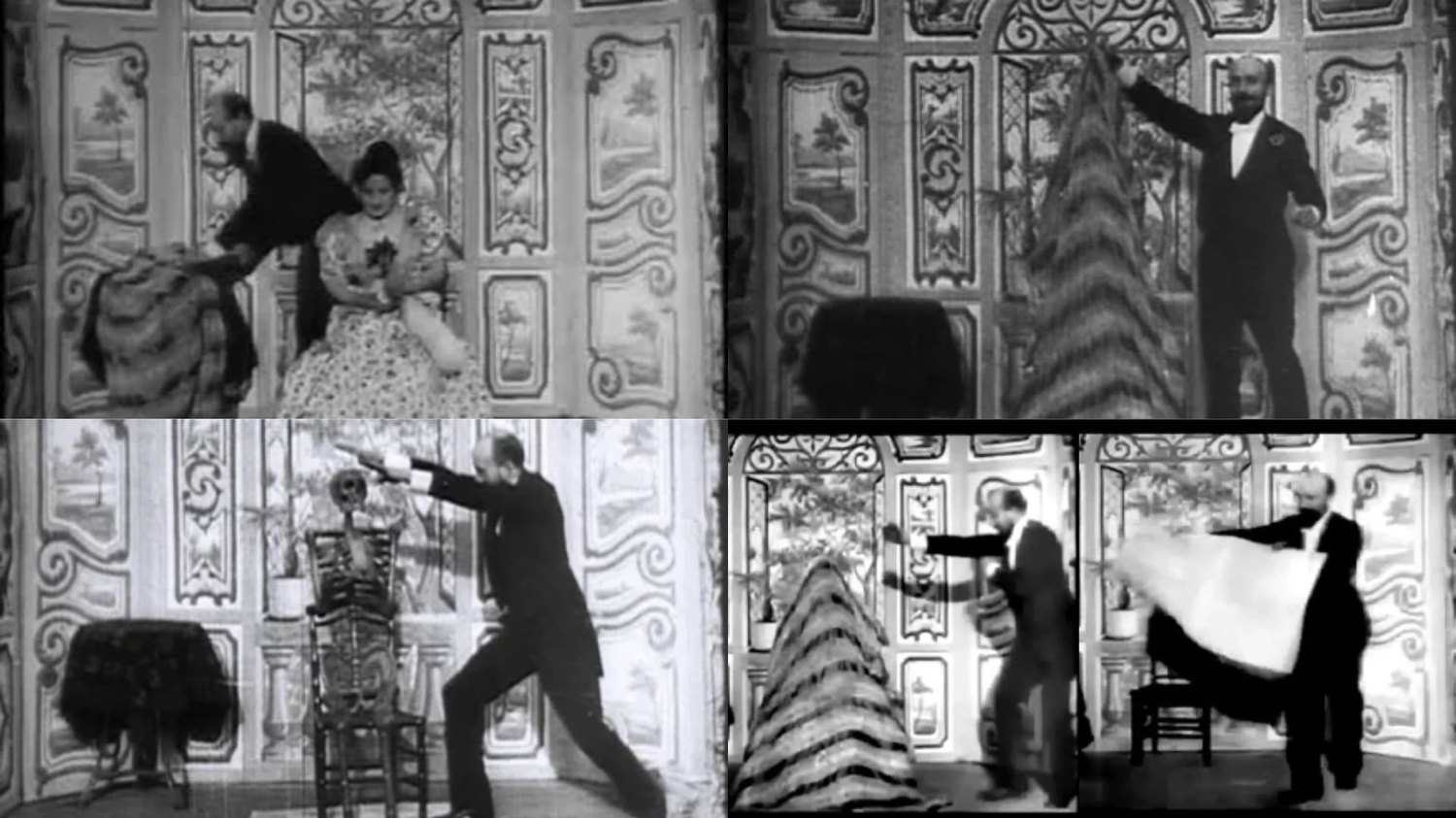
Georges Melies: The Vanishing Lady
The book ‘The Invention of Hugo Cabret’ introduces the important character George Melies. It does this by first introducing his toys and the toy booth at the railway station where he works. This is the place that Hugo steals from, taking things to help him repair the automaton.
The Supplement 3, p. 48
Then, the book shows Melies doing magic tricks, which makes us think that as well as a toyshop owner he is also some kind of magician. And eventually it is revealed that he was a very famous film-maker.
The book tells us that Melies saw himself as a film-maker who had been forced to become a toy-maker and seller, who believes that this has caused him to lose his soul. In a past life, he was a celebrated magician and film-maker, the first film-maker to add magic to movies and making impossible things seem possible in his films.
This connects Melies to the idea of illusion. In the novel, illusions are shown to be like dreams, using the imagination to make impossible things seem somehow real. Films and illusion are therefore connected by having some apparently unimaginable scenes i n films actually happening or being created for the screen.
Therefore, illusions and dreams have connections and they are somehow similar. First, illusions have elements of the impossible in them and dreams can also be impossible. Second, like dreaming while you are asleep, illusion is something that you imagine. And last, illusion and dreams are all things that are not real. The book Hugo finds in the library, ‘The Invention of Dreams’, is about this and connects film-making to dreaming. It is about dreams and the films involved in making those dreams look real. Films are like dreams because even though they look impossible they are often based in real life.
Films and dreams can also be similar. In the film ‘The Prestige’, it shows how this can work. For example, when you watch the film, it seems that time moves in a straight line. But actually, time moves in a zig-zag way. It shows Danton with Olivia, then it shows the trick, then back to Borden, then last, back to Borden and his teacher. These cuts are across time and space, which are sort of impossible in real life. Often, dreams also happen in impossible timelines, which makes them similar.
Nathan, Grade 4
Georges Melies is one of the most important characters in the book ‘The Invention of Hugo Cabret’ by Brian Selznick. He is a merchant now but he used to be a great film-maker and magician. He is also a legendary person in real life. He turned movies into art and he started the way that movies tell stories. He is both a film-maker and a magician, and magic tricks and films can’t leave each other – they are closely connected. They both create illusions to trick peoples’ eyes.
Nowadays, movies still create illusions using green screen, CGI, cuts, and other special effects. For example, green screens can make you believe people ‘transport’; CGI makes impossible things ‘possible’; and magic tricks, too, somehow tell us that things are not as they seem.
Melies was one of the first to work out how to create such illusions. He made films and performed magic, bringing the two together. For example, in his early short film ‘The Vanishing Lady’ (1896), Melies uses cuts to trick you into thinking the lady vanished and had turned into a skeleton.
The book also shows us how illusions and dreams are connected together. Dreams sometimes have impossible things happen in them. Just like films, however, it’s an illusion. The book has a section where Hugo dreams and turns into the automaton he is repairing, which is an illusion – like films, magic and dreams.
An example of the way that films use illusion is in ‘Oppenheimer’ (2023), which flashes between two timelines – how Oppenheimer invents nuclear fission and how Lewis Strauss wants people to support him. The film feels like a dream not only because Christopher Nolan didn’t use chronology but because of his great use of time – what is happening, the different timelines, the cutting between them, and the incredible true story, which all show the power of films and the power of events over time. I believe we all salute Georges Melies for making films into an art, and all the subsequent films and stars for making the films that entertain us.
Derrick, Grade 4
The book introduces is to Georges Melies. On pages 46-7, it shows him arguing with a girl, Isabelle. He is an old man who sells toys in a toy shop and he also used to be a film-maker. He was a film-maker and a magician at the same time because he could make something in a film suddenly appear, disappear or change, just like a magician would do. This connects the idea of illusion with film-making: just as you think something is happening in a logical sequence of events, he actually makes it jump over from the past and present by using cuts and editing.
Georges Melies makes films like a magician. On page 405, the author Brian Selnick says, ‘The Lumiere Brothers refused my request [to but a projector from them] so I was forced to build my own, which I did using leftovers from my automaton. I soon found out that I wasn’t the only magician to turn to cinema. Many of us recognised that a new kind of magic had been invented, and we wanted to be part of it’. And on page 355, the author states, ‘He was among the first to demonstrate that film didn’t have to reflect real life. He quickly realised that film had the power to capture dreams. Melies is widely credited with perfecting the substitution trick, which made it possible for things to appear and disappear on screen, as if by magic’. This explains how he made and changed movies to link with magic and dreams, by making them jump from the past to the present, and to move around in time.
Illusions and dreams are similar and they are both connected. They are linked because they can change and will not happen at the same time – events do not happen in a straight line. In the novel, Hugo found a book in the library called ‘The Invention of Dreams’, which is about the first movies ever made, including those by the Lumiere Brothers. It also mentions Georges Melies making movies ‘like magic’ and changing the world because of this. Magic, films, illusion, and dreams are all linked by the fact that they can suddenly change and jump from one time frame to the next.
We also watched a clip of the film ‘Inception’ in which a man called Cobb wanted to make a dream. He asks a girl called Ariadne to design the worlds in these dreams. When they go into the dream world to test her work, there is a big difference between dream time and real time. This is like film and real life. Something that takes a few seconds in a film can actually take much longer in a real life. Films and dreams run at different speeds to real life, even though they feel like they are operating in real time. Georges Melies understood this and that’s why he's a magician.
When people ask you ‘Who are you?’, most people will respond, ‘I am myself!’ But every individual is influenced by various factors, ever since they were born, to form a unique self. Factors like culture, family, gender, memories, and education all contribute to forming yourself and, with the passing of each decade, still having an impact on identity.
Me: A great human who is ‘great’.
The Supplement 3, p. 53
I’m in some ways different and in some ways the same as others. I love to test my extremes. Even when I’m just walking along the road, a few rocks appear in my sight and my mind automatically switches to a ‘parkour’ routine. Even when I have failed at something for the first time, I’ll keep trying until I can accomplish this parkour route, this steady way of negotiating what’s ahead of me. I’m like others, who don’t like going to school – maybe just for the quiz and test parts. I think about this a lot (especially in maths) and I realise that school is good in a few ways, like being able to see my friends and prank on them. The only part I think is absolutely meaningless is the nightmare of midterms and finals, the only function of which is to make students holiday time worse. Normal homework and testing might be necessary, but I can’t think of a real purpose teaching towards these tests
Culture is an essential part of my identity. It has a strong influence on me. I was taught from a young age with a combination of American and Chinese culture. For the American part, I didn’t do so many academic classes out of school. Also, there was more sport and ‘fun’ activities in kindergarten to support my development. In addition, I have been taught about Chinese morals such as respecting elders, acting like a ‘normal’ person, and having good manners in public places. These different cultures all had an influence on me and took me a step closer to who I am now.
Gender is also an important part of what someone should be. My parents often tell me that, as a girl, I shouldn’t be so jaunty or adventurous. But from a young age I’d always love to explore or challenge myself on anything – from boring maths to exploring a cave. Unlike some ‘perfect’ girls, I will sometimes reject others’ ideas (even though it never works). I also have a temper when I’m forced to do something, like play the piano or practice gymnastics. In my opnion, gender is just a physical difference between men and women and has nothing to do with somebody’s courage, behaviour and actions. Girls can be adventurous and boys can do ballet. It's just up to the person it-self.
However, the most important factor of my identity is memories. Memories work like when you need an experience of something or want to remember what you did before. Your mind will select the appropriate sources and transfer the electrical signals to your brain. My memories, from young to recent times, contain the mistakes I’ve made, the happiest and saddest times, the most fearful and anxious scenes, and much else besides. They make me more experienced in knowing how to communicate, act towards others, and behave. Due to my memory, my three theses are: Do your best but don’t stress too much; live a happy life rather than an anxious one; and explore the world around you. That’s the conclusion I have drawn from my 12-year 361day life, and it will keep developing throughout my life, which is influenced by what I choose to memorise.
Education has also formed me in many different ways. Different education systems will form different mindsets. I’m formed into a ‘student’ when doing academics but will also participate in numerous sports and a number of relaxing activities. These things give me good health – both mentally and physically.
All in all, all aspects of the world you meet are influential and form a part of you that will keep developing in the future.
From analysing all these elements that form the individual, I have a true knowledge of knowing myself. As a girl, people often assume I should be dancing or reading. I actually don’t really like either of them (especially dancing). I also don’t like learning to play instruments, which I feel is nonsense – I only do it to get the certificates. What I actually do like is sports and to try and so something that is unique and different from others. If I really had a goal, I would really work towards it even though in daily life it seems that I don’t have a schedule. Online, there was once a trend to test your personality called MBTI (Myers-Briggs Type Indicator). Each letter corresponds to a personality trait. Mine was ENTP, which stands for extrovert (or likes to talk, which is my understanding!), intuition (N), thinking (T), and (finally) P for not having a specific schedule to achieve anything or how to deal with the outside world. I think this test is a great way to actually know more about yourself. The explanations behind my ENTP are having a ‘bouncing logic’, a love of debate, and being the most introverted ‘E’ person. These characteristics all fitted me and told me something about how to participate in life. In conclusion, I just love to play, explore, always delay every assignment to the last moment, and try to have a positive mindset. That’s me!
Robots can think and feel but their programmes tell them most of the things, which is the same as AI. I think if robots are like Roz, they can have feelings because they will get used to a thing or animal and will imprint or like or even miss that thing. So, my opinion is that robots can have feelings.
I also believe that technology can work with nature because if we don’t have technology in our life we will be back in the BCs. Also, if we don’t have nature, we will die, with no oxygen and too much gas.
Roz shows she is a parent because a parent has to take care and protect its children. Roz takes care of Brightbill by feeding him, and teaching him to swim and fly. I think it would be wrong to brainwash Roz to forget Brightbill and Fink, the animals who helped her. She would then become an ordinary robot again and no longer be a WILD robot.
Roz also shows that robots, humans and nature can exist together because in the novel Roz survived in the wild and if something is too hard for us, we could use the robots. Also, nature provides oxygen to people. We need nature and robots!
In conclusion, Roz survived in the wild and she becomes the ‘wild’ robot. Roz is a robot because she was supposed to be a robot and she also has a programmer. Roz came back to her home because she wants to protect the animals. I think she took great care of Brightbill, which shows that even though is technology, she is also compassionate and has empathy. Chloe, Grade 3 Roz the robot mothers Brightbill (above) and cares for other animals (below)
Roz is like a human because she treats people in a friendly way and also acts friendly by being brave. She wants to learn, to help people and animals, and she has curiosity. She is also like a mother because she helps Brightbill become a good child.
The Supplement 3, p. 58The Supplement 3, p. 58
The wild life on the island is difficult because you need to be careful of being eaten or killed by other hungry animals. You need to eat other animals and not be eaten yourself. The place you live is cold and hostile. When winter comes, it is especially hard. Roz helps the other animals when it gets cold.
Roz is the main character in the book. Because of her actions and the way she treats Brightbill, we can see that she is not just a robot without feelings. She is able to connect with other characters.
Tico, Grade 3
Robots can think and feel just like humans. We learn and observe the ways to become a good person. We don’t know it just by the way we think. The same with Roz. Actually, some characteristics just feel ‘right’. It’s the same with robots and especially Roz.
In the book, nature, technology and survival are connected. For instance, humans need animal meat and nature’s fruits and vegetables to survive. But animals and nature also need humans to care for them – give them some shelter, food and water if they need them. The same if trees want to live. They need birds to peck out the bugs in their bodies. And if birds want to survive, then they need trees below them, hiding from their predators. Everything is connected.
The novel says that being a mother is hard. Being a real mother, you need to do several things to make the baby think you are caring for it. A bad person can never be a whole, 100% parent, or be close to being a mother. Only real caring works, which is why Roz is a good mother.
Therefore, the novel wants to say that science can exist with animals – we can all be together. It doesn’t say that someone can be excluded. This is shown as wrong. Everything is linked together.
In the first few chapters, the animals do not welcome Roz. They just want to live with other animals and are suspicious of the robot. This is also shown as wrong. But this event happens because, first, Roz is not similar to them: she is science. Second, animals like to get along with animals that are the same as them. The book shows that this need not happen and that Roz can live with the animals.
In conclusion, Roz is 99% close to being a human. Even though the animals beat the Recos, she knew that the Recos would keep hunting her until she was caught. She understood this would be harmful to the animals so she went back to the factory. This shows that Roz has empathy, which makes her ‘alive’ rather than ‘artificial’. She is truly a ‘wild’ robot.
Hit.Shoved.Taken.Away from the comfort of my home.Plucked from the ground,Uprooted,Harshly pulledUpUpAndUp.ButFor I’m just a simple carrot,In a world more complex than IWhat more could I do?
Driven.Weighed.DrownedIn icy cold waterSending shivers down my spine.They rubbed meHarshly,
Wiping away my brown coatMy scentAnd every trace of my home,They rubbed me,Until I’m shiny,Until my skin cries orange tearsThey pluck my leaves off me,The very leaves I’ve been proud ofThe very leaves I used to show offButFor I’m just a simple carrot,In a world more complex than IWhat more could I do?
Dried.Packaged.Stacked.With a tag stuck to my naked body.Telling people what I amAnd what I could be.But I don’t want to be labelled.I want to escape the wrath of itEscape everything trapping me in a boxBlocking all other possibilities.But
For I’m just a simple carrot,In a world more complex than IWhat more could I do?
Picked.Taken.Stashed.AndI wonderWhat’s the meaning of my meaningless life?To be chewed into mush?To sit and wait until age draws dark spots across my skin?To look into faces etched with laughter and wonderif they have any space left to hold grief for my fate?I don’t want any of that to happen.But I don’t have a choice,BecauseFor I’m just a simple carrot,In a world more complex than IWhat more could I do?
Felt.Gripped.Choked.By the hands,
That tighten their grasp around me,Like a cage.I wish to be like the winged creatures,Soaring across the horizon,No fear,No regretAnd free.Instead,My wings are clipped backAndI’m trapped in a cage without a key.ButFor I’m just a simple carrot,In a world more complex than IWhat more could I do?
Washed.Placed.Hit.I felt the cool, sharp edge enter my body,Or maybe,It’s just the weight of the world,Weighing down on me.From the top,Through the bottom.
A crackSplitting me in two.Then againAnd again.ButFor I’m just a simple carrot,In a world more complex than IWhat more could I do?
Picked.Raised.Thrown.Into the panAnd I watch helplessly as the heat overtakes my senses.As the sizzles and bubblesRubs against my bare skin,Slowly,My body didn’t feel like mine anymore.Or maybe it was never mine to begin with.Maybe from that very first momentOut the dirtWhen a cool breeze brushed against my skin,It also carried me along,The real me.I left with
No one there to remember my story,No one to mourn my fate,And no one there to care.I felt myself relaxing,Giving in.I felt myself sinkingDeep into the puddles of goldDeeperAndDeeperButFor I’m just a simple carrot,In a world more complex than IWhat more could I do?
Is J.R.R. Tolkien’s ‘The Hobbit’ more than a fantasy adventure story?
‘The Hobbit’ by J.R.R Tolkien is a fantasy adventure, first published in 1937. In the book, readers meet a character called Bilbo Baggins, a comfort-loving hobbit who is tricked by Gandalf the wizard into embarking on an unexpected journey with a company of dwarves. Together, they embark on a quest to regain their ancestral wealth from the fearsome dragon Smaug. During the story, the actions and personalities of the Lord of the Eagles and Beorn develop the theme that friendship helps people overcome obstacles.
How the Lord of the Eagles behaves, helps to illustrate in what ways friendship can help people overcome difficulties. When the dwarves are trapped in the burning trees by the wolves and Goblins, he makes a significant decision: ‘Just at that moment the Lord of the Eagles swept down from above, seized him [Gandalf] in his talons, and was gone. The dark rush of their beating wings smote the wolves to the floor or drove them far away; their talons tore at goblin faces. Other birds flew to the treetops and seized the dwarves, who were scrambling up now as far as they ever dared to go.’ (Tolkien, 77.) Thus, the Lord of the Eagles decided to help Gandalf, Bilbo and the dwarves escape from the Wargs and Goblins. It suggests that he doesn’t want to leave them in this dangerous situation and let them be caught by the Goblins. Gandalf had once healed the Lord of the Eagles from an arrow-wound. In this way, the eagles want to repay Gandalf, their thanks proving that their lord was a considerate person with a heart full of obligation and gratitude. This is because only a grateful person with a sense of honour and duty would help or act in such a friendly way towards someone who had helped him. This matters because by helping their friends, the eagles and their Lord demonstrated the essential qualities of friendship, which included an obligation to help, a willingness to do their best on behalf of those they cared for, and a readiness to repay debt. Also, their desire to help is reflected in the words ‘their talons tore at goblin faces’. In other words, they were determined to do harm to the enemies of their friends.
Similarly, Beorn’s actions illustrate how friendship works. When the dwarves were about to pass Mirkwood, they went to Beorn’s house and he provided them with some resources, advice and words of warning. This is what Beorn says in the text: ‘In there the wild things are dark, queer, and savage. I will provide you with skins for carrying water, and I will give you some bows and arrows. There is one stream there, I know, black and strong which crosses the pass. That you should neither drink of, nor bathe in. And you must never leave that path in the forest.’ (Tolkien, 97.) This makes it clear that Beorn was trying his best to help the dwarves to pass Mirkwood. This is because he told them what to be careful of and provided them with plentiful resources. His concern and careful words show that Beorn doesn’t wa nt them to encounter any disaster or danger in that wild area. Beorn knows that they had a hard journey by listening to their story, and he understands their exhaustion and anxiety. He wanted to thoroughly prepare them for the rest of the journey, so he provided them with food and water and other resources. This matters because it not only shows that he is very helpful and kind, but also that he sympathises with their situation and is sensitive to their needs. Only a helpful and kind person would provide someone with such careful and compassionate advice, which also shows how friendship involves empathy and understanding a friend’s specific needs.
In conclusion, ‘The Hobbit’ is more than just a tale of adventure, it is a story of theme and moral. In this book, the actions, and personalities of the Lord of the Eagles and Beorn develop the theme that friendship helps people overcome obstacles. From slightly different perspectives, the qualities of friendship are emphasized and the book becomes more than just a dramatic story. Loyalty, friendship and obligation are shown to be noble emotions that enable good to triumph over evil.
The Meaning of Balloons in ‘The Red Balloon’ and ‘Up’
The last scene from ‘The Red Balloon’
We watched a short film called ‘The Red Balloon’ and a short extract from ‘Up’. They both featured balloons, which had important parts to play in both stories.
The Supplement 3, p. 70
In ‘The Red Balloon’, a small boy called Pascal lives a rather sad life in Paris. He rescues a balloon and the two of them become companions. He plays hide and seek with the balloon and they grow to like each other. They were both lonely because the other boys didn’t like Pascal and no one else came to the balloon’s rescue. The boy and the balloon also had enemies, like Pascal’s teacher, who locked him in a little room while the other boys were having class when he brought the balloon to school. When the red balloon wanted to go into the room to find Pascal, the teacher forbade it. Even though the balloon can’t speak, the things it does mean it wants to be Pascal’s friend. When the other boys break the red balloon, Pascal tried to protect it. At the end of the film, after the balloon has been punctured by the boys, other balloons from all over the city come and take Pascal away from them. They take him into the sky and he escapes his sad life.
The feeling of balloons being linked to lightness and joy is also clear in ‘Up’. At first, when Carl and Ellie first met, he brought a balloon. But the balloon flew up into the roof and when Ellie pushed him to get it back, Carl fell to the floor. Carl and Ellie both like adventure and their hero is an explorer who flies in a zeppelin, which is an enormous kind of balloon. Carl and Ellie eventually marry and become old. Carl’s job was also making and selling balloons because he wanted kids to be adventurous like him. Carl and Ellie saved money to have their dream adventure even though they never actually went on one. After Ellie dies, Carl still wants to be an explorer. Second, he needs to escape the police after hitting someone. So, he gets all the balloons he can and uses them to fly his house away. Finally, he is having his adventure! Balloons mean life, happiness, escape, and adventure. Also, in this story, love!