supplementnoun 1 the handout is a supplement to the officialmanual. addition, supplementation, additive, extra, companion, add-on, accessory, adjunct, appendage, appurtenance. 2 the single room supplement is$30. surcharge, addition, increase. 3 a supplement to theessays. appendix, addendum, endmatter, tailpiece, codicil, rider, postscript, addition, extension, coda, sequel. 4 our specialsupplement is packed with ideas for healthy hair. magazinesection, pullout, insert, special-feature section. verb most of the families in the villagesupplemented their incomes by working in the wool-spinningmills. augment, increase, add to, boost, swell, amplify, enlarge, makelarger/bigger/greater; complement, roundoff, complete; widen, broaden, expand; British English top up.
Welcome to the second edition of ‘The Supplement’.
As explained in the introduction to the first edition, the selection of included writing will be quite arbitrary, i.e., it won’t be systematic or structured, or even the ‘best’ of the students’ writing. It’s simply designed to give a sense of the things that have been done in lessons, and to allow a glimpse of how some of the students have responded some of the time.
At the moment, there is no particular theme or intellectual patterning to each edition though, over time, that may change. And for the most part, though also for the moment, students are limited to a single contribution.
Having said that, there are a few patterns that can be detected in the writing. One of these, for example, is the notion of dreaming, memory, the imagination, and the nature of reality. Another loose association might be the connection of dreaming to film and, sometimes, by implication, to painting.
In addition to material from our students, we would also welcome contributions from parents or, in fact, anyone closely connected to the students. The editors wish to develop the magazine and one of the ways to do this is to expand the pool of potential writers. Thus, in this edition, the editors have also contributed a piece. While the aim is always to focus on student writing, and this will always be the main focus of ‘The Supplement’, it makes sense to include other works from related and close associates.
For the moment, please enjoy the various contributions in this edition and feel free to respond, in whatever form you prefer.
‘His Dark Materials’: a trilogy by Philip Pullman
There are three books in Philip Pullman’s ‘His Dark Materials’ series and various groups are currently reading one or other of those texts. Here is a selection of responses to some of the issues in Pullman’s work.
Before reading them, a few notes about the worlds that Pullman has created. The heroine, Lyra, lives in a world that is like our own – but not. People’s souls or spirits are represented by their daemons, which are animals that embody a person’s innermost self.
The various worlds Pullman’s characters live in are not distant, intergalactic places but parallel worlds, i.e., they exist in our universe though we can’t sense them. One of the characters, Will, has a knife, which enables him to ‘cut’ between these different worlds.
It’s maybe best to think of these different worlds as being non-identical, dissimilar versions of reality. The Magisterium, which is essentially the governing body in Lyra’s world, wants to shut down any knowledge of these alternate worlds as it regards them as dangerous. The actuality of such worlds offers the possibility of a different way of existing, such contradictory models of behaviour and thinking threatening their monopolistic control of people’s minds.
Pullman’s genius is to tell his story in a way that can be read by children and adults. The ideas are complex but somehow accessible; the language is grown-up but intelligible; the drama fantastic but true to life.
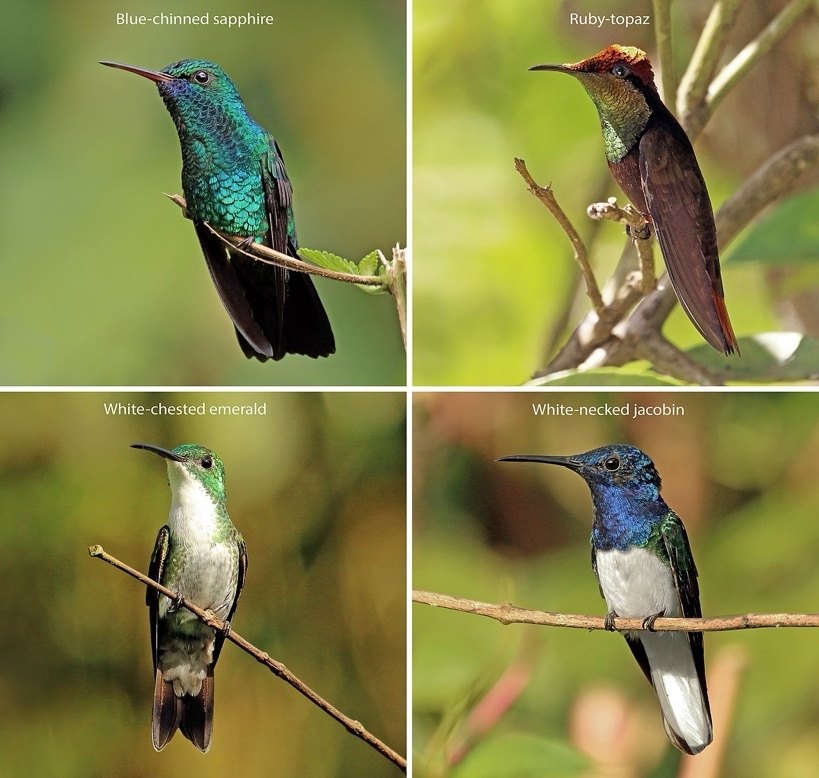
In the book ‘The Golden Compass’, each one of the characters will have a daemon. If I had a daemon, it would be a busy and active animal, with a lot of energy and a complicated ‘inside’. It would probably be a hummingbird, a meerkat, or a cat. That would be because of the active movements of these animals, their agile bodies, and very interesting, occupied minds. I am very passionate with things and extremely helpful to others, but I often think too much, and my thoughts, and the place I live in are messy. My personality changes a lot, I can be extremely extroverted to very shy, very aggressive to plenty calm. I am generally easy-going but I do like people to follow what I say, which makes my personality complicated and a little contradictory towards each side.
The Supplement 2, p. 3
The hummingbird is an extremely busy animal that moves restlessly, which is similar to me. The meerkat is often on watch for others, and they are thoughtful or responsible towards one another, and are observant creatures which sort of clashes with my personality. For the cat, they are very interesting but hard-to-deal-with animals, being very quiet, timid and shy but very aggressive and irritable at other times, so being complicated and changing as I am, I am similar to them in ways.
However, I do know that daemons tend to change, and there could be other animals that are more like me than the others stated, but overall, the daemons I have identified seem quite appropriate.
In the novel ‘The Golden Compass’, Lyra’s daemon is not settled because she is still young. Even so, her daemon always seems to have some of her characteristics – headstrong, wilful and free-spirited. This is not surprising when you consider her upbringing and parentage.
Lyra, has two parents that never show up to ‘claim’ her during her 11 years of growing up in Jordan College, Oxford. She believes she is an orphan whose parents were killed in an airship accident.
Lord Asriel, who is her father but publicly known as her uncle, is a fierce man – an explorer of the far north and an intense intellectual. Lyra’s mother, the ambitious Mrs Coulter, is part of the General Oblation Board and works for the Magisterium. She is also part of the so-called ‘Gobblers’, an organisation that kidnaps children for experimental purposes, and is generally shown to be a sly and nasty woman.
Mrs Coulter was married to Edward Coulter, though she and Lord Asriel met and fell in love. Mrs Coulter then gave birth to Lyra and left her with the Gyptians. When Mr Coulter discovered what had happened, he angrily charged to Lord Asriel’s property, threatening to kill both him and baby Lyra. Asriel fought Mr Coulter and killed him.
If I were the judge, whose duty was to adjudicate Asriel’s case, I believe that the confiscating of the Lord’s property and leaving aside Mrs Coulter’s involvement is neither suitable nor appropriate. Mrs Coulter should bear some responsibility for the financial losses and also receive some kind of punishment for the consequences of falling in love with Asriel and giving birth to a child while she was still married to someone else.
However, I do think it was correct for Lord Asriel to protect his child even though I don’t think it was necessary to kill someone while he was doing it. As for the confiscation of his property, I believe a portion of it should be taken from him though seizing all of it is pointless. Asriel won’t succeed later or be able to give the same contributions he has now, and there’s nothing one can do about death, regardless of how much money is paid back or taken from him.
Furthermore, the child is innocent, so she should be sent to a proper place by the government, with her parents’ approval. Sending her to an old college with old men looking after her can do nothing to help her.
The logic here is that by not being loyal to one’s husband, Mrs Coulter also deserves a degree of punishment. Both she and Lord Asriel need to be financially punished by being fined a significant amount of money. In a sense, regarding Mr Coulter’s intrusion onto his property, Lord Asriel has done little wrong: he was just protecting his family. The dead man had already received punishment by being killed so he came out of it worse than anyone.
From this tangle, you can see something of how Lyra’s wayward, often unruly character was formed, which is reflected in her daemon.
A response to the difficult question of Lyra’s parentage and wrongdoing
Lyra's family situation is very complicated. Her Mom is Mrs. Coulter and her Dad is Lord Asriel. However, her Mom is not married to Lord Asriel. She is married to a politician named Edward Coulter. Then, she meets Lord Asriel and falls in love with him. Soon, they give birth to a kid named Lyra.
But Mr. Coulter's friend told him about this and then Mr. Coulter was very, very angry. He tried to kill Lyra but Lord Asriel killed him to protect his daughter. The law says that a man can take revenge on a man who messes with his wife; but the law also says that it is not wrong to protect your child if someone wants to kill them. So, neither Lord Asriel nor Edward Coulter was in the right. As Edward Coulter used his death to repay the wrong things he did, the court only punished Lord Asriel by taking away all his property and money.
However, this is also not strictly fair because Mrs. Coulter is also wrong. The law did not punish her and she still held her position of working for the board, and living in her big, beautiful apartment.
The fairest way of treating this situation would be to take away Lord Asriel's money and property and to punish Mrs. Coulter by also taking away some of her things and giving her a period of suspension.
People learn to do wrong in different ways, like through experience, influence from others, or personal choices. In ‘The Golden Compass’, Philip Pullman suggests that wrongdoing is linked to growing up. He shows this through Dust, which is attracted to adults more than children. This suggests that as people get older, they become more capable of doing bad things. In the story, adults often do more serious wrongs than children. Mrs. Coulter is clever and powerful but also cruel, as she helps with separating children from their daemons. The Master of Jordan College also does something wrong by trying to poison Asriel, though he believes it is for a good reason. Meanwhile, children like Lyra and Roger do break rules, but they do not act out of greed or cruelty. This suggests that learning to do wrong happens over time as people grow up and face difficult choices. As people grow from children to teenagers, they start to explore right and wrong. In the television series ‘Adolescence’, Jamie is both a young boy and a criminal, which shows how people can be innocent but still do bad things. This makes us wonder whether people do wrong because of their surroundings or if it is something natural. Thinking about personal experiences, many people can remember a time when they did something they knew was wrong, like lying to a friend or breaking a rule. These moments often come with feelings of guilt and help people learn about right and wrong. Society also decides what is considered bad through laws and rules. Some things, like hurting others, are always wrong, while other actions depend on the situation. People learn about morality from feelings like guilt and from rules set by parents, teachers, and society. In the end, learning to do wrong is part of growing up. But what matters is how people recognize their mistakes and try to make better choices in the future. Eva, Grade 6
Four pieces on the significance of the Fall in ‘The Amber Spyglass’
The Significance of ‘The Fall’ in ‘The Amber Spyglass’
I think ‘The Fall’ in the ‘His Dark Materials’ trilogy is significant for adding more dramatic and meaningful plot-lines to the whole book, in order to attract readers. But it also connects to a sort of deeper thinking and presents ideas that I think are hard for me to explain in my own mind.
Some of my thinking is that "the fall of humankind" is about truth and knowledge. I think that the gods want to keep humans under control, which can also connect to the Magisterium (which wishes to control everything, including thought and beliefs), and when the most primitive humans, in this case Adam and Eve, violate this rule by eating fruit from the tree of wisdom or knowledge, of course God can say, ‘You are sinful and have sinned and therefore need to be punished’. Therefore, humanity needs to atone for its crime, which also makes me feel to an extent that God is deliberately putting temptation in the way of humans, intentionally to put Adam and Eve in a ‘sinner’ place.
In ‘His Dark Materials’, I think Lyra's place is really ‘Eve’. In my thinking about her, she wouldn’t choose to eat the fruit by accepting temptation like the true Eve, but would start thinking if by doing this she would affect anything. In my conclusion, it’s a process of human awareness, a kind of awakening, making fuller use of your mind.
Adam and Eve could also be innocent because they didn't even know that eating the fruit might be a crime, which is one reason I believe that it’s really about God guiding and pushing humans towards temptation, almost branding primitive humans as sinners.
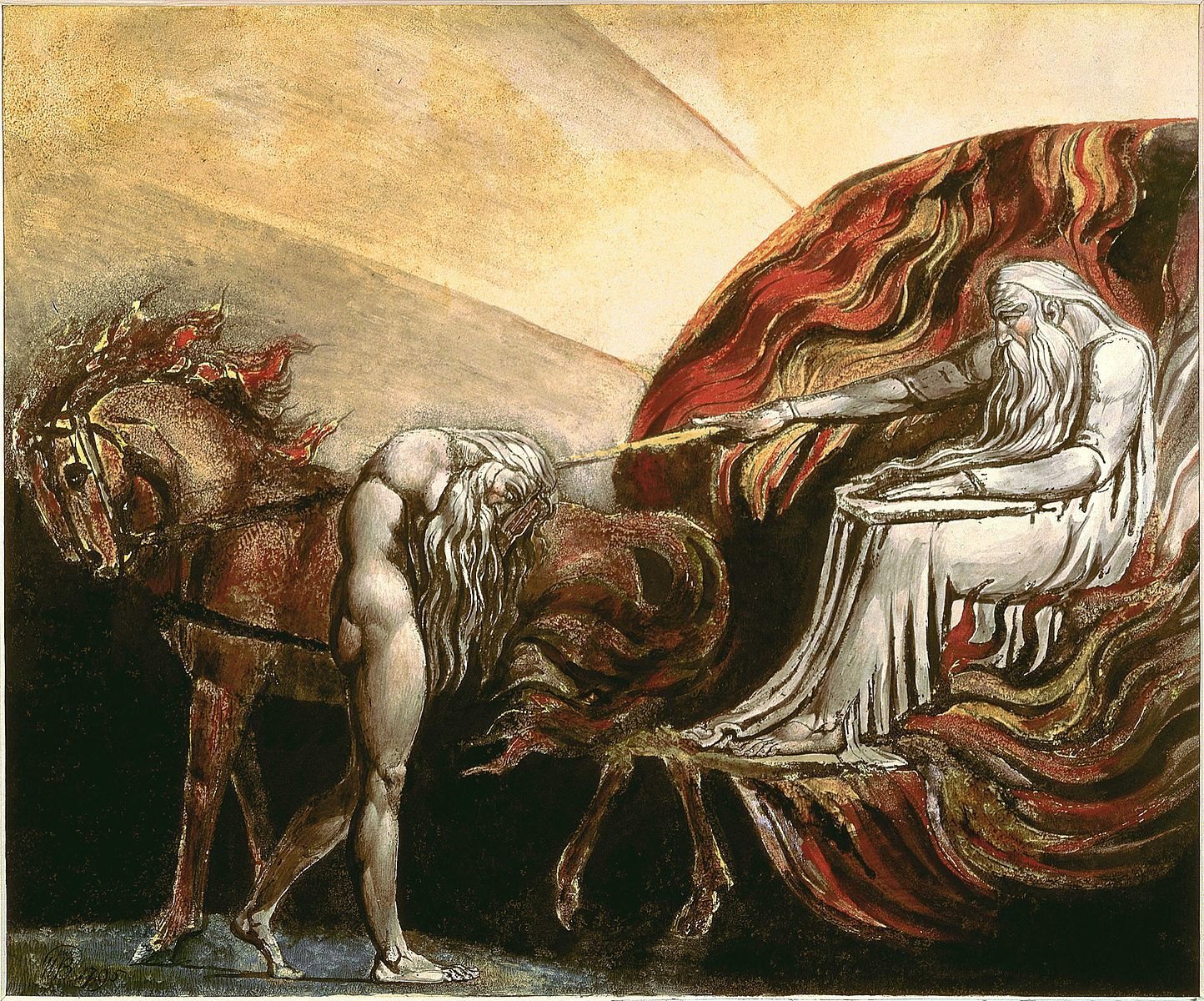
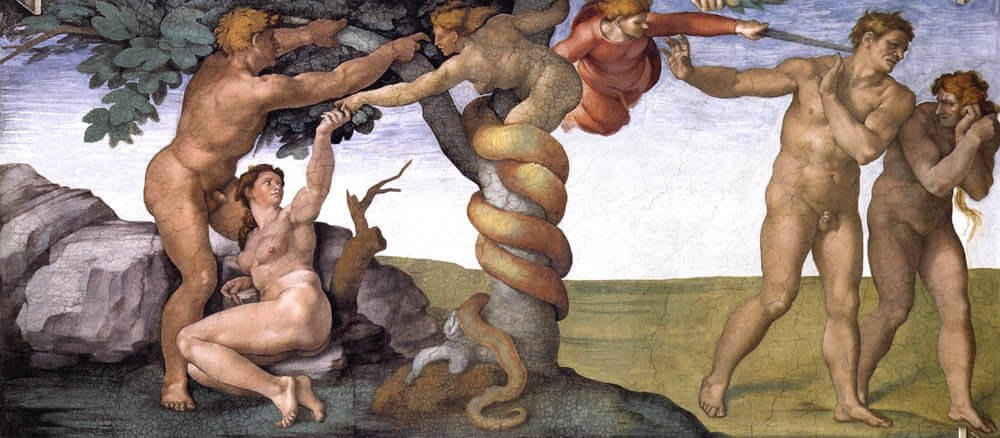
In William Blake's painting ‘God Judging Adam’, the tone is closer to warm colours, which makes us feel God’s anger. Closer to Adam, the colours are darker and more singular, highlighting Adam's sin.
If Asriel wants to fight with the Magisterium, he must take something that the Magisterium can't give, which is freedom. A hard question might be, is true freedom really desirable? If Asriel wins and gives absolute freedom to people, there must surely be somebody who uses this freedom to do evil things. But if Asriel gives freedom with rules, then people will think that Asriel is the ‘next Magisterium’, and his whole plan would be broken.
So, in this sinful world, it's impossible to have total freedom, only freedom with different levels of rules. But people also don't want to be totally controlled – they need freedom, even though total freedom would unbalance the world, even collapse it. Therefore, there is no such thing as the existence of total control or total freedom in this world. Asriel, along with Lyra and Will, need to fight the Magisterium by ‘killing the old and making the new’, making new rules from the old style of government.
Serena, Grade 6
God Judging Adam (William Blake)
The Significance and Use of The Fall in Philip Pullman’s ‘His Dark Materials’ Trilogy
In Philip Pullman’s ‘His Dark Materials’ trilogy, the idea of “the fall” is very important. To understand this, we first need to look at what Christians mean by "original sin" and how it connects to shame, innocence, and purity. According to Christian beliefs, when Adam and Eve ate from the Tree of Knowledge in the Garden of Eden, they fell from grace. This means they lost their pure, innocent state because they disobeyed God. From that moment on, humans were born with a sense of guilt for this mistake. Many paintings show Adam and Eve covering themselves after eating the fruit, which shows their new feeling of shame.
The Supplement 2, p. 11
However, in Pullman’s books, the fall is not seen as something bad or shameful. Instead, it represents growing up, learning about life, and becoming free thinkers. Asriel, one of the main characters, says that having full knowledge and being able to think freely are important for independence. He believes people should decide for themselves what to believe instead of following rules set by others just because those people have power.
The Magisterium, which acts like a church in the story, wants to keep everyone under control. They do this by telling people what to think, how to act, and even what to believe. For example, they try to stop Lyra from discovering her destiny because they fear she will bring change. In contrast, Lyra and Will fight against the Magisterium’s control. They want to protect freedom and help people grow into who they truly are. When Lyra reads the alethiometer, she learns things the Magisterium doesn’t want anyone to know. This shows how knowledge can be powerful and dangerous to those trying to control others.
I think people should be allowed to make their own choices and explore ideas without fear. Rules are okay sometimes, but only if they help everyone live peacefully together. Forcing people to believe certain things or punishing them for asking questions isn’t fair. A good society lets its members learn, ask questions, and express themselves openly.
Imagine a school where teachers tell students exactly what to think all the time. Would you enjoy studying there? Probably not! I would feel it was boring and unfair. But if the teacher encourages curiosity and helps students find answers themselves, then learning becomes exciting. The same goes for managing a community, a city, or even a whole country. Leaders should listen to different voices and respect each person’s right to choose.
In conclusion, Philip Pullman’s ‘His Dark Materials’ Trilogy lets me understand that growing up and gaining knowledge is not something to be afraid of. We shouldn’t stay stuck in an innocent state forever; instead, we should embrace the challenges of adulthood and become wiser. Societies work best when people are trusted to think for themselves and leaders support growth rather than controlling minds. Like Lyra and Will, we must stand up for freedom and truth whenever someone tries to take them away.
John, Grade 7
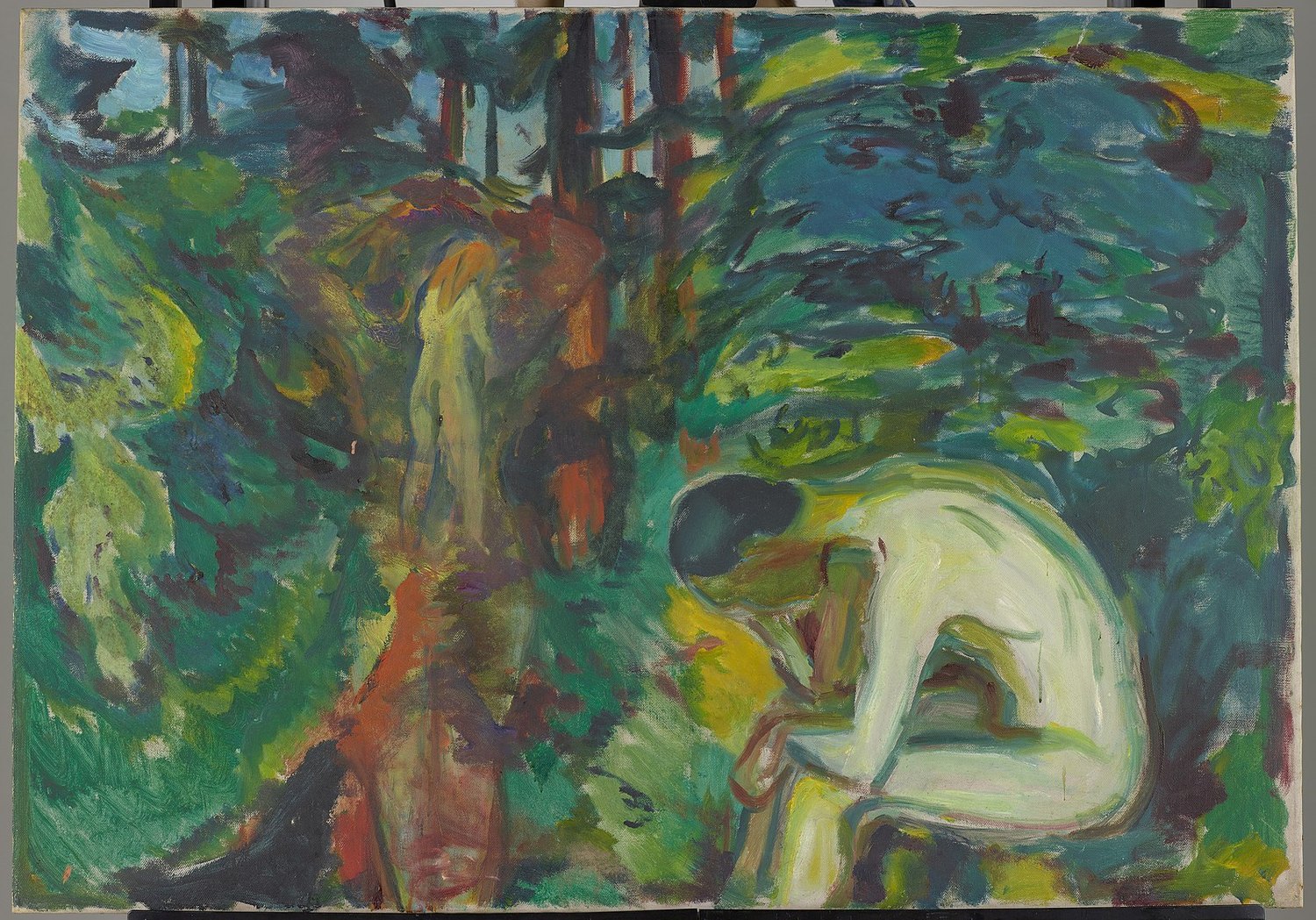
Original sin is a central principle in the Bible that explains the introduction of sin into the human experience through Adam and Eve’s disobedience. For example, in the painting ‘After the Fall’, we can clearly see that Adam and Eve had broken up because they’ve been expelled from Eden. From my perspective, the fault is Adam’s, because when Adam saw Eve eating the apple, he didn’t stop her at once but is followed her example and ate the forbidden fruit. Lyra as Eve, Will as Adam; we can see that Will follows a bad decision made by Eve-Lyra.
The word ‘shamefulness’ means disgraceful or dishonourable. We can list another example, the painting describing the serpent persuading Eve to eat the apple and exhibit their disgrace and shame to people. So, they cover their body parts with leaves after finishing the apple.
The Pullman novels give us a lot of examples showing that original sin and shamefulness are not wrong. The Magisterium thinks that everybody should listen to them and not have their own thinking, just like God thinks that everyone should listen to Him. And Lord Asriel thinks that everyone makes mistakes but that, nevertheless, everyone should have their own thoughts and own mind to decides things, not just listen to and obey orders. The Magisterium keeps control over people and limits their thinking by using threats and violence, sometimes even killing people.
I think that societies should be not be managed in the way the Magisterium dictate but also not in the way Lord Asriel thinks. We can’t give people no chance to think but, equally, we can’t give them too much space to think, which would cause chaos. The good side of the Magisterium is that they can control one certain topic, not allowing the discussion to develop into an argument. The good in Lord Asriel is that everyone has a chance to be part of a discussion so that people will slowly build upon trust with each other.
The middle ground can be achieved by having restricted freedom and limited control expressed as ‘the law’. Therefore, people can’t have as much as they want but they will still have a chance to achieve something.
Sometimes the law is wrong and people will feel aggrieved and believe the law is unjust. I have a personal example of this: in a match I played in, the game was in the last minute and the referee gave an unfair judgement that caused us to lose the game. This made our coach mad, too. So, the law is not always reliable but it is better than having no law at all.
We can bridge these two systems by blending different perspectives in from different people’s views. Some people think a thing might be wrong, but others believe that this is not wrong. They must find a way to agree and see something from another point of view, one that is acceptable to both of them.
Michael, Grade 5
After the Fall (Edvard Munch)
The original sin is recorded in the Bible, where Adam and Eve ate the apple from the tree of knowledge under the lure of the serpent, which is against the Gods’ own rule of allowing them to do whatever they want except eating the apples from the tree of knowledge. Therefore, after they committed this apparently terrible crime, they felt shameful and remorseful about what they had done, causing them to cover up their body parts, which is now known as clothing. Afterwards, the Gods try but fail to punish Adam and Eve, which is shown in many paintings, often with God’s radiant light and heat pointing accusingly at them.
The Supplement 2, p. 15
In the book of the series of ‘His Dark Materials’, Phillip Pullman smartly describes and indicates that, like the complex story in the Bible, doing the wrong thing may in fact be right. The magisterium views Lyra to be Eve, while as they want to gain control over the people, the magisterium wants to kill Lyra. Meanwhile, in Lord Asriel’s troop, they are rebelling, which is arguably the wrong thing, but is thought to be right by Will and Lyra. This evidence all points out that Phillip Pullman has the awareness of thinking that the action of doing the ‘wrong’ thing in a society with questionable values is actually ‘right’, and puts this valuable idea into the book.
Before I choose whether independence or control is better in our modern society like the magisterium and Lord Asriel’s group, let’s compare the benefits and flaws each have.
On the one hand, a controlled society can be more sustainable and have fewer crime rates and life that is the same every day. This can help the society and community to be much better organized and reduce the fears of getting robbed or killed. However, this society will not be a creative one. Robots and animals all do things repeatedly or follow the rules and instructions from their owner. So, if the society is like this, isn’t it the same as a herd of low IQ animals doing things as they are told? So, everybody needs to have some special skills or hobbies to let them be different from others.
On the other hand, an absolutely independent society will also be a disaster. While the society is lively with people all showing their talents instead of doing all the things on the rules that are given to them, thieves will be more on the run, and that is the drawback of freedom. The meaning of independence is to rely on yourself and show the things you are good at while not being restricted. In some cities of America like San Francisco, people will be robbed and forced to give money. I went to New York for a few times, and the heavy smell of drugs and marijuana wafts in the air with some needles containing illegal liquid on the street. So, if all the people are not restricted, including criminals or terrorists, it will definitely be a chaos, with hundreds dead.
Therefore, both of the extreme options that are suggested are both unrealistic. I recommend to choose a middle group, both gaining manage but allowing people to be independent and individual. Laws can often go wrong, so to achieve this kind of society, the opportunity to speak up or push against the law is required. This can let people not completely follow the rules while having a chance to vote for a fairer law and remaining a quite stable society. Let’s take an example when I am on a trip to the United States. First of all , the US is famous for its independence, and do not have very strict laws. While I am enjoying my beautiful and sunny afternoon spending money in the Quincy market that is organized in my boarding school, I am disturbed by people chanting on the streets of Boston. In a law that was made but unappealing to most of the people, they start a protest, holding bands and banners and marching straight to the White House, which is strictly forbidden in China. This has helped people reach their best will while still maintaining laws. Although the United States’ freedom of getting the right to have guns does not work so well like I mentioned above, I am still impressed by the opportunity to give citizens the right to protest. This can shorten the gap between the extremes of control and independence while still following the two different sides at the same time.
In conclusion, Philip Pullman made an excellent and exciting book that strongly encourages the importance to be independent and I express my opinion to choose the middle of being controlled or independence for the benefits of both people’s own safety while supporting the creativity of people.
Some initial thoughts about death and the afterlife
Some initial observations about death and the afterlife
The land of the dead is a place only for dead people. It is the place people go after they die. To go there you need your dead to lead you there. The Magisterium doesn’t want Lyra to lead people out of the land of the dead because then they cannot control everyone. One of the ways it exerts control is through the harpies, who constantly remind everyone of their sins and failings. The atmosphere there is gloomy, dismal and hopeless. People in the land of the dead do not have souls, like daemons. In other words, they have had their spirits taken from them.
The Supplement 2, p. 18
Also, the Magisterium relies on the fear of hell and the promise of salvation to maintain control over the population. Lyra’s actions, which would free souls from the afterlife, would negate that fear and destabilize the Church’s power. When the dead escape from the afterlife, they wouldn’t get their daemons back, and they will not have souls. They would still ‘look’ dead. In addition, the harpies make them feel guilty. Lyra tells the dead stories of what they can do and what it feels like to be alive, having freedom and having feelings. She gives hope and confidence and gives them the belief that they can re -enter the world, rather than being paralysed by guilt in the land of the dead. Guilt is a form of shame that causes fear and makes people scared to act. This is what weighs on the dead people’s minds.
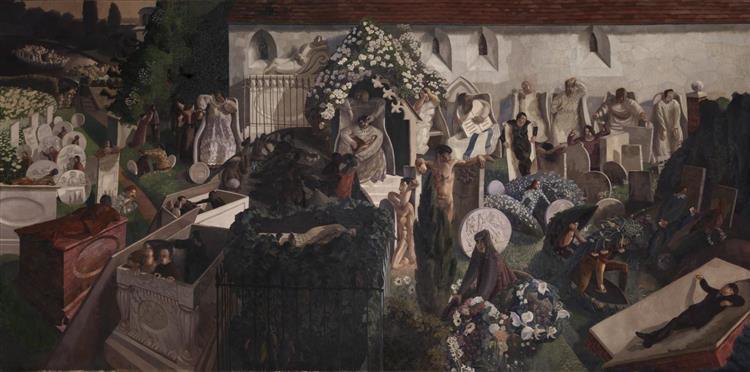
In Stanley Spencer’s painting, ‘The Resurrection’, dead souls are shown climbing out of their coffins and mingling with the living in the real world. This suggests that although the living may not be aware of the dead, they are nevertheless all around us and indeed are part of the living world. This is the similar to what is happening in ‘The Amber Spyglass’.
‘The Resurrection’ (Stanley Spencer) The belief in the afterlife may make you more positive, because you think that even once you have died, you will still ‘live’, but only in another way. I think the after-life is the “life” after you die, and different people have different beliefs in what will happen after their lives. Some think that people will go to a place called heaven; some in China think that people will go and drink a kind of soup and will forget what happened in life and will live again in a new body. The belief in afterlife is so important to many people because they want to live for a long time and they also care about how can they exist after they die.
The Supplement 2, p. 19
In the film of ‘A Matter of Life and Death’, when you die, you will go to a place kind of like heaven. Everyone there has a life folder, which is full of personal details including the date of each individual’s death. When you die, you will be taken to heaven. However, in the film the main character has forgotten to be counted as he died because the angel sent to collect him as he jumped from his aircraft missed him, so he didn’t go to heaven and still lived in the world. When the staff in heaven found that they missed him, they came and tried to take him away. Again, there is a close relationship between life and death in the film. An angel comes down to earth to try and persuade the airman to go with him to heaven. The conversation they have shows that there is a close connection, an overlap, between the living and the dead.
At the same time, there are also beliefs that when you die, you will go to a place only for the dead, just like in ‘The Amber Spyglass, where you will go on a boat and across a river to the land of the dead. In the drawing ‘Landscape with Charon Crossing the Styx’, one side is where we live, and one side is the land of the dead. There is a river between them, separating the two places. The world we live was shown like a disaster, where the mountain is on fire, and it is very chaotic. However, on the side of the land of the dead, people lived happily and relaxed. In conclusion, in my opinion, I think that nothing will happen after life – when you're dead, you’re dead. You won’t have any consciousness anymore. I can’t think of anything that might happen after death and the various ideas described above seem too fantastic to be real.
The concept of original sin, which was established by Christianity, approximately suggests that Adam and Eve committed the first negative action in God’s new world. At first, Adam and Eve, who were the first people in the history of the world, were told by God that it was forbidden to eat fruit from the Tree of Knowledge. But then a serpent appeared, who tempted them and they ate the fruit – this was known as ‘the Fall’, when humankind became corrupted or developed the idea of freedom instead of just following rules. In one artwork by Edvard Munch, Adam and Eve’s emotions are painted after they had committed the world’s first sin. We can observe the furious, regretful emotions they have, reinforcing the significance of this original sin.
According to Pullman’s novels, the original sin isn’t a shameful event that people should regret – actually, it was the beginning of independent logic and free-thinking. This developed further into the consciousness of freedom and uniqueness, examples of which are the battles against the Magisterium and the attitude of Lord Asriel.
In the first book, ‘The Golden Compass’, Pullman introduced a concept called ‘Dust’, which was later defined as free thought by the Magisterium. Through the many evil things they have done, by which the Magisterium tried to prevent anyone in the world thinking for themselves, Asriel tried to expose their lies. The first step of the rebellion is when Asriel rejects the Magisterium’s opposition to people having the ability to get their own freedom. Lyra’s role is to become the new Eve, where she doesn’t do an ything that could be called ‘bad’. Her temptation with Will is part of the journey to restore Dust. Will, who is a kind of Adam figure, helped Lyra to take the journey.
Regarding the concept of ‘restrictions versus freedom’, I am most sympathetic to freedom, because as long as people have freedom, their creativity will significantly increase. Also, there will be a rapid development of technology, enabling every type of person in society, students and adults, can choose the thing they really like and would be dedicated to in order to achieve an objective or ambition instead of accomplishing nothing.
Still, there will always be pros and cons for each type of society, because for societies with more restrictions, creativity will decrease so that a minority group of people will form an elite. On the other side, in a society full of creativity, people will find the things they really admire, and elites from all different subjects could be established, and their skills will be higher than the other society.
If there is a middle ground, I think during the learning period, schools should find out what students actually love to do, but not just do something because they are told to do it or forced into doing it. Laws are restrictions for people so that they won’t harm society and thoughtlessly create public problems. They work because of the severe punishments given to certain levels of crime. So, if you committed a more severe crime, the level of punishment would be more inhuman and brutal. This is how laws work and prevent criminality. Another aspect of enforcing laws is to protect victims, with the goal of treating every human equally. Of course, the law can sometimes be wrong, because the world is never really equal, but laws need to be continually upheld to make people’s lives easier and more stable.
What happens when Lyra and Will go to the Land of the Dead
I’m going to say what happens when Will and Lyra go to the Land of Death in ‘The Amber Spyglass’. When they go there, Lyra is separated from her dæmon, Pan, because only dead people or people who have lost their souls can travel across the river dividing the worlf of the living from the world of the dead. Lyra’s heart hurts because she has to leave her daemon so far away, and she cannot control the pain. Even Will, who does not have a daemon, feels a kind of pain or loss.
After some time, Lyra feels a little better. She and Will arrive in the Land of the Dead, where Roger is, and she finds lots of other human-type ghosts, who she decides to take with her out of the gloomy underworld. Lyra know from the speech of the dead that there are some monsters controlling the region – they are known as ‘harpies’ and constantly remind the dead of their sins, causing constant guilt.
Lyra finds Roger, who is also, now, a ghost. She discovers that Roger’s personality has changed. He has become more heartless and is easier to make angry. Then Lyra and Will confront the harpies, the ones who are controlling the ghosts. The harpies bring Lyra and Will into the despair of the dead world, reminding Lyra how jealous she is and telling Will he was selfish to leave his mom alone. In other words, they begin to feel like the dead souls in the Land of the Dead. When Lyra asks why the ghosts don’t leave the desperate place, they answer that the harpies are controlling them. They can’t leave the land because the harpies have caused their souls to disappear. They are full of guilt and have no hope, which means they have no energy, confidence or expectations. This means that they are have no spirit – they see no existence beyond the one in the Land of the Dead, where they are condemned to wander, aimlessly and without hope, weighed down by their despair.
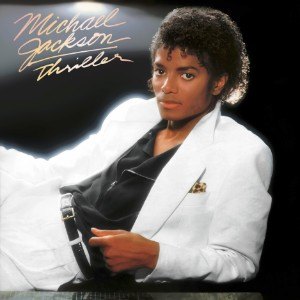
‘Thriller’: an album of pop music by Michael Jackson
‘Thriller’, the sixth studio album by The King of Pop himself, Michael Jackson, was released on November 30th, 1982. It changed the course of music history.
The early 1980s saw the rise of music videos as a storytelling medium though the dominance of the radio industry and the emergence of MTV - but ‘Thriller’ was truly revolutionary, blurring the lines between music, storytelling, and visual cinematics.
Teaming up with legendary producer Quincy Jones, whom he worked with on his first album, ‘Off the Wall’, Michael wanted this album to only contain hit songs. When asked about it, he said, ‘Why can't every song be so great that people would want to buy it if you could release it as a single? ... That was my purpose for the next album.’ (smooth radio.com)
Michael was right and he did just that.
The Supplement 2, p. 25
Jackson pushed musical boundaries, blending elements of pop, rock, R&B, and funk into an album that not only resonated with audiences worldwide but also addressed universal themes of love and violence.
Its unique style, electrifying music videos, and genre-defying songs helped Thriller become the best-selling album of all time, with over 70 million copies sold worldwide. All this helped MJ nab an eye-watering eight awards at the 1984 Grammys.
I am going to analyze three of the biggest hit songs from the album and dissect those elements that contributed to its unprecedented success and the lasting legacy of the record.
This is Michael Jackson’s ‘Thriller’: a landmark in music history and a testament to an artist who not only embraced innovation but also shaped the very fabric of pop culture.
Oddly, the first single from ‘Thriller’ was not the song that propelled the album to iconic status. It was a duet with ex-Beatle Paul McCartney, called ‘The Girl is Mine’.
It was pleasant enough and seemed to have the ingredients to develop the impression made by Jackson’s previous album, the soulful ‘Off the Wall.’ It was also a song endorsed by a global superstar and drew on the type of sound that had made Jackson a popular, identifiable, and even respected performer who was gradually making his way from child protégé to superstar in his own right. However, ‘The Girl is Mine’ was not the right song to transform his career.
But then, the following March, with the release of ‘Billie Jean’, Jackson’s life and career were permanently changed.
‘Billie Jean’ was a song that repositioned Jackson as a young man confronting adult themes of fame, sex and being taken advantage of by a fan – Billie Jean – who claimed that the pop star in the song was the father of her child. The song's groove, driven by its bassline and drumbeat, drew from funk and disco, while the pop melody made it accessible and catchy.
‘Billie Jean is not my lover, she’s just a girl who claims that I am the one. But the kid is not my son,’ sang Jackson.
This lyric encapsulates the central theme of the song — the tension between truth and rumour. The story revolves around a woman, Billie Jean, who falsely claims Jackson is the father of her child. Here, Jackson confronts the challenges of maintaining his reputation while battling false accusations. Billie Jean is not a real person, and Jackson said that Billie was rather inspired by fans in his Jackson five years who would accuse his older brothers of false paternity claims. (rolling stone.com) The constant repetition of this line throughout the song emphasizes the psychological toll such rumours take and the difficulty of navigating through them as a celebrity.
The song contains the line, "For forty days and for forty nights, the law was on her side".
This lyric invokes Biblical imagery, suggesting endurance, much like the Biblical story of Jesus resisting temptation from the devil for forty days and forty nights in the desert. It highlights the prolonged nature of the false claim against Jackson and his struggle to clear his name. The use of ‘forty days’ underscores the duration of the emotional and reputational battle he faced. Like a Christ figure, Jackson is innocent and resists temptations standing firm in his truth despite external accusations and false narratives.
The song also took advantage of MTV and the recent framing of pop culture with visual, videodriven expression. MJ debuted his version of the moonwalk with the iconic white glove and suitcase. The moonwalk was a moment that instantly became a cultural phenomenon and solidified his status as a global superstar. His effortless precision, charisma, and innovative choreography set a new standard for live performances and highlighted his unique ability to captivate audiences worldwide.
‘Billie Jean’ was a song and a video that repositioned Jackson as an adult in a difficult world. It was a huge, extraordinary success.
In the album, Jackson seems to express fear about a number of things – gold diggers (‘Billie Jean’), the supernatural (‘Thriller’), and violence – which was the subject of his next single, ‘Beat It’. In other words, this was a pop star alert to the negative, challenging aspects of life.
Suddenly, Jackson was doing more than simply recycling soulful tracks about love and romance.
‘So beat it, but you wanna be bad Just beat it (beat it), beat it (beat it)’, he sings.
The lyrics in the song emphasize stepping away from conflict, with lines like ‘You better run, you better do what you can’ and ‘Don't wanna see no blood, don't be a macho man,’ urging listeners to step away from violence over proving toughness. MJ acknowledges that it is hard to put your ego aside and succumb to societal pressures to engage in conflict, but he makes it clear that true strength lies in making smart, non-violent choices to ensure your safety.
The lyric ‘They'll kick you, then they'll beat you. Then they'll tell you it's fair’ highlights the unfair cycles of violence and oppression and the dangers of engaging in fighting. Again, Michael encourages his listeners to rise above these challenges and to ‘beat it’ or to run away and leave it behind. By addressing the universal struggle of confrontation and the pressures of societal expectations, Jackson uses the song to promote self-awareness and show his stance on peace and avoiding violence.
The song ends with the guitar solo and about thirty more seconds of lyrics. Eddie Van Halen’s electrifying guitar solo, became one of the song’s most iconic elements, bringing rock authenticity to a pop track and broadening its appeal across genres. The combination of Van Halen’s raw energy from rock and Jackson’s clean yet gritty natured voice, was ground breaking and unlike anything at the time. It also broadened the singer’s appeal and introduced him to a new kind of market.
As Island De Jam LA Reid put it, ‘Today we do things called ‘mash-ups,’ right?’ he says. ‘Take Linkin Park and Jay-Z and put it together, and it’s certainly unique, but it’s not unusual. But at that time, Eddie Van Halen was at the top of his game and fit right in with ‘Beat It.’ It didn’t feel like a guitar solo over some R&B track. It was very organic.’ (rolling stone.com)
The music video featured 80 real gangsters on two sides seemingly fighting, in a synchronized and almost chaotic fashion. Jackson’s appearance and intervention calms the conflict, and the two sides dance together. Once again, the unique and dramatic dance highlights the central theme of conflict resolution and Jackson’s commitment to peace.
The 6th track on the album, ‘Thriller’, the title track, goes into terror and suspense mode with vivid imagery and the iconic music video. Jackson puts the listener in a horror movie and blurs the lines between fantasy and reality.
The lyric ‘It’s close to midnight, and something evil’s lurking in the dark’ sets the tone, pulls you in to an eerie world where danger feels real. The opening verse sets the suspense, Jackson’s voice filled with fear and curiosity. The song is about humanity’s fascination with fear, setting up a fun yet creepy exploration of the supernatural.
The song is about all kinds of fear, even fear itself. Who in the world has not felt fear? Jackson was instantly talking to everyone.
‘You start to freeze as horror looks you right between the eyes / You’re paralyzed ’ is the paralyzing grip of fear. Here Jackson is not only describing the feeling of dread but playing into the horror movie tropes where the protagonist is trapped, and vulnerable to the monster. This personification of ‘horror’ as a living thing that can ‘look you right between the eyes’ adds to the dramatic and suspenseful tone.
However, it is the choreography of the ‘Thriller’ music video that makes it so iconic. The zombie dance sequence is stiff, with haunting movement filled of bursts of synchronized energy, mimicking the common impression of zombie behaviour. Directed by Michael Peters and Jackson, the dance is a unique blend of fear and entertainment, a testament to the song’s playful take on the horror theme. The sequence with Jackson in his red leather jacket has become the ultimate 80s pop culture image.
The video itself, directed by respected filmmaker John Landis, was out of this world. It blurred the lines between music and film, was 13 minutes long, and very cinematic.
The storyline matches the lyrics where Jackson becomes a werewolf and then leads a dance with zombies, a surreal experience. This marriage of music, dance and narrative made music videos an art form in itself. ‘Thriller’ broke new ground, becoming a cultural phenomenon. The song's playful embrace of fear and its integration with ground-breaking choreography and cinematic visuals was the main reason behind its timeless appeal.
As I have shown, Michael Jackson's album ‘Thriller’ remains an iconic testament to his artistry, pushing the boundaries of pop music with its revolutionary blend of genres, innovative music videos, and timeless appeal.
Each of the analyzed songs highlights distinct elements of Jackson's genius. Together, these tracks showcase the diversity and innovation of ‘Thriller’, not just as an album but as a cultural phenomenon that continues to leave a lasting legacy.
A more dangerous world was ready for Michael Jackson and Michael Jackson showed he was now ready for the world. His blend of edgy paranoia with sublime entertainment was both serious and pleasurable. It proved to be a career and era-defining combination.
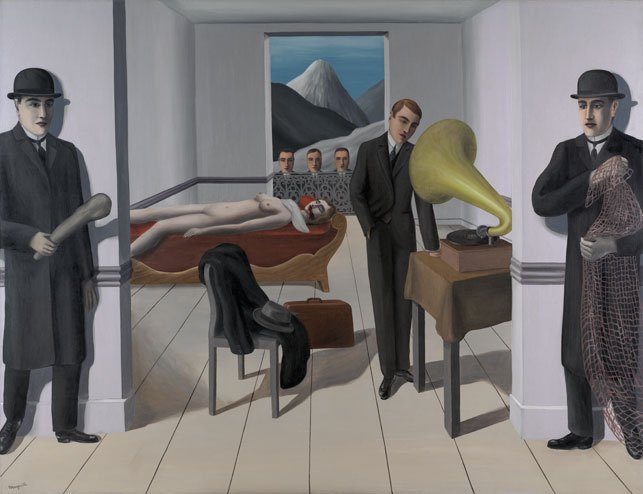
The Menaced Assassin (Rene Magritte) I guess that there are a lot of things in the world that do not seem normal, but the definition of the word ‘unreal’ is different for everyone. I would like to describe a dream I had when I was small. Dreams are believed to be a mirror of somebody’s real life, but sometimes it is hard to explain where and why dreams like this are fiddling around in your brain. This nightmare was about murder: someone broke into our house with a pistol and killed my sister. I was woken up by the noise and managed to kill the murderer with a knife. It sounds like some kind of stupid random dream, but since dreams are believed to mean something deep in your brain, out of curiosity, I looked it up online, and it says that I’m in some kind of argument with my friends.
The Supplement 2, p. 32The Supplement 2, p. 34
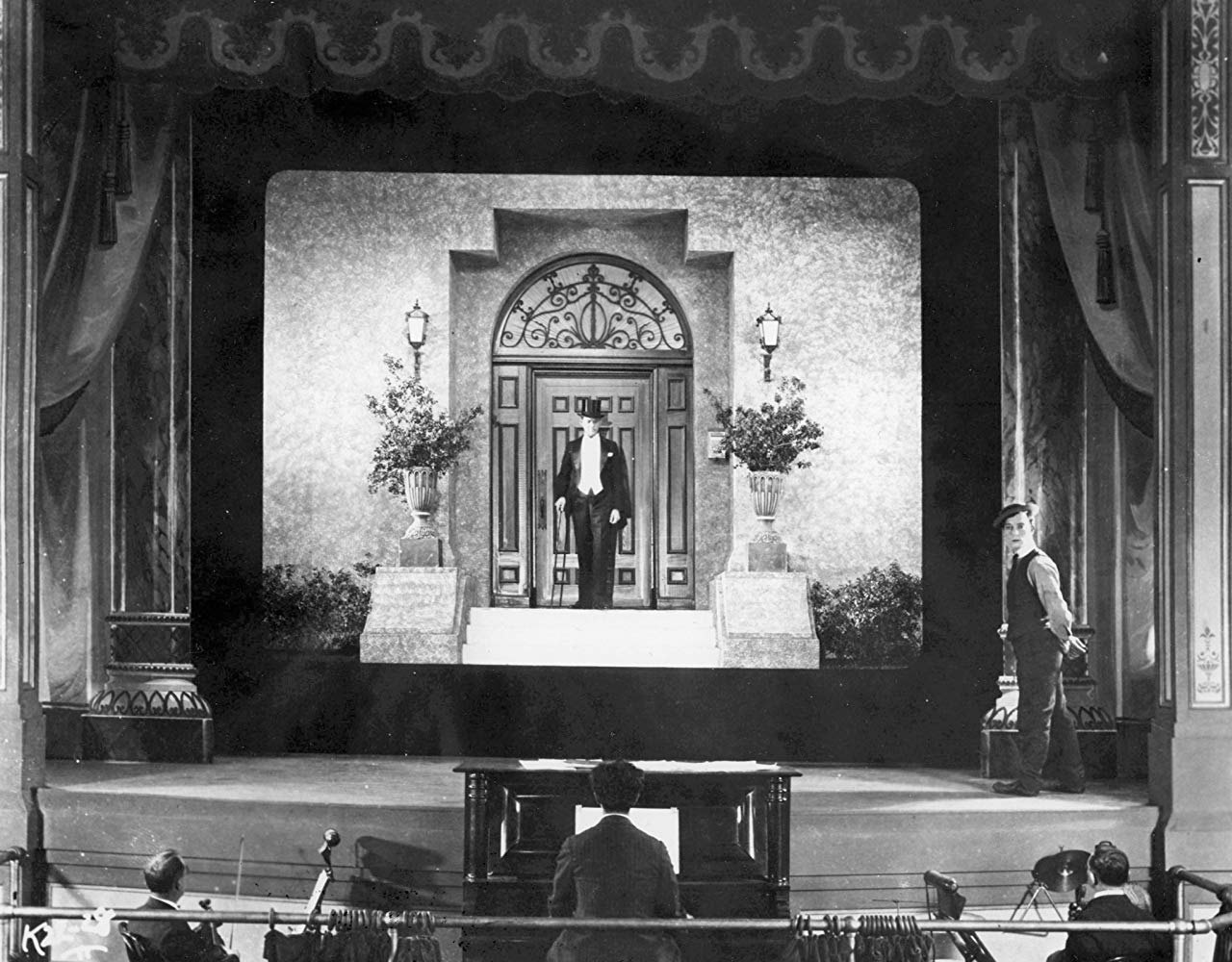
Of course, I didn’t believe it, because my relationships seemed fine to me. So, the question is whether dreams are linked with our personal lives, and I concluded that dreams are not direct reflections of reality but fragmented echoes of our subconscious—pieces of emotions, memories, and fears stitched together in surreal narratives. My childhood nightmare, violent and illogical, lingered in my mind not because it mirrored any tangible conflict but because it tapped into a primal fear of loss and powerlessness. The online interpretation linking it to an argument with friends felt shallow, yet it made me wonder: Could the dream symbolize something less literal? Perhaps the “murderer” represented an unresolved tension I hadn’t consciously acknowledged, or the act of fighting back mirrored a desire to regain control in a situation where I felt vulnerable. Psychologists have long debated the purpose of dreams. Freud argued they reveal repressed desires, while modern neuroscience suggests they help process emotions and consolidate memories. My experience aligns more with the latter. At the time of the dream, my sister and I were navigating typical sibling rivalry—petty arguments over toys and jealousy over parental attention. Though trivial, these interactions carried emotional weight for a child. The dream’s violence might have amplified those everyday frustrations into a visceral metaphor, my mind grappling with feelings I couldn’t articulate while awake. Adam, Grade 7 Movies Showing Nowhere The following pieces are about a novel called ‘Movies Showing Nowhere’ by Yorick Goldewijk, In the book, 12-year-old Cate receives a mysterious invitation to a long-abandoned cinema and discovers its screen is actually a gateway to the past. This unique cinema allows visitors to revisit past memories, and Cate, who has a history of grief and loneliness, finds herself drawn to the opportunity to meet her deceased mother. The cinema's ability to transport people to their past memories becomes a central theme, exploring how memories shape identity and influence the present. A still from Buster Keaton’s 1924 film, ‘Sherlock Junior’, in which the main character (shown here on the right) falls asleep, dreams and enters a cinema screen The identity and relationship of the characters in the novel ‘Movies Showing Nowhere’ is extremely interesting. The important characters in the book are Cate, Mrs Kano, Tubs, the old lady, Henry, and Cate’s dad.
From all angles, we can see that Cate is actually Mrs Kano. There are many similarities between them, plus lots of other evidence. And we can suppose that the old lady is also Cate – a future version of her. We suspect the old lady is Cate because she has a dog called ‘Henry’ and at the end of the novel, young Cate meets a boy, also called Henry, and they decide to build a time machine together, which might well be the time-transporting cinema.
In addition, Mrs Kano marries someone called Henry, while Cate’s game-playing avatar is called ‘Kano’. This suggests she may well have changed her name or, possibly, that Henry’s surname was ‘Kano’. Mrs Kano is always ‘Mrs Kano’, too, and never ‘Ms Kano’, which emphasises the connection between them.
Furthermore, by the time Cate is an old lady, it is very possible that Henry might have already died. And, so, the old lady buys a dog and calls it ‘Henry’ to remind Cate of her dead husband.
In the story, at one point Cate travelled back to her dad’s childhood, so why can’t Mrs Kano also travel to her own, i.e., Cate’s, childhood? And I think the author added the part where Cornelia called Cate’s dad ‘Harry’ to create a confusion or blurring between Harold, Henry, Henry the dog, Henry the young boy, and Henry the husband. What the book implies that inside ourselves we are many different kinds of people, often at the same time, a mixture of memories and echoes of who we were, who we are, and who we might become.
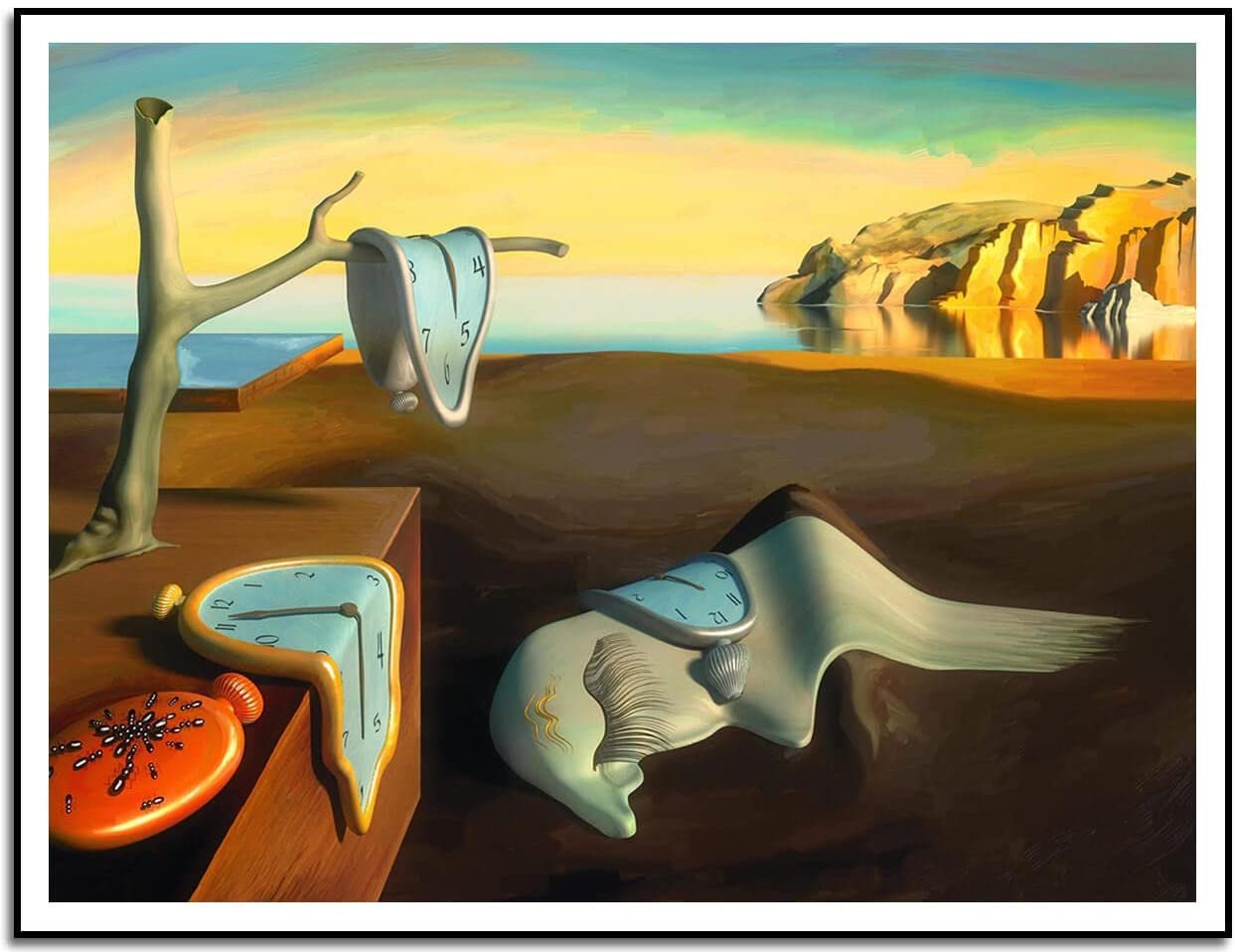
It’s a bit like the painting ‘The Persistence of Memory’ by Salvador Dali. This is a painting which shows illustrates things about time and memory.
First of all, the word ‘persistence’ itself means long-term, things that won’t stop, are continuous and never give up. Let’s put the definition in and it will change to ‘long-term time memory’.
Take a look at the watch in the left-hand corner of the painting. There are ants and small insects all over it and we know from daily life that if something is covered with ants it must either be delicious, previously untouched, very old, or decaying. And we know that a watch is not ‘delicious’ – so, the ants are crawling all over it because is old and represents death.
Now take a look at the two watches or clocks. They are not regular clocks, they are twisted, melted and bent. That might mean time is not equal, linear or that it runs at the same regular speed. Memory is also like this. We feel time as if it runs at different speeds inside our heads, as if the past and present and a feeling for the future all exist at the ‘same’ time.
When we are having happy moments, it always seems that time is so quick. With sad moments, it always seems very slow. And we can put all this together in one sentence: Time is fluid; it could be slow or quick. Memory works in the same way, especially as it turns old and there is more to look back on. Different memories and versions of the past all run together and operate at the same time.
Derrick, Grade 4
The Persistence of Memory (Salvador Dali)
There are a variety of multiple Cates mentioned at the end of the novel. I am sure that Cate must also have been Mrs Kano and the old lady. There are many hints that they are all the same person.
The story also made clear that Mrs Kano had a husband called Henry, who young Cate first meets at the very end of the book. Also, every time she interacts with Cate herself, she was also carving pictures in his mind of another Cate from the past.
As for the old lady that appears in the story, she also has a dog called Henry, and maybe it is so she can remember her now dead husband.
The Supplement 2, p. 37
There is also a scene where a boy called Tom tries to bring back a special dog from the past into the future, which could be there for no reason without her. Possibly, this is Cate’s son, knowing that she has had a miserable life with the dog like Cate’s dad, so he tries to retrieve the dog in order to solve a problem. That could also be the explanation for why these characters appear and then disappear, apparently for no reason. Mrs Kano had explained that a single photograph can’t keep you in the past for too long.
One final thing: I wonder how Cate and Henry could have fallen in love and spent the rest of their lives together, since they were only on vacation when they met. Maybe everything is a kind of dream? The novel constantly suggests that who we are is very uncertain and fluid, and that memories and even reality are like dreams.
Aiden, Grade 4
The Daydreamer
Note: ‘The Daydreamer’ is a book of connected short stories by Ian McEwan. In it, Peter Fortune the actual daydreamer. In the first three stories, the dreams he has are strongly connected to his own life.
In ‘The Dolls’, for example, he dreams that the dolls come to life and at one point he changes places with the Bad Doll. This is because he has mixed feelings about being moved from the room with his sister, Kate. In ‘The Cat’, Peter changes place with William the cat for one day.
And, finally, in ‘Vanishing Cream’, he is fed up with his parents and his sister, and daydreams that he makes them all vanish by smearing cream on them.
All these stories are about daydreaming. The difference between dreams and daydreams is that Peter has a certain amount of control over what happens. So, in ‘Vanishing Cream’ he realises that getting rid of his family and being by himself is not as good as it first sounds. That is when the dream ends. In ‘The Cat’, the dream ends when Peter realises that William is dead. Therefore, there is a connection between his life and what he dreams.
Although daydreaming allows Peter to imagine things which do not exist in ‘real’ life, Peter is still very much part of the dream world he imagines and his real life is never too far away.
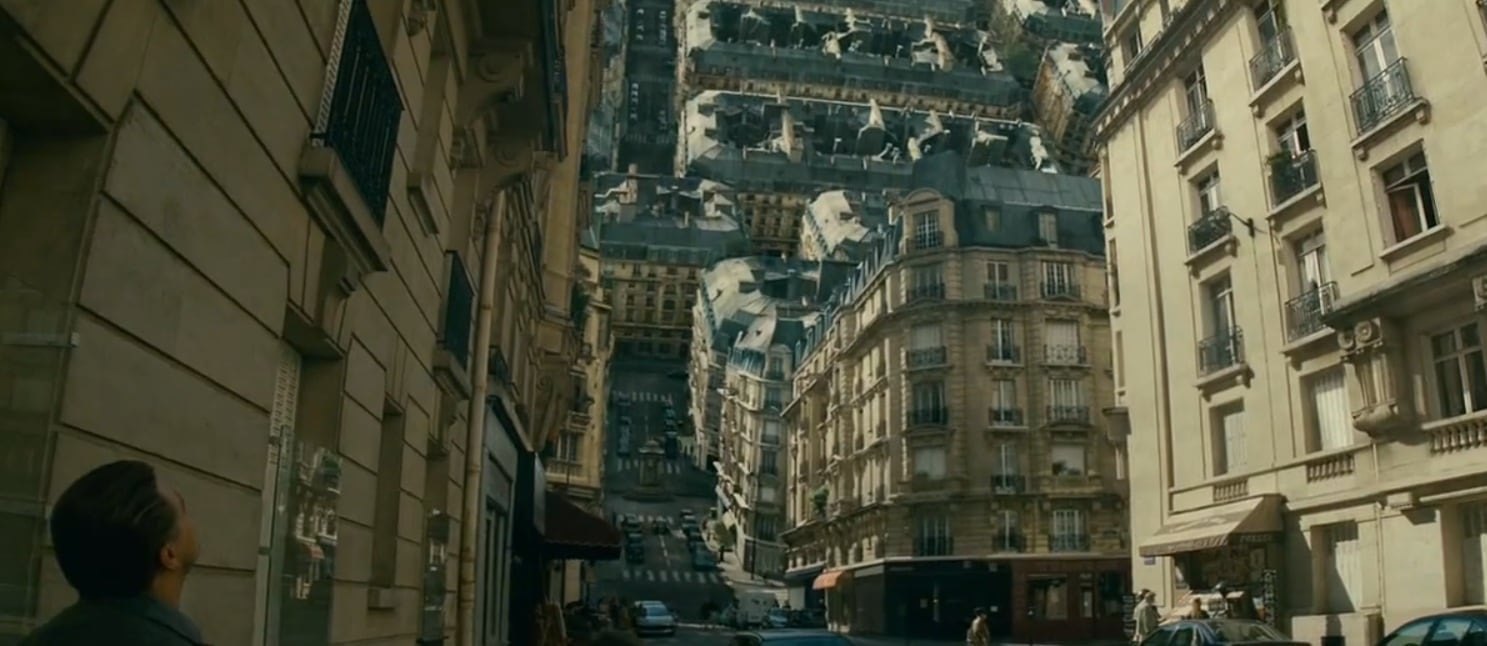
In the film ‘Inception’, the character called Ariadne is asked to create a dream world. You only use ten per cent of your brain when you are conscious, which leaves a lot of room for the imagination. In dreams, therefore, you see things from life but you imagine them differently and with impossible ‘moves’. It means that you have perception and creation at the same time.
In the movie, Ariadne saw the city (Paris) and imagined it a folding city. When she thought that, the city in her dream really did fold in on itself. And when she is about to cross a bridge, the bridge quickly became higher and higher. Then, when she is at the end of the road, she arranges two mirrors and created a bridge in real life.
But creating things in real life can sometimes be bad. In her dream, a group of people intrude on her imagination and a woman with a knife stabs Ariadne. As with Peter in ‘The Daydreamer’, dreams and imagination are fantastic but there is also a dangerous and disturbing side to invention.
Nathan, Grade 4
The film ‘Inception’. Paris folding in on itself.
Memory Movies
In the book ‘Movies Showing Nowhere’, the feel of thew screen is like being shocked be being immersed in icy water. This screen can let people go back to their memories. You need to put a photograph in a black box that shows the exact time you want to return to. Then, you can enter the screen and ‘see’ the memories and experience them.
The Supplement 2, p. 40
A film projector shows many tiny, small delicate moments in time. A film strip is really just lots of still photographs being shown in sequence. A projector shows these pictures in very quick milliseconds, tricking your mind into believing they are joined together. Really, there is a very small gap between each still photograph.
When you go into the memory in the book, at first it feels like you have an icy bath. Also, you must stay inside the memory too long, otherwise there would be time cracks and, after that, what’s beside you – the world of your memory – would turn to nothing. Afterwards, you need to step into the mist to exit the memory.
The first time Cate goes into the screen, she is a ‘time-mate’. She enters with an 18-year-old boy. They entered his memory, which involved going back to look for a dog. However, the boy then takes the dog from the past and brings it back to the present. When Mrs Kano saw him doing this, she quickly returned the dog to the past – because if you change the past, the future would also change.
This is also the way that memory works. We can’t bring old memories to life and we have to be careful not to change what actually happened in our heads. Memory is a creative process and every time we remember something, even the same thing, we remember it slightly differently.
We also saw bits of two movies that showed how memory works – ‘Still Alice’ and ‘The Bourne Identity’. In the first one, Alice has a disease called Alzheimer’s so she is making up her memories even when she has forgotten things. When her daughter asks her a question, she pretends to know the answer even though she realises she doesn’t know. And in the second one, a man called Bourne is found in the sea and has no memory of who he is, even though he can remember how to talk and behave as a normal human being.
All of this shows how memory is not only a creative act but moves around and changes in our head. We can remember and forget things in different ways and that’s why we have to read ‘Movies Showing Nowhere’ as a collection of clues about Cate at different memorised stages in her life.
In real life it is not a shockTo almost not believe such things
Not believing such things is not a shockIn real life
WonderSurprise
In real life is it any wonderThere is almost always not sun but thunder
In real life is it any wonderThere is no magic, no blood-and-thunder
HungerNumber
Is it really any wonderThe love that a stranger might receive.You cast your spell and I went under,I find it so difficult to leave.
But in the main is it any wonder
But as a rule, is it any wonderThere seems to be almost no blood-and-thunder
But in being, is it any wonderThere seems to be almost no blood-and-thunder
But as a rule, is it any surpriseThat clinging to wonder is not too wise
All that going to the ball and wearingThe pretty dress and shoes and then bearingYourself with dignity and in the endBeating your sisters to the boyfriend.But as a rule, is it any wonderThere seems to be almost no blood-and-thunder
All that being told when you were so youngThat being beautiful was not for everyoneAnd somehow being duckling-ugly was okBy magic it would all come right one day.But as a rule, is it any wonderThere seems to be almost no blood-and-thunder.
Our almost-instinct almost true:What will survive of us is magic
It’s almost true that our almost-instinctIs to believe in fairy tales
Jim’s Terrible City: J.G. Ballard, China, and the Shanghai Experience
The English novelist J.G. Ballard was born and grew up in Shanghai. He became famous when ‘Empire of the Sun’, his heavily fictionalised autobiographical narrative about a young boy being interned during the second Sino-Japanese war, was published in 1984. Earlier, he had become infamous when ‘Crash’, a novel about car crash fetishism, was issued.
Originally perceived as a science fiction writer, Ballard actually avoids any kind of easy classification and became known later as a chronicler of dystopian modernity and the psychological effects of technology. The Oxford Dictionary of National Biography describes him as being preoccupied with ‘eros, thanatos, mass media, and emergent technologies’.
His father was a chemist who was also managing director of a textiles firm and, the game of Empire being up, the family relocated to England immediately after the war, after their release from Lunghua internment camp. But what influence did China and in particular Shanghai have on Ballard? What are the effects Ballard carried with him into his career as a writer and which caused one English newspaper to describe him as ‘beyond depravity’?
The drowned worlds, scorched cities and overgrown jungles of his early fiction; his concentration on the new media landscape of celebrity and stylised catastrophe; his exploration of the connections between sex, eroticism and death; his fetishism of motorw ays, cars, technology and high-rise buildings – Ballard wrote about the twentieth century in its own idiom, at a time when most other literary writers were no more than grappling with the same old tired clichés of the English class system.
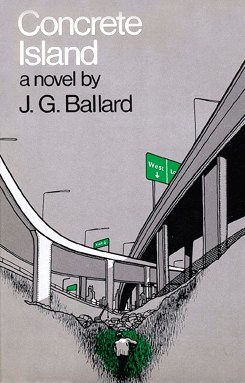
The motifs in his work are abandoned airfields, drained swimming pools, crashed cars, flooded lagoons, overlit motorways. His male heroes – doctors, pilots, architects, engineers – are emblematic last men, moving uneasily though flimsy, disintegrating worlds (in their impassive striving they recall the sad urban dreamscapes of Edward Hopper).
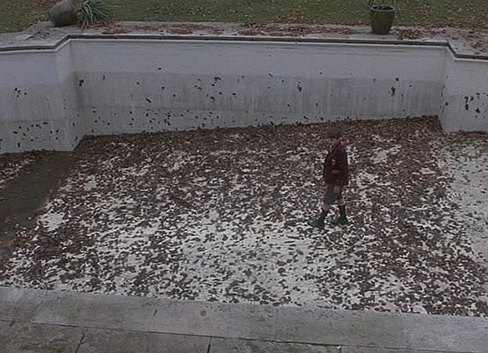
On the face of it, it is relatively straightforward to see where all this stuff came from. Ballard has talked about the casual savagery he witnessed while in Shanghai and the inverted nature of reality he experienced. Thus, the swimming pools he was used to paddling in as a pampered, privileged ex-patriot child were drained and immediately came to represent something other than leisure and entitlement. He imagined them as human abattoirs, their suddenly revealed tiles making it more convenient to wash away the blood from butchered corpses. Domestic servants, once so subservient, abruptly began hitting their erstwhile masters. Here was a topsyturvy world, a world gone mad.
The Supplement 2, p. 47The Supplement 2, p. 47
Although Ballard himself sometimes tried to resist the notion that his time in Shanghai had such a significant bearing on his writing, eventually he had to accept it. As he put it in (in his 2008 autobiography ‘Miracles of Life’), ‘The memories of Shanghai that I had tried to repress had been knocking at the floorboards under my feet, and had slipped quietly into my fiction.’
‘Vanished, ruined, forgotten, disused, drowned, drained – these are the key words of his lexicon; it is as if, in his landscapes, human life has gone, passed through, absented itself, leaving only icons and totems for the next wanderers to interpret,’ observed Martin Amis. And this is the clue to much of Ballard’s work – the sense of absence, of the portrayal of a life in which life itself has either gone missing or has assumed an unearthly, dreamlike, surreal presence.
Still, I’m not sure that it is merely the effect of the war in Shanghai that explains Ballard’s aberrant literature, rather Shanghai itself. The war and the atrocities that attended it, and which Ballard witnessed, only amplified what was already latent in its Chinese context.
The fusion or overlapping of internal and external worlds was present in the opposition between Ballard’s naïve, cloistered, remote, restrained, entitled schoolboy and the illimitable, boundless, rowdy reality of Shanghai that surrounded him but from which – until the Sino-Japanese conflict – he was protected.
The film of ‘Empire of the Sun’ makes this clear, presenting in a vivid cinematic sense the testing and then the actual breaking of the barriers between these two worlds. As panic breaks out on the streets of Shanghai, young Jim watches the untamed Chinese world from inside his parents’ car. Comically, the family are in fancy dress, Meanwhile, a cockerel is butchered and blood is smeared on the car window; grotesque Chinese faces leer at him; the car is physically rocked.
The internal and the external are brought close together and the boundaries between them are tested. Soon, they will be breached. The sense of encroachment would be familiar to most westerners, and especially most Britons, who live and work in Shanghai. For Ballard, as for young Jim, the blockades were violated in ferocious and irreconcilable ways.
From that extended moment of realisation, and once the internal (the British) has been purposefully pierced and penetrated by the external (the Chinese), Ballard’s mind becomes a restless, porous, open-ended entity able to inhabit multiple perspectives, in stinctively interconnecting them and creating a hybrid, surreal, Ballardian reality that embraced both actualities simultaneously.
As Ballard once said, making it apparent that no single definable reality was adequate once he had experienced Shanghai, ‘The writer’s task is to invent the reality’ (or as Nietzsche put it: ‘No artist tolerates reality’) and not the fiction which is all a round us – mass merchandising, advertising, politics as advertisement. David Cronenberg, the Canadian director of ‘Crash’, bears this out from his reading of the novel ‘Crash’: ‘…it provided you with fantasies you didn’t know you had before. Once they were there, they were real. They made sense.’
The result is a plummy, BBC-inflected, ‘proper’ style of prose that expresses bizarre, dreamlike truths. Only Ballard, for example, could come up with a sentence such as, ‘What links the first flight of the Wright Brothers to the invention of the Pill is the social and sexual philosophy of the ejector seat.’
He wants to dissolve the accepted and conventional boundaries between worlds, to decontextualize them. Take the short story ‘Manhole 69’, for example, where an experiment to eliminate sleep goes horribly wrong and ends with the subjects suffering from catatonic seizures.
The central hypothesis of this short story is that the mind cannot endure continual consciousness, particularly self-consciousness, and reacts by shutting down. They could ‘no longer contain the idea of their own identity’. As in so much of Ballard’s work, we see this inexorable battle between the unconscious and the conscious, the internal and the external, with the former characterised as the more primeval and ‘real’ part of ourselves.
Ballard himself was self-consciously aware of what had happened to him in China, of the sluice gates of his imagination being prised apart in such a particular way, of the breaking down of his Britishness by the violent ingress of Chinese sensibilities into his psyche. In 1946, aged fifteen, he sailed to the ‘exotic’ land that he had only read and heard about: England. ‘The culture shock is still with me,’ he once said. ‘I wasn’t prepared for the greyness, the harshness of the light, the small, exhausted shattered community, the white faces, the closed nature of English life.’ His mind flipped everything round: England was foreign and the food at his school was worse than that in the internment camp. Surrealism at its most literal.
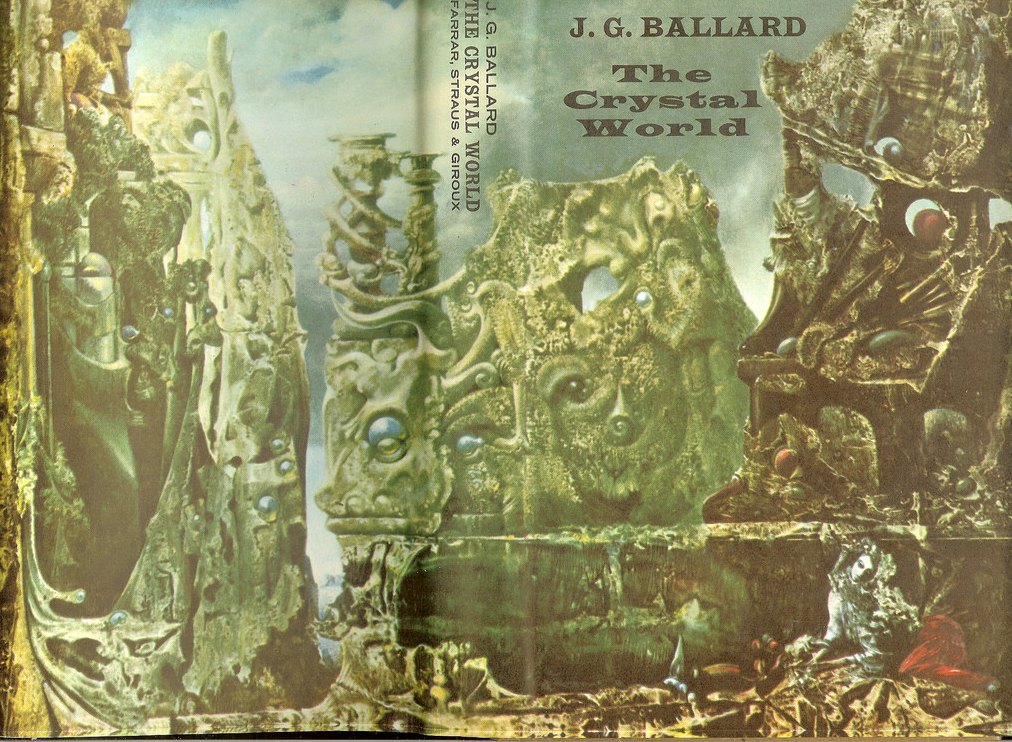
Ballard’s surrealism has a great deal more affinity with pictorial, rather than literary, surrealism. Paul Delvaux’s ‘The Echo’ features in ‘The Day Of Forever’, for example, and Salvador Dali is something of a hero to Ballard, featuring prominently in his books as well as on them. Max Ernst’s silent forests and swamplands, weathered scenery and gnarled post-apocalyptic detritus are redolent of much of Ballard’s early disaster fiction (‘The Drowned World’, ‘The Drought’, ‘The Crystal World’). Strikingly, there is also the similarity with Yve Tanguy’s strange beaches. The point is that along with these surrealists Ballard interested in psychological landscapes, i.e.
mindscapes. They are all concerned with the externalisation of the mind’s ‘iconography’. Even with ‘Empire of The Sun’, or, more recently, ‘Cocaine Nights’, his most realistic or naturalistic novels are full of these signature images and recurrent themes. They are the signifiers of an unreal, uncanny and phantasmagorical mind.
The Supplement 2, p. 51The Supplement 2, p. 51The Supplement 2, p. 51
And the point to be made is that although Ballard’s wartime experiences accelerated the eventual state of his mind, the fundamental elements that shaped it – the tension between British and Chinese sensibilities – were already present. ‘Shanghai was a huge city,’ Ballard has said, ‘anything could happen.’ The closed nature of English life and the wide open possibilities of Chinese life: for Ballard, these were the internal and the external forces that became synonymous in his mind, almost interchangeable, forging his characteristic authorial voice, what Martin Amis called ‘tranced perversity’ – everything is faintly ludicrous but bizarrely logical.
'Pre-war and wartime Shanghai was a huge Surrealist landscape,' Ballard has said. 'It was a time of sudden changes…There was a complete transformation of everything, complete unpredictability, while formal life went on, just as in Bunuel's films or Delvaux's paintings -- a bizarre external landscape propelled by large psychic forces.' And this, of course, is precisely what China and particularly Shanghai is today.
It would be insensitive to exactly transpose the Shanghai of Ballard’s childhood with today’s city, though there are certainly temperamental and psycho -geographical traits that are distinctive to the city across time. Straddling two different eras, Shanghai is still a recognisable entity.
In one interview, Ballard described it as place of infinite possibility, saying that, ‘In a way, the Shanghai of the 1930s and forties was a preview of the world to come…Shanghai was a brutal and cruel city. Unrestricted venture capital was going full blast there twenty-four hours a day. It was a vast metropolis – human life was worth absolutely nothing – if you fainted with hunger on the streets of Shanghai and fell to the pavement you lay there until you died…I think it was an extremely modern city…I think if you introduce elements of the latest technology…you’re facilitating a much larger exchange of human ambitions, motives, hate s, fears, fantasies, aggression, paranoia, political ambition, criminal violence…’
As one moves around Shanghai today, all of these things hold true. It’s the same city. In one day, I saw an elderly woman fall over and remain on the ground, ignored by pedestrians until she struggled to her feet, by herself, five minutes later; a man cut the head off a chicken with a pair of scissors in full public view; people are transfixed by their mobile phones, incubating who knows what kind of solipsistic fantasies as they ingest various hypnotic narratives and images; a policemen struck a middle-aged woman on a scooter because wasn’t able to produce her identity card. Shanghai seethes and writhes like no other place, its churning energy held in check by the curious alliance between law and self-interest.
As in Ballard’s day, ex-patriots tend to insulate themselves from all this: brunches, choirs, cycling expeditions, and charity work are the modern equivalents of fancy-dress parties, games of cricket, and ‘the club’. Coping mechanisms dressed up as leisure. But once the barriers have been breached, as they were in Ballard’s case by the Sino-Japanese War, and the two worlds collide and then mingle, the imagination is set free. ‘I saw the strange surrealist spectacles that war produces,’ Ballard once commented. ‘It taught me many lessons, above all that the unrestricted imagination was the best guide to reality.’
In Ballard’s novels and short stories, the text often makes no concrete distinction between the landscape of his characters’ imaginations and the literal ones they inhabit. This freewheeling perviousness, initiated by his exposure to Shanghai almost eighty years ago, is still apparent in today’s city. Its extremes of wealth, glamour, intrigue, violence and destitution are even now emphatically current.
‘The course of true love never did run smooth.’ Comment on this observation in any way you
choose but try to illuminate what you think love might be.
In my view, ‘The course of true love never did run smooth’ because so-called true love does not exist. True love, in my understanding, is the pure affectionate emotion that allows one to want to provide anything and sacrifice anything unconditionally for a nother person without expecting anything in return. This concept in itself doesn’t exist because I believe humans are, in our nature, selfish beings, thus everything we do is for a certain purpose or purposes, though the purpose itself is hard to identify due to its complexity, leading us to believe falsely that something we do might not be expecting anything in return. Also, we are unable to observe and judge our love from a perspective which strips off any social expectations and other elements, which again proves that true love does not exist because pure affectionate emotion cannot be present alone.
However, what we commonly address as “love” could exist, and in that case, love is to be defined in a different way. This love involves much more complexity than the pure true love. In my opinion, for this love to exist, there needs to be something in which you gain from the love to sustain your emotion, whether it is the idea of being loved back (could be seen as an approval of your personality/social status/or just any aspect of you) or how you elevate yourself and recognize yourself as someone with the ability to be kind or forgiving or anything (since love commonly is associated with being positive though it is not always the case). The so-called love evolves as the relationship between the two enter different stages, and Shakespeare, for example, leads us through the changes he experiences with his wife and portrays, through his plays, how his perceptions of love changes as he grows.
Though we can never be sure, we can perhaps interpret that Shakespeare and his wife fall in love and experience the innocent and pure love before they married. This could be recognized as the first stage of love, where people think that they have found true love. This stage is more, in my view, a stage where hormones come into work during puberty. Shakespeare’s wife, who is several years older than him, is married to the teenage Shakespeare after becoming pregnant. Shakespeare also presents this love in his comedies ‘A Midsummer Night’s Dream’ and ‘Twelfth Night’, where young couples fall in love with each other mainly due to impulse and how they are in love with the feeling of themselves being in love. The characters almost don’t even seem to care or care very much about who they are in love with, which is ironic since within love’s definition, it is almost assumed that it could and should only be directed to one person.
In ‘A Midsummer Night’s Dream’, the love that caused the couples to marry happily ever after is only due to a love potion put inside their eyes, similarly, the love in ‘Twelfth Night’ seems to only be about appearances, about physical attractiveness (since Sebastian and Olivia hardly even knows each other when they are married), and curiously, about gender (it is weird how Orsino doesn’t have feelings for Viola beforehand due to her disguised as a male but turns to love her once she reveals herself as being a female). Also, this idea is presented in one of the most famous Shakespearean tragedies, ‘Romeo and Juliet’. Romeo is madly in love with a girl called Rosaline who never even knew him. He wrote countless love poems expressing his love towards her. However, once he arrived at the party to find Rosaline, he falls in love with Juliet immediately, the so-called “love at first sight”.
From this, it is perfectly reasonable to interpret that Romeo’s love for Rosaline is almost the result of a trend among young people, a fashionable kind of love which would make them look cool, which tells themselves and justifies to others that they can feel the emotion, instead of it being love towards only one person. In fact, this love can be almost directed at any person, and the person it is directed towards is almost made insignificant by Shakespeare (by providing confusing plots and long names to purposefully make characters seem unimportant). We can draw, therefore, from all these examples, that the first stage of love is blind, it is just us enjoying the feeling of being in love and being loved back.
But this first stage, though lovely, almost ends every time after marriage. At the first stage, the word love is constantly spoken to each other due to us having the feeling of almost needing to be reassured that we are loved so we can feel secure. After marriage, though, the idea of being married almost serves the purpose itself and bonds the couple together. Therefore, the couple now faces much more issues in the real world and love is no longer portrayed as something associated only with happiness but is instead challenged. Shakespeare’s attitudes towards his wife changes as the marriage goes on. A lot of people see this as love no longer existing between them.
The idea of love disappearing is also commonly discussed among people. However, I see this as love evolving and changing its shape. This is also presented in his literary works like ‘Macbeth’. The relationship between Lady Macbeth and Macbeth is unarguably nothing like that between Romeo and Juliet. The love between Macbeth and Lady Macbeth is almost a trade, in which they are expected to be willing to sacrifice some aspect of themselves for the good of both. This definition of love is clearly portrayed whe n Lady Macbeth persuades Macbeth of killing the King, Duncan. Lady Macbeth mentions how she is willing to “unsex” herself to persuade Macbeth of killing the king. During the time, women is expected to be tender and loving, yet she is willing to sacrifice her “womanly traits” and the traits she attracted Macbeth with to support their ambitions. This demonstrates the type of love has shifted from a sexually attracted love into a love where both are expected to sacrifice for the good of both.
However, a lot of couples never even reach the second stage. A classic example is the one presented in ‘Othello’. Desdemona and Othello just married and went to Cyprus together, looking forward to their future. But Iago’s plot broke the young lovers only in a matter of days. Othello becomes jealous and suspicious of Desdemona and Cassio’s relationship and killed her just because of that. This proves how Shakespeare believes love at the first stage is fragile and is ironic how love, once thought of as so strong by both, can break so easily due to internal struggles and insecurity of one.
A lot of what I wrote previously may be generalization, and of course everyone’s love and their understanding of love is sure different, but these examples show that love is complex and multidimensional, and should not exclusively be understood as something that might simply be called ‘pleasant’, which suggests that purely unselfish ‘true’ love for another person doesn’t really exist.
Pip’s great expectations in Charles Dickens’ novel ‘Great Expectations’
Pip’s great expectations in Charles Dickens’ ‘Great Expectations’
One day, a boy called Pip went to the graveyard beside the church because he wanted to visit his parents’ grave. While there, he met an angry old man who was actually a convict, just escaped from a prison ship. The convict ordered Pip to bring him a file and food; he says he will kill Pip if he doesn’t do these things.
So, Pip went home and tried to get the things the convict asked for. However, Pip’s sister, Mrs. Joe, who treated Pip and her husband, Joe, badly, often using ‘tickler’ to hit them and scolding them. Taking the things the convict wanted was, therefore, very risky, but he nevertheless stole a pie and a file, then taking them back to the graveyard.
While there, he saw another convict, who had also escaped. A gun fired on the prison ship, telling everyone about the escaped prisoners. Pip avoided him and found the first convict, giving him the food and the file. Pip wanted to help him firstly because of the man’s menace, secondly because he understood him, perhaps because his sister treated him badly and he understood cruelty.
The man used the file to saw off the shackles on his hands and legs. After a day or so, the army came to find the convicts. First, they went to Pip’s home but Pip didn’t give the convict away. The army started to search in the graveyard and the surrounding countryside, eventually finding the two convicts fighting in the mud. They were arrested. Pip shook his head slightly when first convict looked at him, signaling that he hadn’t given him away. The convict said that he had stolen the pie, because he didn’t want Pip to get into trouble. This showed that he trusted Pip and appreciated what he’d done.
Thirty years before all this, a woman called Miss Havisham was supposed to marry. But on the day of the wedding, the man didn’t show up, so she could not get married. Feeling heartbroken, she continued to wear her wedding dress every day afterwards. She wanted revenge on men in general and trained a girl called Estella, who she had adopted, to bvreak men’s hearts.
Back in the present, Pip was invited to Miss Havisham’s house and she told Estella to break Pip’s heart. Estella always called Pip ‘boy’, which was very rude, making fun of him and saying nasty things against Pip’s rough hands and working boots. She also laughed at Pip’s inability to play cards. There were spider’s webs all round the room. Pip felt very small – Estella called him ‘common’ which means poor and ordinary.
However, Pip still liked Estella and she let him kiss her, maybe because she can break his heart afterwards. When Pip leaves the house, she gives him some bread, meat and a little mug of beer, handing it over without looking at him, as insolently as if Pip was a dog in disgrace. Everything she did made Pip feel humiliated, hurt, spurned, offended, and angry. He even cried. Despite not being older than Pip, Estella kept calling him ‘boy’, which made him feel small, weak and helpless. Miss Havisham and Estella wanted to break Pip’s heart, slowly, one step at a time, so that he would be tormented. Nevertheless, Pip continues to like Estella, despite feeling heartbroken.
Every clock in Miss Havisham’s house is stopped at the time the bridegroom didn’t show up for the wedding thirty years ago. Miss Havisham hated men because a man had broken her heart – she wants revenge on all mankind.
Then, suddenly, Pip is offered a large sum of money and he has ‘expectations’ – of being a gentleman and living in London. The two conditions of his ‘great expectations’ are that he will continue to use his name, Pip, and that he cannot know who gave him the money. So, instead of being a common blacksmith, like Joe, he can become a gentleman, a man of leisure, with status in the community, and respect. All this is communicated to Pip by the lawyer, Jaggers. Pip wants to become a gentleman because of Estella – she made fun of his identity and he wants to overcome the problems of his upbringing. In this way, he thinks Estella will like him, even love him.
For various reasons, Pip believes that Miss Havisham was the one who provided the money and that she wanted him and Estella to get together. Miss Havisham does not say this is wrong when Pip brings it up with her. When Pip goes to her house to say goodbye, before going to London, she even hints that the money might have come from her.
However, later, Pip is horrified to discover that the escaped convict – named Magwitch – was the one who gave him the money in return for Pip’s kindness in the graveyard. This threatens Pip’s new social standing and he confronts Miss Havisham, angry that she led him to believe that she was the provider of his great expectations. She seems to see the horror of her behaviour and says, ‘What have I done?’ She understands Pip’s pain and broken heart. The fire which kills her immediately afterwards is almost a cleansing moment of past wrongs – as if she allows herself to be burnt in the fire.
The ending of the novel, much later, where the last lines are, ‘I saw no shadow of another parting from her’, could mean two things depending on how the reader wants the book to end.
At this point, Pip and Estella have met by chance after years of not seeing each other. The first meaning is that Pip and Estella will be together forever; they will no longer part again. The second ending is that Pip and Estella will no longer be together again after their meeting because there will not actually be another parting. Pip’s great expectations have an undecided and unclear ending, perhaps like all our expectations.
‘The 101 Dalmatians’: differences in the book and the film
‘The 101 Dalmatians’: differences in the ways the book and the film show the puppies’ escape
The Supplement 2, p. 63The Supplement 2, p. 63
In the book, Pongo and Missis and the puppies escape quietly while the Baddun brothers are sleeping or watching television. They are there because the pups need looking after food to get stronger before the journey back to London – the outside is dangerous for them. Cruella’s visit makes the escape more dangerous. The television show allows time for Pongo and Missis and the pups to escape from Hell Hall quietly. The Colonel and Tibs help them get out.
In the film, we see the on the second hand of the clock on the television show moving, showing that the escape time is shorter, which makes it more dramatic. The television show also tells us that the brothers are really criminals. When the Baddun brothers see the pups escaping, they chase them round the house, which is different from the book. Pongo and Perdita (her name is changed in the film) are not there in the escape and arrive later to save the pups. They fight the brothers and bite them, allowing the pups to escape. The colonel is very old in the film and seems more foolish and funny.
Therefore, the film has more action and movement. But the book can’t show too many of these kinds of things. Films are generally better at showing action and drama, which explains the difference. An example of a film showing action is ‘Life of Pi’, where the tiger is on a small boat with a boy in the middle of the ocean. The tiger can be shown as frustrated and fierce when he attacks him.
Lionel, Grade 3
In the film, Pongo and Perdita were not there at the beginning of the escape. So, Sergeant Tibs was trying to lead the puppies out but then the Baddun brothers saw them and chased after them all round the house. Sergeant Tibs led them to a hiding place, just in time, but the brothers found them. Pongo and Perdita suddenly arrived and bit the Baddun brothers’ butts and generally tried to distract them. They also pulled down their shirts so they couldn’t move. Meanwhile, Sergeant Tibs led the pups through a hole in the wall. Finally, after a lot of drama, they escaped.
In the book, it’s not that dramatic. Pongo and Missis were already there in the room with the pups and they led the puppies out by themselves, not with Sergeant Tibs. It is not so exciting.
The film has lots of action and gives you a lot of things to see and look at. However, the book needs to let you read and it works your brain more. You need to imagine the action. An example of films showing action are the Harry Potter films. Whenever Daniel Radcliffe, as Harry, feels scared or brave, he performs some kind of action to show his emotions.
Chloe, Grade 3
Pongo and Missis will train the puppies so they can walk to London. In the film, the cat will train them and lead them out so they will not get noticed by the Baddun brothers. They are very young and would get cold. Also, they would not be able to walk such a long way. If the brothers find out they were going to escape, they will be killed and we don’t want their skins being peeled off their bodies. Things change because Cruella wants to make fur coats from them very quickly.
When Cruella visits, the brothers are watching television. The programme is ‘What’s My Crime?” and the dogs get out while the brothers are watching it. Cruella says that the work needs to be done ‘by tonight’. She hits one of the brothers because he wasn’t listening to her.
When she slams the door, the brothers vote what to do. One will hit the puppies on the head and they get ready to go to work. But when they look, the puppies have gone.
Tico, Grade 3
In the film, the little cat, Tibs, comes in and says to the puppies that they have to run away. The two brothers didn’t notice, since they were watching something on television about thieves. They were interested because they were also thieves. While they were watching the programme, the pups used the hole in the wall or the door to run away. When all the pups had escaped, the television programme also came to an end and the brothers went to find tools to kill the puppies. That was when they noticed the puppies weren’t there anymore. They had run outside the room and were hiding from the brothers, who started to look for them. The brothers chase the puppies around the house, up and down the stairs, into the corner of one room. That is when Pongo and Missis arrive and fight the brothers, attacking and biting them. After a battle, the brothers are defeated and Pongo and Missis run out of the house along with all the puppies.
In the book, Pongo and Missis are already in the room with the pups. Although the television programme is the same, it is not shown in the same detail but the puppies still escape while the brothers are watching it. So, the escape is quiet and not so exciting.
Although the book and the film follow the same general story, this story is told in slightly different ways. The film always shows exciting and funny things that the book can’t do. For example, the film shows how the Dearlys meet and makes the puppies escape more thrilling. Films are generally much better at showing adventure.
One film I enjoyed watching was ‘A Quiet Place’ because it had great action scenes and showed people using sign language. The film of ‘101 Dalmatians’ also shows great action scenes, which aren’t in the book. I like both even though they are a little different.